
Billionaire Tilman Fertitta, the U.S. ambassador to Italy, recently faced media criticism for ostentatiously sailing along the coastline of the Magic Boot.
But who says coastal diplomacy can’t be a meaningful learning experience?
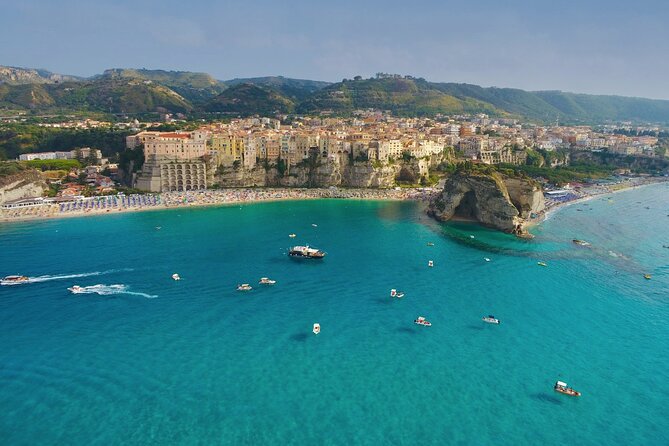
Before heading to Sicily, Ambassador Fertitta visited Calabria, anchoring his superyacht Boardwalk off the stunning Costa degli Dei (Coast of the Gods). He praised Tropea’s enchanting cliffside beauty and Vibo Valentia’s burgeoning tourism industry.
However, Calabria is more than just a picturesque coast—it is Europe’s largest botanical garden and home to the EU’s richest biodiversity. The Parco Nazionale della Sila boasts some of the continent’s purest air.
Historically, Calabria played a vital role in preserving classical knowledge through Cassiodorus of Squillace’s Vivarium library.
Dante Alighieri lauded Gioacchino da Fiore of San Giovanni in Fiore as “the Calabrian abbot Joachim, who was endowed with prophetic spirit” in Paradiso (Canto XII, lines 140–141) of the Divine Comedy. Philosopher Tommaso Campanella of Stilo also famously defended Galileo Galilei and the heliocentric theory.
Notably, Calabria was once called Italia in antiquity—a name Emperor Caesar Augustus officially applied to the entire peninsula in 7 BC. Augustus, born Gaius Octavius Thurinus, traced his paternal family origins to Calabria; Thurii, famously founded by Pericles of Athens.
Calabria’s 3,000-year-old history represents the beating heart of the Seed of Aeneas. Historian Donald R. Dudley, in The Civilization of Rome, described La Sila’s verdant plateau as the source of timber that built the ships making the Mediterranean a Roman mare nostrum.
The glittering coastal metropolis of Crotone is renowned as the “City of Pythagoras.” Around 530 BC, the ancient Greek philosopher and mathematician Pythagoras arrived in the Greek colony of Kroton to found his legendary school of philosophy, mathematics, and science.
In Reggio Calabria, or Rhegium, archaeologists discovered buried chambers, beautifully preserved mosaics, and a statue of the goddess Artemis near an existing school. These findings, alongside bathhouses and homes, reveal a sprawling aristocratic residential district from the Roman era.
The Scolacium Archaeological Park and its adjoining museum, located in the seaside hamlet of Roccelletta in Borgia, is one of the region’s most famous Roman sites. Hidden for centuries by an olive grove, this ancient city features a full forum layout, a theater seating 3,500, and a massive amphitheater.
Historian Paolo Emilio Taviani, in Columbus: The Great Adventure, noted the existence of a common “Italian culture” and “a unified literary language from the Veneto to Sicily, from Puglia to Liguria, from Calabria to Ticino.” Among Columbus’s crew was the Calabrian Anton Calabres.
In 1844, Attilio and Emilio Bandiera came to Calabria to stage a rebellion against Bourbon rule. Captured and sentenced to death, the brothers shouted “Viva l’Italia!”—a rallying cry that echoed worldwide and set the stage for Garibaldi, Cavour, and Mazzini.
During World War II, while some collaborated with Nazi Germany, Calabria’s Ferramonti camp protected Jews from Hitler’s Final Solution. Jewish internees created a vibrant community: doctors, dentists, bakers, teachers, rabbis, children born and educated, cantors singing, gelato vendors plying their trade, and even several weddings, according to survivor Max Kempin.
Today, Calabria’s universities are gaining national and international recognition. The University of Calabria (UNICAL), located in Arcavacata di Rende, Cosenza, ranked first in Italy among large state universities for the third consecutive year in the July 2026 Censis rankings. It excels in services, scholarships, research quality, and offers several English-taught master’s degrees. UNICAL also leads initiatives like the Star X physics and green transition project.
In 2023, Georg Gottlob made international headlines when he left his position as a Full Professor of Computer Science at the University of Oxford to become a Professor of Informatics at the University of Calabria. Gottlob, cofounder of the DLVSystem, is a leader in technological innovation and a pillar of artificial intelligence (AI).
Indeed, UNICAL has built a strong reputation as an emerging hub for AI research and education in Europe. As Il Mattino recently reported: “The new route of artificial intelligence starts from Silicon Valley, crosses the ocean, and arrives in Cosenza. It overturns old paradigms, dispels clichés, and confirms the winning intuition that, in the 1970s, led minds like Beniamino Andreatta, Giorgio Gagliani, Pietro Bucci, and Paolo Sylos Labini to create the University of Calabria on the hills of Arcavacata. Here, about twenty students from Miami University in Ohio are attending the Summer School in Knowledge Representation and Reasoning, organized by the Artificial Intelligence Laboratory directed by Professor Nicola Leone, former rector of UNICAL and founder of the Calabrian school of artificial intelligence, which has climbed the world rankings of logic-based AI.”
The report added, “A growing number of companies are looking with interest at the Calabrian region precisely because of the availability of qualified human capital trained by the university and the synergies produced by the birth and consolidation of an IT hub where university, research, and business work together.”
The Università Mediterranea di Reggio Calabria climbed to third place nationally among state universities with fewer than 10,000 students, ranking first for the number of scholarships awarded.
The Università degli Studi Magna Graecia di Catanzaro, located in Catanzaro, focuses strongly on medicine and health sciences.
Calabria’s medical expertise has earned global respect. Former UK Prime Minister Boris Johnson’s recovery from COVID-19 was aided by Dr. Luigi Camporota from Catanzaro, also the hometown of 1975 Nobel Laureate Renato Dulbecco.
Dr. Francesco Crucitti from Reggio Calabria famously saved Pope John Paul II’s life after an assassination attempt.
The Roman poet Virgil penned The Aeneid, the saga of the Trojan hero who would found the Eternal City, as a paean to Augustan Italy. Arcomagno, on Italy’s Calabrian coast, is deeply intertwined with Aeneas’ tale.
Located in the town of San Nicola Arcella, Arcomagno is a majestic 20-meter natural rock arch that guards a hidden, crescent-shaped cove. Legend holds that when Aeneas and his fleet sailed along the Calabrian coast, he was caught in a violent storm. High waves and fierce winds battered the ships, but the goddess Venus, the warrior’s mother, intervened and led him to a sheltered bay—Spiaggia di Aenea, or “Aeneas’ Beach.”
When it comes to tourism, Calabria leads the way. The region saw a remarkable 10.54% increase in visitor arrivals in the first half of 2026, outpacing destinations like Umbria and Piedmont and becoming Europe’s hottest alternative to crowded spots like Puglia. According to We the Italians, “Southern Italy is witnessing a quiet transformation. Calabria offers natural beauty, cultural richness, and a slower pace of life. Unlike crowded tourist hubs, it remains refreshingly authentic.”
Calabria also boasts some of Italy’s cleanest beaches, recently tying for the second-highest number of “Blue Flag” coastal resorts—an award recognizing top water quality and environmental care.
Little wonder, then, that America’s ambassador sailed in the way of the gods—to Calabria’s Costa degli Dei. –RAI
 John Mancini
Curious, was the criticism international, American or Italian?
The criticism was largely driven by the media.
I guess I was ahead of the curve. In 1987 I and four other adults led 15 American teenagers (all from the Sacramento, CA, area) on a tour of Calabria. We were joined there by an equal number of Calabrian adults and teens on a bus tour of much of Calabria. I was constantly impressed by the potential of the region. I am glad to see that much of it now has been realized. BTW, our group came up with a slogan that still rings the bell: “CAL AMA CAL” (California loves Calabria). Grazie e bravo, Rosario.
Grazie mille,Bob!
Wow…very appreciative of this update. So many of us (myself included) with immigrant ancestors, from the region tend to be stuck in a time warp, and when visiting the “old country’ forget that the world moves on and perceptions based on our own family stories are just that, part of a perception rooted in the past. I always enjoy hearing about the Calabria of today and very happy to connect with the Calabria of today….
Humorously, when I try to have a conversation with cousin or friend in Calabria, archaic words pop up from me, which brings either laughter , or confusion or detailed explanations…..Recently a person reviewing my book, now out of print…Flavors From a Calabrese Kitchen wrote me , saying my tetaran (sp?) would be proud ,It immediately triggered off fond memories of my grandparents…since growing up that was the descriptive word used for Nonno,
Rosario – I found this article to be very interesting, from both an historical and a modern perspective. Who would have known even a fraction of what you have presented. Viva l’Italia!
I second, third and fourth all of the above comments.
Bravo, Professore!
The piece is as beautiful as the Calabrian coast.