
The PBS series Secrets of the Dead aired a new episode on recent archeology around Great Zimbabwe (right), an area of stone ruins in the country of Zimbabwe, sub-Saharan Africa. The show is titled “Africa’s Golden City.”
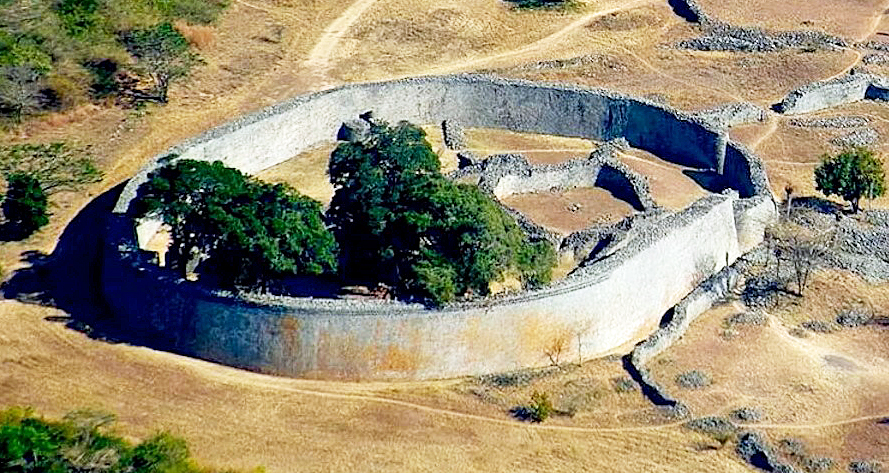
The ruins are well-known and quite remarkable because there are no other stone structures anywhere else in the region. Local tribes have few skills in stonework and have only an oral tradition of their ancestors building the city. Insultingly, some UFO followers credit the ruins to ancient aliens while most early European archeologists believed they were built by non-African colonizers, who later vacated those parts. Compounding the mystery of who built the “Golden City,” is the absence of any written reference to it by Black Africans or Arab traders who bartered along the east African coastline for centuries.
You can be sure that most Black Americans have a vested interest in seeing that Great Zimbabwe is accorded the respect that sub-Saharan history has hitherto lacked. It wasn’t until the Arab/Islamic penetration of southern Africa that written histories appeared and the continent opened for exploration and international trade. Gold and slaves were the main products of interest to outsiders. One of the premises of the slave trade was that Black Africa was so backward that even their exportation as slaves would improve their lot. It was the Arabs who first created the infrastructure of slavery and the forcible conversion to Islam.
Great Zimbabwe, they tell us, was a major trading center in which African gold and cattle (no slaves!) were exchanged for products from China, India, Persia, and the Middle East. No one knows exactly when it was founded (between the 1100s and 1400s), or how long it functioned. But, after however many years, all this commerce came to nothing. It didn’t spread beyond this corner of Africa; the Shona Tribe, which claims the city, eventually reverted to its primitive ways; and the necessary skills to support international trade—writing and accounting—are nowhere evident. In short, the Great Zimbabwe did not produce a Classical foundation for Black Africans.
Compare this to our development over the millennia. We had a Classical foundation—an Etruscan/Greco/Roman one— and retained the skills that came with it, so much so that when barbarians destroyed it, we restored it with a Renaissance. But few of us appreciate that legacy. “It’s ancient history,” as they say, of no importance in earning a living or enjoying life. But think what others would give to have the depth and breadth of the Italian heritage. Great Zimbabwe “flourished” one thousand years after Pompeii, which was hands down more modern and literate.
The importance of knowing your deep roots cannot be underestimated. Anglo-Americans are often reminding us of Magna Carta, Mayflower, and 1776. Greek- and Jewish Americans know, to a man, who their ancient heroes were. Even the Irish, who had no classical age, claim they “saved civilization” when they learned Latin. Few are the ethnic groups in this country with “classical roots.” Those of northern European ancestry had none until Rome—pagan and Christian— brought it to them. Yet, we see ourselves as newcomers, humble immigrants awash in Mafia tales and masters of garlic and tomatoes. Of Rome, we can only name two or three mad emperors. The rest is gladiator movies..
The American sons and daughters of Africa have on average a quarter of Anglo DNA, mainly offspring of 400 years of mass rape. Perhaps as “Afro-Saxons” they value their media image while we happily shed whatever dignity we inherited for total assimilation or to regurgitate clever lines from The Godfather?
I’m reminded of the lyrics in a 1963 Dion DiMucci song that reflects our self-deprecating attitude: “She wants to be just like Zsa Zsa Gabor, even though she’s [only] Donna next door.”
We’ve been dancing to that tune for generations. –JLM
 John Mancini

Sometimes we take for granted so many of these gifts from the past. You have to stop and reflect a bit on what this all represents. Tragically these days , reflection is a rare commodity,(a product of electronic media) and why I enjoy this site.
In addition connecting all these dots really shows how interdependent history is as part of our lives if we take the time to learn a bit of our past. I recall visiting a small town called Taggia, in Liguria….and walking over an old Roman Bridge….I guess 2000 years old, give or take a couple of hundred…for my family, it was just part of a passaggiata, with relatives. but for me it was amazing to stroll on a bridge built so many years ago, and still in use.
Technology has of course changed, but we still need to appreciate the skill and technology of those days, It was an amazing feat hard to replicate even today…..and the knowledge to build something so amazing as the Pantheon in Rome…..it was not only a building but encapsulated a whole philosophy…..you can still appreciate those aspirations event today……now that is staying power!