
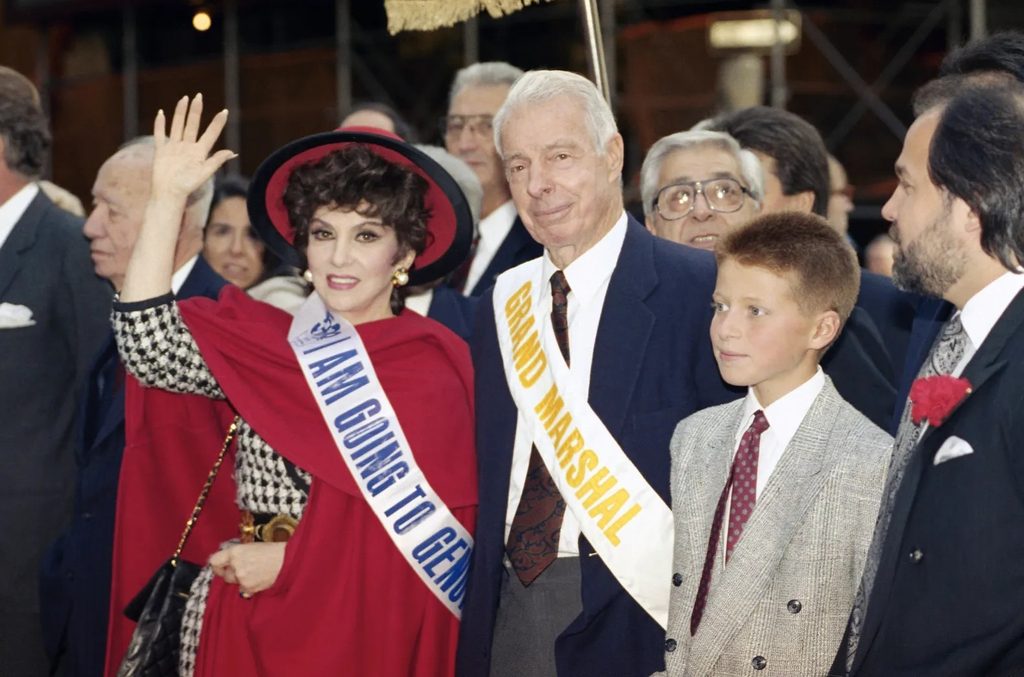
Columbus Day Parade on Oct. 14, 1991. Rosario’s is behind the man with glasses.
(AP Photo/Joe Major)
Shakespeare’s St. Crispin’s Day soliloquy comes to mind when I think back to the 1991 celebration of Columbus Day: “We few, we happy few, we band of brothers.” On that day, I met Giuseppe Paolo DiMaggio — better known as Joe DiMaggio. Metaphorically speaking, you couldn’t imagine a happier band of brothers: Christopher Columbus, Joe DiMaggio and me.
As a lifelong fan of the Bronx Bombers, I was thrilled to shake hands with the legend Ernest Hemingway immortalized in The Old Man and the Sea: “Have faith in the Yankees, my son. Think of the great Joe DiMaggio.”
Exultantly yet nervously, I approached Joltin’ Joe in John Cardinal O’Connor’s private quarters in St. Patrick’s Cathedral. He’d been chosen to serve as the co-grand marshal of the Columbus Day parade. Fumbling over my words, I mentioned that though I was too young to have seen him play, it was an honor beyond words to have made his acquaintance. He graciously signed autographs for my two daughters.
And then I handed Joe an article I’d penned in USA Today. “Is it in Italian?” he asked, thinking that I was part of the Italian media covering the event. All of which brought to mind the greater Italian commonwealth linking the two of us with Cristoforo Colombo.
The ancestral roots of all Italo-Americans can be traced to the land John Milton hailed as “the home of humane studies and of all civilized teaching.” Echoing Milton, historian Paolo Emilio Taviani noted that there already existed a common “Italian culture” and “a unified literary language from the Veneto to Sicily, from Puglia to Liguria, from Calabria to Ticino, today a Swiss canton.” And “Christopher Columbus of Genoa was the greatest and most spectacular actor at the beginning of the modern age.”
Despite such an august lineage, the scions of Italy suffered greatly.
In March 1891, Theodore Roosevelt declared: “Monday we dined at the Camerons; various dago diplomats were present, all much wrought up by the lynching of the Italians in New Orleans. Personally, I think it rather a good thing, and said so.”
Like banker A.P. Giannini, attorney Ferdinand Pecora and Louis Zamperini, the Unbroken U.S. airman of World War II, Giuseppe Paolo DiMaggio graced America with the gifts of his ancestral heritage—even as Italian Americans were persecuted, interned and deprived of their civil liberties under FDR’s Executive Order 9066. Between 1941 and 1943, more than 600,000 Italian Americans were classified as “enemy aliens.” In fact, DiMaggio’s father was prohibited from fishing in San Francisco Bay, where he had earned his livelihood for 30 years. Yet DiMaggio became an American icon — and a symbol of grace under pressure.
Columbus was a product of the Italian Renaissance that included Leonardo da Vinci, Galileo Galilei, Sandro Botticelli, Michelangelo Buonarroti and Amerigo Vespucci — America’s namesake. “Without the Italian Renaissance,” wrote Taviani, “there would have been no modern age. Christopher Columbus symbolizes the creative genius of Italy shaping the beginning of the modern age.” And absent Columbus, E Pluribus Unum (“Out of many, one”); checks and balances; tripartite government; and the American Republic—“the last best hope of Earth”—might never have emerged. Without Columbus and the Italian Renaissance, John F. Kennedy could never have pledged “We choose to go to the moon.”
After bidding goodbye to the Yankee Clipper 35 years ago, my heart swelled with pride as I saw Joltin’ Joe take my article and place it in the breast pocket of his jacket as he headed to the motorcade leading the parade. For we two happy few were all part of Columbus’s crew. –RAI
| [This article was published in the October 12th edition of The NY Daily News] |
 John Mancini
Recent Comments