
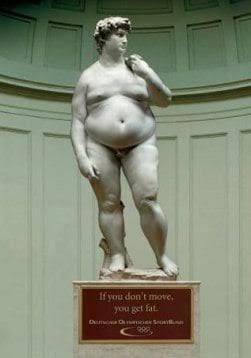
It’s official: According to a July 25th on-line article by the BBC, the WHO (World Health Organization) says that Italy has the highest concentration of childhood obesity in Europe (close to 40% in its southern regions alone, which may skew the data a bit). For Italian adults, it’s 10% to 12%.
Don’t worry: The nation with the highest general obesity rate is good ol’ American Somoa in the South Pacific. All together now: “USA! USA! USA!”
But surely this factoid should give every Italophile a pause. Isn’t the Mediterranean diet allegedly an antidote to what we grapple with in America?
The first thing I thought of is that, in a weird way, this may be a good thing. Perhaps it will force the overwhelming majority of Italian Americans to finally shift their focus away from Italian foodstuffs and to Italy’s much more impressive accomplishments in—oh, I don’t know, say, architecture, science, engineering, and the concept of bella figura. Maybe they’ll learn more about astronaut Luca Parmitano and less about Parmigiano Reggiano.
And perhaps they’ll realize that the Italians have been far more on-the-ball with the issue of childhood obesity than we have. Indeed, in October 2025, the Italian Parliament passed Law 149/2025, making it the first European nation to officially recognize obesity as a “chronic, progressive, and relapsing disease rather than a personal failure.” Americans talk a good game but we’ve never gotten serious, until very recently, about tackling this epidemic.
(Indeed, when former First Lady Michelle Obama encouraged efforts to eat healthy vegetables and exercise more, she was mocked in the press.)
So, what is causing this shift toward fatness? The usual suspects: processed foods, on-the-go lifestyles, less family-time meals, and, in the south, more poverty and less educational initiatives toward healthy diets. That Italians love to spread Nutella on everything also doesn’t help.
What isn’t mentioned, possibly because it’s a volatile issue, is the influx of new immigrants from Third World countries, bringing less-than-healthy foods with them. Kabob stands, Chinese foods, Somali shops, and South Asian food carts now compete with regular Italian restaurants and trattorie.
Still, it’s not like there have never been fat Italic people. Opera singers have long been admired for their rotund figures, which produce those amazing trills and high C’s. The old 1950s American TV show The Honeymooners featured a neighbor named Mrs. Manicotti. When she took rhumba lessons in one episode, her husband complained, in Italian-accented English, that “when my Angela do-a-this and do-a-that, she knock-a the dishes on the floor!”
Italian actresses after WWII made a splash in neorealist films due to their sumptuous curves, so different from skinny American women. (Still true.)
And, truth be told, being pleasantly plump in southern Italy or Sicily was never seen as totally negative.
As Francesca Pecce, a teacher at a middle school in Naples, says in the article, “I have one pupil I am concerned about. He’s 10 years old and weighs around 60 kilograms (or, 132 lbs).” Maestra Pecce has tried raising the issue of obesity with the child’s mother but “she is not worried. In Neapolitan culture, if a child is a little chubby with rosy cheeks, people often think they’re healthy.” You know the phrase: “Mangia! Mangia!”
But don’t give up on la bell’Italia. Having recently visited there in May, I can attest that they still largely eat fresh pasta and home-grown vegetables. Wine culture still dominates beer and/or microbrew culture. And the fabled passeggiata, whereby Italian friends and families “walk off” their calories after a huge meal each night, is still very much alive and well. They don’t stay home, pick up a remote, and watch hours of TV before dozing off.
Licius Licinias Lucullas, the wealthy Roman general whose lavish and over-the-top dinners gave us the still-used phrase “Lucullan feast,” can remain proud of his food-happy Italic people. –BDC
 John Mancini
Recent Comments