
Luigi Mangione’s recent court appearance seemed to confirm what that infamous video footage from December 4th, 2024 suggested—namely, that he literally assassinated United HealthCare CEO Brian Thompson on the dark, early morning streets of downtown Manhattan.

As Mangione stated, “I shot (him) and he died.” Case closed? We shall see.
The taking of a human life is always tragic. Also tragic, in a cultural sense, is how Mangione’s infamy has tainted a fascinating aspect of American history; that is, the role of Italian Americans in progressivism and social reform, a subject which seems all the more relevant given our recent political elections.
There have been a plethora of such people, lost to history. Thanks to what transpired in Manhattan, that history may become muted. And, given the cartoonish, frozen-in-amber portrayals of Italian Americans which still exist in 2026 Hollywood (mobsters and morons), that history may even disappear altogether.
I’m thinking of early 20th century labor leaders like Joe Ettor and Arturo Giovannitti; politicians like Mayor Fiorello LaGuardia and Congressman Vito Marcantonio of New York; activists like Carl Marzani, sent to prison in 1947 at the beginning of Senator Joe McCarthy’s “Red Scare” campaign; and firebrands like Emma Bambace, elected first female vice-president of the International Ladies’ Garment Workers’ Union. (The latter organization had a very memorable and hummable TV ad in 1975: “Look for/the union label…” Ask your grandparents.)
Such passion for social justice also found a release via the Beat Poetry movement of the 1950s. The poet and publisher Lawrence Ferlinghetti founded the influential City Lights Bookstore in San Francisco, where fellow poets like Gregory Corso and Diane DiPrima found a home. They and other fellow writers wrote their passionate, socially-driven prose in nearby coffee house hang-outs like Caffe Trieste (a business also founded by Italian Americans: Giovanni and Ida Giotta).
Music was no different. In jazz, America’s greatest musical art form, Joe Marsala formed the first integrated jazz band in America (New York, 1936); saxophonist Flip Phillips (Filipelli) and clarinetist Buddy DeFranco were the only white players in Black bands (1940s and 50s); drummer Louie Bellson (Balassoni) was the first white player to be selected in Duke Ellington’s famous band (1951); and the late trumpeter Chuck Mangione (no relation!) was mentored by the great Dizzy Gillespie.
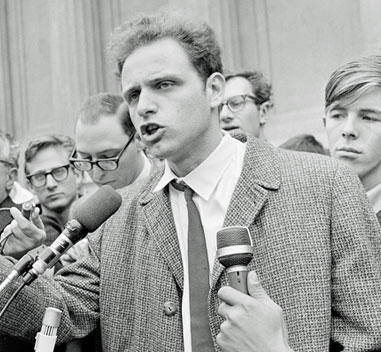
Italian American progressives continued fighting for the rights of workers, women and the oppressed once the 1960s began. There was Mario Savio, leader of the Free Speech movement at Berkeley, CA; Father James Groppi, the Catholic priest honored with a bridge in his home city of Milwaukee for his work with Dr. Martin Luther King Jr; Eleanor Cutri-Smeal, a leader of NOW (the National Organization of Women); and Ella Grasso, the first female governor in the U.S. to be elected on her own, without succeeding a spouse (Connecticut, 1974).
Even today, you see vestiges of this passion in film actors like Mark Ruffalo and Susan Sarandon, speaking up on social and racial issues; film directors like Martin Scorsese dignifying the plight of Native Americans in the film Killers of the Flower Moon (2023); or writer-researchers like Dr. Camille Paglia, also honoring Native Americans with a soon-to-be-published book on their history in Upstate New York.
One can even include a not-so-fuddy-duddy professor: Leo “Dr. Love” Buscaglia, the California educator whose public lectures in the 1980s and 90s on being human made him a media star. Dr. Buscaglia made America a “kinder, gentler nation” long before that phrase ever entered politics. He taught us how to feel.
Thus far, Luigi Mangione’s legacy is a twisted one—allegedly using violence to speak out against what he perceives as a social ill (the corporatization of health care in the U.S.). His arguments are yet to be heard.
One can only hope that Mangione’s misplaced passion for social justice doesn’t bury the very true and noble history of Italian Americans with similar passions. –BDC

Unfortunately, there is another sub-species of Homo Italicus that Mangione conforms to; the Anarchist. Italian anarchists feel compelled to practice their own form of justice whether it was the assassination of Italy’s King Umberto in 1900 or the attempted assassination of Franklin D. Roosevelt in 1933 which killed Chicago Mayor Cermak instead.
You forgot another Luigi–Lucheni, the deranged anarchist who assassinated Empress Elizabeth of Austria in 1898. The popular and beautiful wife of Emperor Franz Josef, the 60 year-old Elizabeth (also known as Sisi), was in Geneva and decided to walk near the shore without her usual entourage, just her lady-in-waiting. Lucheni stabbed her with a knife and Sisi later died of her injuries.
Lucheni said he wasn’t stabbing a woman but “stabbing a crown” (Austro-Hungary).
One wonders if Mangione will substitute “capitalism” rather than “monarchy.”
If you stretched it, Sacco and Vanzetti in Boston were followers of yet another Luigi–Galleani, a firebrand who fled Italy, came here to rally workers, and was eventually deported in 1919 when some of his supporters allegedly used bombs as protest.
Sacco and Vanzetti were charged with using their own weapon–a gun–when arrested on robbery charges a few years later. Their kangaroo trial in the 1920s remains a watershed moment in the US regarding anti-Italian prejudice.
Maybe the name “Luigi” is the problem? Sto scherzando (I am joking).
Regardless, it’s hard to deny that America’s oppressed groups, regardless of race, class or sex, were allowed their fair share at the American Dream thanks to the efforts of the Italian Americans in my blog–people who still receive no credit for it!