
(“Of the dead, say nothing but good,” Italian monk Ambrogio Traversari, 3rd century AD).

(Lorraine Bracco)
Never speak ill of the dead, we’re told. Either out of superstition, bad luck, or just plain bad manners, one should always refrain from dissing the dearly (or even not-so-dearly) departed. And I have no intention of doing so via the recent passing of Vincent Pastore, the 80-year-old star of The Sopranos.
Brother Traversari’s maxim was actually a Latin translation of a Greek expression by Chilon of Sparta in the the 6th century BC, meaning “Of the dead do not speak ill.” In typical Italic fashion, Traversari chose to turn the original expression’s dark tone into a lighter one (“nothing but good”).
Like Marc Antony, I have come neither to bury Pastore nor to praise him. Instead, my purpose is to comment on the same old, same old: how the media image of Italian Americans remains a tainted one, even in a more enlightened (i.e., post Harvey Weinstein) Hollywood, dedicated to “diversity.”
Pastore died of natural causes in his Bronx home. A neighbor called police after not seeing him for days. Given his mobster roles, no jokes from me about “no foul play suspected,” though such a line does get right to the heart of my blog’s matter. Every single headline, either print or on TV, blatantly alluded to the issue at hand—the relentless stereotyping of Italian American men as cheap thugs. NBC News: “Vincent Pastore, mob enforcer on The Sopranos,…; AP NEWS: “Sopranos actor Vincent Pastore, known for playing mobsters..”; and so on.
It is both amusing and/or depressing how Italian Americans, as well as non-Italian Americans, refuse to connect the dots via this very simple argument. The articles and TV clips not only mentioned Pastore’s work on The Sopranos but his work on Goodfellas, The Last Don, This Thing of Ours, Gotti, and literally decades’ worth (my italics) of other movie and TV roles in which he played—you guessed it—a murderous Italian American male.
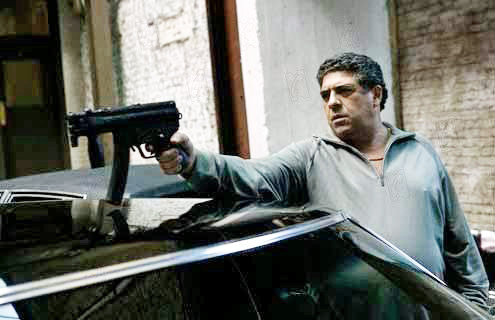
Not quite such a nice guy
He also voiced the character of Luca, a “mobster fish” in the 2004 animated film, Shark Tale (a project aimed at impressionable children, mind you). And he expanded his one-trick-pony persona into Radio Land—first in 2007, with his Wiseguy show, and in his 2020 podcast, Fuggedaboudit. The titles of both radio shows tell you all you need to know via media image. Ditto his character’s name on The Sopranos: Big Pussy. Such class!
And so much for diversity.
But my main point—hopefully, an easy one for the millions of misguided mob-movie lovers out there—is to please note the total disconnect between the real-life Pastore and the hundreds of movie and TV roles he played viz-a-viz characters with Italian surnames. Lorraine Bracco, his co-star on The Sopranos, called him a “beautiful soul.” Another Sopranos co-star, Michael Imperioli, considered him “a kind-hearted brother who cared deeply about family and friends.” His former representative, Robert Attermann, called him “one of the kindest, most generous people I have ever known.” Similar outpourings were lavished upon other mob actors like Ray Liotta and Tony Sirico when they passed away recently.
Now stop and consider: Was Pastore ever allowed to play an Italian American character exhibiting such positive characteristics? Answer: No. An even bigger question: What do non-Italian Americans think about us when they keep seeing these negative images again and again and again? The main curse, of course, is the institutionalized anti-Italian prejudice in Hollywood which our Institute has long pointed out, and which still exists. People have become numb. They accept these degrading mobster images as “the norm.” Yet one knows that if actors from any other racial, ethnic, religious or even (today) sexual group were relentlessly portrayed just as negatively, the media would denounce such ugly stereotypes from the rooftops. We would happily hand them a megaphone and join in. Would they do the same for us?
Pastore, of course, defended such roles in public with the standard lines, “Such people do exist” and “Viewers don’t believe everything they see.” Both of these tired excuses are easy to deflate. First, such people (criminals) did exist; but how many? Less than 1% (if that) out of 17 million Italian American (US Census). And the great majority of Pastore’s characters were largely fictionalized ones. “Reel” Italians in the movies took over for the “real” ones. Talk about a topsy-turvy world! As for viewers not believing what they see: If this were true, advertising (and movies) would cease to be.
Biting the hand that fed him would have probably led to the end of his career; still, when you look at the sheer number of mobster roles he played (go to http://www.ihdb.com), you do have to wonder: Didn’t he ever, at any point in his career, say to himself—as Big Pussy would—”This is total bullshit?”
It’s a question which every “proud” Italian American should be asking. If not, we bury our culture next. –BDC


Bill – You make a very powerful case for the unceasing media negative stereotyping that that we have to endure. Actually, Pastore did have a non-gangster movie role once, as a priest (“Deuces Wild”, 2002). I found it quite amazing that he played the role so convincingly. Tony Sirico had a long criminal record prior to his role in the Sopranos, but he has a brother Robert who is a priest and founder of the Acton Institute. I have seen Fr. Robert a number of times on cable news programs, and he speaks in a very cultured and learned voice, unlike his brother. Such is life in the U.S. (at least in an earlier era).
This (acting in mob roles) is on a par with the t-shirt vendor selling “Italian” t-shirts with crude & offensive sayings or the blogger, podcast host or social media influencer who emphasizes the mob and/or obnoxious dialogue. For these people, where there is money, there is no room for integrity. They would sell their souls to the devil himself for LIKES, FOLLOWERS, and VIEWS because that will equate to money and like the successful “mob” actor, these people further perpetuate the negative image of Italian Americans. It’s quite sad.