
Institute members may recall that in 2007 we initiated, co-produced, and supervised the first-ever, full-length (60 minute) documentary on the history of Italians in Chicago called, appropriately, And They Came to Chicago: The Italian American Legacy. It was shown on both indie PBS WTTW Channel 11 and NBC corporate Channel 5, a rare feat for a local production.
(Nota bene: A future project is to fully upload the film to our website so that new members may see it and it is saved for posterity.)
Narrated by actor and Chicago native Joe Mantegna, the film demonstrated, yet again, the Institute’s commitment to genuinely promoting our heritage.
To wit: Our institute chairman, John Mancini, has a favorite quote: “Italic pride rarely survives the banquet hall.” Anyone who has attended huge galas, local or national, knows that there is endless talk during the evening of how proud everyone is of being Italian. Yet nothing ever comes of these events—no national agendas, no media projects, and nothing beyond a few scholarships.
The theme of every gala seems to be the same: “Say ‘cheese.’ See you next year!”
Rinse, wash, repeat.
It’s almost if people are embarrassed to be Italian unless surrounded by fellow Italians in an echo chamber, egging them on. Once they march back into regular, everyday American life—work, school, etc.—being Italian, or promoting our culture, disappears as fast as sunlight during a Chicago winter.
Our Institute doesn’t just talk the talk. We walk the walk. Like our Roman ancestors, we take action. Pride, not prosecco, is our weapon.
There are always a few regrets after completing a major media project. Our Chicago film was no exception.
We should have done more to showcase the amazing Cuneo family, whose ancestors emigrated to the Windy City in 1847. Within a generation, they became members of Chicago’s wealthy Gold Coast elite, even predating the later billionaire Pritzker family of Hyatt Hotel Fame. (A Pritzker great-grandson, JB, serves as the current governor of Illinois).
We made up for this oversight of the Cuneos by doing a lengthy article about them afterward in an issue of Italic Way Magazine: (https://italic.org/wpcontent/ResearchLibrary/ItalicWay/Editions/ItalicWay2008XXXIV.pdf)
The Chicago film should also have highlighted the equally amazing, Italian-born explorer Enrico Tonti (often spelled Tonty), who sailed through what is now Chicago with Robert LaSalle in 1681. Indeed, this was nearly a century before Jean Baptiste Point du Sable, a mixed-raced (French/Haitian) fur trader who is now credited—ubiquitously and falsely—as the man who “founded the city of Chicago.” In truth, he set up a trading post in the 1780s and left around 1800 with his Native American wife, Kilithawa.
DuSable’s name certainly deserves recognition—but a bust near Michigan Avenue, a future city park with another bust, a high school, a museum and both a local harbor and an iconic street named after him? (DuSable was added to “Lake Shore Drive” in 2021, a salve for the George Floyd riots).
And the Chicago film should definitely have done more on Vivian Della Chiesa, an opera singer who shot to national fame in the mid-30s and stayed there through the early 1960s. She was so popular, in fact, that she sang the national anthem at the last game of the 1959 World Series at Comiskey Park. She also hosted an early talk show on ABC local Chicago, predating both Phil Donahue and Oprah Winfrey.
The same for Carmelita Pope, famed for a popular TV commercial in America in the 1970s (PAM Cooking Spray). Yet Ms. Pope was more than just a pretty face. She was a highly accomplished actress whose childhood friend in Libertyville, IL in the early 1940s was no less than future Oscar winner Marlon Brando—who, decades later, defamed the heritage of his beloved neighbor by starring as mob boss Vito Corleone in The Godfather. Some friend!
Ms. Pope also performed for the troops in WWII, was one of the first American women to enter both Rome and Milan after the war, and became a pioneer in early TV in 1950s Chicago. She followed her famous TV ad as one of the founders of the Hollywood Humane Society, the group responsible for protecting animals on film productions. And she followed that accomplishment by documenting the oral and visual histories of WWII veterans when she retired and moved out to Idaho after her husband died. What a resume!
All of the above is a very long elucidation of the main theme of my blog: i.e, that Chicago’s Italians still have even more amazing stories to tell.
I now (finally!) get to my main subject: Forget Capone. How about Cipriani?
No, not the famous hotel in Venice nor the famous restaurant in New York.
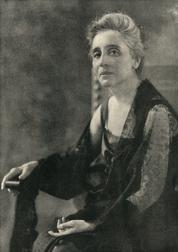
I’m talking about Lisi Cecilila Cipriani, who in 1928 wrote Italians in Chicago and Selected Directory of the Italians in Chicago. It was an annual compilation which she documented through 1934. Its subject, as you can guess, was a listing of Italian businesses, stores and individuals in the city.
I’ve only recently read her 1934 edition. But talk about eye-opening!
Instead of the usual imagery of unwashed immigrants, Cipriani details example after example of Italian American doctors, lawyers, authors, scientists, wealthy businesspeople, et. al. At a time when the national media was relentlessly depicting our community as criminal apes, Ms. Cipriani was quietly noting the successful and educated amongst us. And there were a lot!
She herself was one of them. Cipriani spoke six languages and taught French and comparative literature at the University of Chicago. Her father was Italian royalty: Count Giuseppe Cipriani, brother of Leonetto Cipriani. The latter fought with Giuseppe Garibaldi in the Risorgimento campaign before being sent to America in 1852 by King Victor Emmanuel II, where he (Leonetto) represented the “Kingdom of Sardinia.” He became the first “Italian” consul general of San Francisco until returning to Italy in 1858.
What was Zio Leonetto’s stated job in America? Assisting the thousands of Italians who had emigrated to California during the 1848 Gold Rush.
And who also was in California in the late 1840s, selling pick-axes and other items much needed by the miners? Riccardo Cuneo—brother of one of the early Cuneos of Chicago. (Riccardo didn’t like Chicago and headed west).
Full circle, as they say. From Italy to Chicago to San Fran and back.
Fascinating, no?
Yet in 2026, the American media still refuses to play us fair and square via our true history. –BDC
[The author would like to thank Ms. Jean Guarino, Ph.D, an architectural historian based in Oak Park, IL, for alerting me to Ms. Cipriani’s books.]
 John Mancini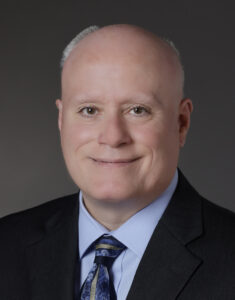
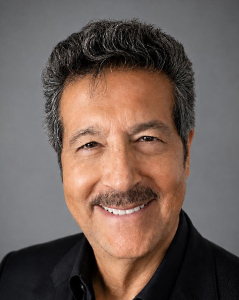
Very interesting, thanks. But I respectfully disagree with your take on the usefulness of galas. When produced properly, they are tremendous sources for fundraising and recruitment, in addition to enabling all of us to celebrate our heritage and accomplishments with our fellow Italian Americans, family members and friends. Showcasing our heritage instills pride in all of us, and galas are enjoyable venues that serve to acknowledge the efforts and accomplishments of the organization’s leaders, increase membership, and heighten awareness of the organization’s initiatives and goals. Which, in turn, increases fundraising potential and the organization’s ability to produce films, media and other educational tools without depending on public funding sources and the goodwill of those who allocate those resources.
We need Anti_Defamation committees to be part of these galas and organizations please.
We need it badly to combat stereotypes still in all the media. Stereotyping that would never be said about any other ethnic group and then be proud that we fought for respect.
GLORIA: I think most Italian Americans aren’t aware that the annual budget for the ADL (Anti-Defamation League in NY) is $100 million, with $53 million of that allocated for “educational and anti-defamation efforts.” It’s no accident you don’t see gross anti-Jewish stereotypes in American movies. Money talks.
Or, rather, money spent wisely talks.
Not so with Italian Americans. It is the opposite–our money walks. None of it ever gets invested in major educational or anti-defamation efforts. That is why the media feels no guilt walking all over US, stereotyping us so relentlessly.
Galas produce good feelings but please note: Jewish, Black, Hispanic, Asian, etc. groups also produce galas. Yet their galas always yield results. Not ours.
Note the following from Charity Navigator, which monitors org spending:
“The Anti-Defamation League (ADL) operates with a total annual expenditure often exceeding $100 million, largely focused on combating antisemitism and extremism. Recent reports indicate program service expenses for anti-hate education and advocacy efforts constitute the majority of their budget, with roughly $53 miIlion dedicated specifically to program services.”
While we don’t have any in depth history books of that era these documents are in reality factual histories of those epochs….while stereotypes and generalities may provide superficial glimpses of italian Americana they don’t compare to the reality of the industry and energy the Italian American Community contributed to urban American life. I am reminded of this because a friend Alessandro Baccari, in San Francisco, came across a 1907 Italian newspaper (L’Italia), and the edition was put out after the devastating fires and earthquake of 1906, while the city was in ruins…The purpose of the edition was to mobilize the Italian American community into action in terms of rebuilding the city and not to move away..This 30 plus page newspaper, contributed to by all forms of Italian American businesses and adds for me became a text book of the actual energy found in our local communities.
While it goes without saying we enjoy a great meal,and appreciate our culinary heritage, people overlook the fact that it is only after a hard working day, and that part of the equation needs a lot more recognition. Alessandro used his own funds to replicate the paper and for me , is a textbook and tribute to the energy and industry the immigrant commit represented.
VINCENT: As a now “veteran” of the Italian American community myself (nearly 30 years), I can only speak of what I’ve seen and experienced. And, as a trained journalist, I see very little evidence of major, or even minor, Italian American organizations taking any kind of lead to, as Mr. Mancini, has noted, move Italian American pride beyond the banquet hall.
Educational scholarships to college students studying say, accounting, does very little to advance our image to the general public. It just makes Italian American leaders feel good.
Aside from the Order Sons of Italy producing a video two decades ago on Italian American medal of honor winners from WWII, I remain hard-pressed to recall any hard-core media projects meant to instill Italian American pride or combat continual media hate.
If anything, projects which tried to make a dent have largely been made by outsiders, be it H. Hartley’s “Linciati” (about the New Orleans lynchings of 1891) or the recent film “Cabrini” (2023), funded by a WASP American and directed by a Mexican filmmaker.
Even two new projects on A.P. Giannini are being done by Italians born in Italy. Kudos to them. But shame on us. The wealth in our community could easily fund a Giannini film.
I do agree on one point: galas are a nice time but their only function, which you do admit, is to be self-perpetuating. Italians do love food. But we need more “food-for-thought.”
Speaking of which, our Institute provided such with our AURORA program for pre-teens.
The program took off initially but fizzled. Why? Because Italian American organizations wouldn’t support it financially. They have money for galas but not for young children.
KEN: You hit it on the head: food, glorious, food seems to be our motto, not Oliver Twist’s. What we need is the recognition that food is earned due to our amazing achievements.
And these achievements, alas, as I note in my blog, are catastrophically unknown by the American public at-large–and sadly, and even worse, by Italian Americans themselves.
The last time I attended a major dinner dance (a decade ago), the people at the table were
happily praising “The Godfather.” When I tried to steer the conversation to A.P. Giannini, I got glassy stares and no responses. They soon reverted to talking about the calamari.
Bill — I appreciate your responses, but I have a different perspective than you.
While I understand that the educational mission can be frustrating, it is still useful and worthwhile to fundraise and sponsor events to raise awareness and inculcate pride. I watched my father raise a lot of money for the Institute through its galas, and it wasn’t about the food. It was a social event, and the Institute galas at The Waldorf were a wonderful experience that many people looked forward to. While it may be true that the galas also attracted people who had no understanding or didn’t care about the Institute’s mission, they were willing to financially support the Institute because they were proud of their heritage, and they made a significant contribution. Even though Italian Americans are very different from other ethnic groups (more on that below), the power of pride should never be underestimated. As far as productivity is concerned, we also live in much different times now, and fundraising proceeds would go a lot farther and reach a much larger audience if applied to social media projects, instead of a Giannini film or a mainstream media production.
I think we all agree that Italian Americans are unique, and I think we can also agree that Italian Americans will not organize with the same intensity as some of the other ethnic groups that you listed. But that’s because we are Italians, and our spirit and human nature compel us to assimilate and truly become Americans, and that’s a great thing. We don’t face racist or discriminatory attitudes anymore, and I think it’s safe to say that most Italian Americans are viewed as hard-working Americans and good citizens. It also helps that there has always been strength in our numbers, politically and financially, and Italian Americans never shied away from defending our country. I never had to face any real social or cultural adversity in my life, and neither will my sons, but that’s because the preceding generations confronted the bias and overcame it. True respect is earned, never given, and that’s one of the reasons why the assimilation rates of other ethnic groups are much lower than ours.
I am 100% Italian, with grandparents from the same small town in Apulia, but I don’t think of myself as Italian anymore. Most Italian Americans I know are proud Americans who are proud of their ancestry, and they are generally unbothered by negative Hollywood stereotypes. That’s not due to lack of sensitivity — it just doesn’t matter in our day-to-day lives, and sometimes we can have a laugh at our own expense. The negative Hollywood stereotypes don’t keep us out of the boardrooms, or the halls of power, and most Americans like Italians because of our positive stereotypes — we are warm, family-oriented people who embrace our culture but leave it at home when we walk out the door. The bias that my father and I faced early in our respective careers had less to do with negative Hollywood stereotypes and more to do with having “funny” sounding names and looking a bit different from our Anglo brethren.
So let’s lighten up a little bit and continue to enjoy our success, and the country that nurtured it. Having a gala now and then is a fun thing, and even though we don’t need to organize to protect ourselves, it is still worthwhile to get together and celebrate our common experience. And we can continue to strive toward making more Italian Americans knowledgeable and proud of their heritage by taking advantage of modern media tools such as YouTube and other platforms where thousands, if not millions, can get a taste of our pride and success without great expense.
Let’s stop dwelling on the past, or always comparing ourselves to other ethnic groups. We won’t be an ethnic group much longer, but some part of us will always be Italian.