
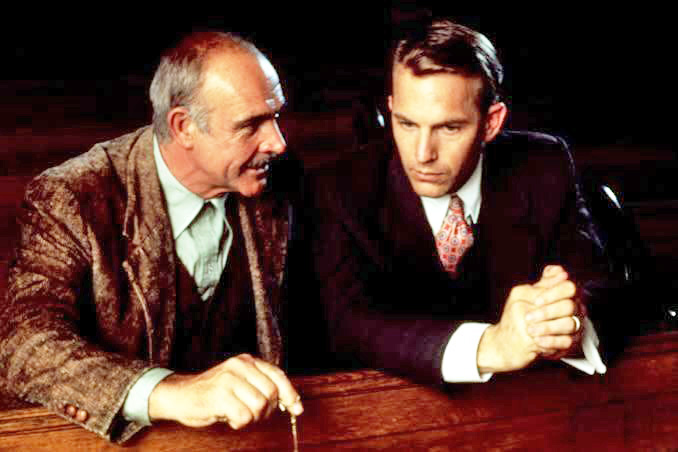
In the 1987 film The Untouchables, set in 1920s Chicago, Elliot Ness (Kevin Costner) gets some advice from streetwise Chicago cop Jim Malone (Sean Connery) on how to handle the city’s current bad guy, Al Capone: “You wanna know how to get Capone? They pull a knife; you pull a gun. He sends one of yours to the hospital, you send one of his to the morgue. That’s the Chicago Way!”
That’s a line written by a native-born Chicago playwright, David Mamet, a phrase which also summarizes the Windy City’s history of corrupt politics. People quote it all the time now—yet another example for the “Nobody-believes-all Italians-are-mobsters” crowd that movies do influence people.
(And not just non-Italians’ perceptions of us: How many Italian-owned delis have pictures of Don Vito Corleone and the cast of The Sopranos on their walls? Answer: Way too many. Italian Americans also swallowed the media lies which the media has fed them. Don’t they ever get indigestion? I’ve been to many Mexican restaurants in my life and have yet to see any proudly display pictures of El Chapo.)
The Italic Way was the name of our institute’s national magazine, which, sadly, suspended circulation exactly ten years ago (2016). Full disclosure: I wrote articles for it and edited it, hence I wear my bias on my sleeve. It was a labor of love, a quarterly publication which even objective (i.e, non-Italian) readers recognized as one of the best Italian-related magazines in the nation.
Food-fashion-famiglia-and-fun-travel? Not in “Italic Way.” We appreciated, and still do, all four of those virtues. But there is no need to lionize them. They are so ubiquitous they have become repetitive cliches.
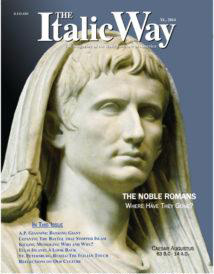
(Indeed, the food-and-family cliches are becoming a bit offensive: Although we certainly applaud UNESCO’s recent honoring of Italian culinary superiority, does this mean no other ethnic groups boast good food or revere stable family units?)
Luckily, thanks to the wonders of modern technology, issues of The Italic Way can be accessed directly through our website: pull up https://www.italic.org, then click on Research Library.
If you’re a remotely curious person, or even if you just like to actually read (that is, not scroll through a cell phone), you will immediately see how revolutionary The Italic Way magazine was—and still is.
It displayed—nay, proved—the deep talent and creativity of the Italic people, then and now.
The whole tone is different—a serious, well-researched magazine which treats Italian/Italian American culture with respect and dignity. Although The Italic Way could be both whimsical and muck-raking, depending on when needed, it had a consistent point-of-view. The focus was the richness of our history.
Instead of profiling chefs, we profiled remarkable historical figures like A.P. Giannini, founder of the Bank of America. Instead of publishing recipes, we published obits of distinguished Italic people both in America and around the world. Instead of travel pieces, we focused on pieces where Italians traveled and left their mark: China, for example, which has statues dedicated to both Marco Polo and the missionary priest Matteo Ricci; Russia, which commissioned Italian sculptors and architects to create the beautiful city of St. Petersburg; and even the good ol’ USA—Alaska, for example, where we learned the city of Fairbanks was founded by Felice Pedroni in 1901 (but whose name had been Hispanicized to Felix Pedro). Facts are fun!
The magazine stopped printing for a myriad of reasons.
An obvious one was the fragmentation of the media; specifically, the rise of social media, which undercut many printed publications, not just ours. Another was the business model of American culture, with its emphasis on quickness and lack of reflection. Yet another was the limited lack of financial support from both the Italian American community and the American media at-large, both of which reinforced the already accepted food-fashion-famiglia-and-fun-travel tropes. It’s hard to reset ideas set in stone.
Above all, our main mission of establishing a “classical” perspective was lost on people. The “Italic Way” wasn’t just a magazine title; it was also a way of thinking. It urged readers to move beyond the comfortable immigrant mentality (“Ah, those Sunday dinners with Nonna!”). Is this really so hard?
Let me try to explain.
Greek Americans, no matter their educational level, whether college professors or diner cooks, know about Aristotle, Plato, and democracy. Jewish Americans revere their cultural figures from antiquity. African Americans use the term “ancestors” to refer to the ancient kingdoms of Mali, Nubia, Ghana, etc. And yet, Italian Americans ignore Rome and the Renaissance (or, to use the proper Italian term, il Rinascimento).
Three words: Connect the dots.
A.P. Giannini was, indeed, a great American businessman. Where did those financial skills come from? Is it an accident that the Medici in Florence were powerful merchants and bankers? Didn’t a Franciscan religious, Fra Luca Pacioli, publish a book in 1494 called Summa de Arithmetic Geometria, Propotioni et Propotionalita, codifying practices the Medici were already using?
The media loves to make “cement shoe” jokes about Italian thugs, although this is an urban legend propagated by Hollywood which has never been proven. (In fact, it wasn’t until 2016 that, according to WIKIPEDIA, “the first and only documented case of ‘cement shoes’ was reported in 2016, when the body of Brooklyn gang member Peter Martinez, aged 28, aka Petey Crack, washed up near Manhattan Beach.”)
Yet the very word, cement, is from the Latin term opus caementum, a reference to how the Romans, a classical people, revolutionized engineering. Out of that grew the magnificent buildings and roads of Rome, many of which still last to this day. Out of that came the sculptors of the Rinascimento like Michelangelo, chipping his marble out of the mountains of Carrara. And out of that came the eventual construction of practically every modern building and skyscraper since then—all with Roman foundations.
Lady Gaga? Madonna? These “modern” performers express what professor Camille Paglia calls “the paganistic roots of Italian Catholicism.” Western music? In the 11th century an Italian monk named Guido D’Arezzo, founded the Western musical scale (do-reh-mi-fa-so-la-ti-do). When your doctor conducts a blood-pressure test using an inflatable arm-cuff, thank Dr. Scipione Riva-Rocci, who created it in 1896.
These connections go on and on and on; but only if you think in an “Italic way.” In short, connect the dots. That is what The Italic Way magazine encouraged—and did—in every single issue. See for yourselves.
Don Vito Corleone who? –BDC
 John Mancini
I guess we just have to accept the reality that we live in two worlds…..and trying to navigate between fact and fiction, and a lot of that experience, comes with being Italian American. I contend too, the American part of Italian ,is something that needs a lot more attention. When I visit and travel with Italian Nationals they have little or no idea of the history of the Italian American experience..
Likewise the unique history of the Italian Argentine experience……These are amazing profiles….I recently visited Buenos Aires and it really was an enriching experience, especially how the cultural blend emerged..Along these lines a wow moment was learning Pierre (Pietro) Cardin was a native of Treviso, the Veneto, and his family fled Mussolini’s Italy to France. equally amazing was his struggle to build his fashion house in France…what a tale….
Why do Italian-deli owners name sandwiches with names like the godfather or the Sopranos or Al Capone?
Don’t they realize that it just emphasizes the stereotype that the media has given Italians. Why not name them the Joe DiMaggio or Henry Mancini or many other great Italian Americans? Would any other ethnic group emphasize the negatives in their ethnicity? Why do some Italian Americans “glorify“ the mafia as if it is something to be proud of? The cure for ignorance is knowledge and our Italian American organizations, from what I have observed, have failed us in providing that knowledge.
In your research library I find that The Italic Way magazine has many interesting articles. It is worth investigating. It is unfortunate that it is no longer published.
Pizzerias all over the country have slices called “The Don,” “The Soprano,” etc. Very sad.
The great majority of It Ams have apparently never heard that classic old song by Bing Crosby: “You’ve got to/accentuate the positive/eliminate the negative…” They don’t.
We literally “eat our heritage,” or, at least, the media’s idea of our heritage.
As a past subscriber I so miss the magazine and have saved some issues to pass on to my grandchildren.
As an aside it was the Sicilians who brought Tango to Argentina, not Spain.
Almost all composers of what is called Argentine Tango music were Sicilian.
Ms. Terenzio: Thank you for passing on the knowledge. We need more people like you.
True about the contributions to tango music. The biggest superstar was Astor Piazzola:
Piazzolla was born in Mar del Plata, Argentina, in 1921,[1] the only child of Vicente “Nonino” Piazzolla and Asunta Manetti.[2] His paternal grandfather, a sailor and fisherman named Pantaleo (later Pantaleón) Piazzolla, had immigrated to Mar del Plata from Trani, a seaport in the southeastern Italian region of Apulia, at the end of the 19th century.[3] His mother was the daughter of two Italian immigrants from Villa Collemandina in Garfagnana in province of Lucca in the central region of Tuscany.[4]
Wow!
So much info on Piazzolla, the Master of Tango Music.
Where did you learn all about him and thank for that.
I also read that the Italians learned Spanish so they could communicate with each other and avoid the varied dialects.
At one time there were more Italians than Spanish there.
Fascinating
Simple Google search. I also wrote a book on Italians/Italian Americans in jazz: “Bebop, Swing and Bella Musica.” Alas, it is out-of-print.
But it has a website: http://www.italianamericanjazz.com
Is it available at I am Books?
I’ll check.
And Nick LaRocca, 1st Dixieland recording right?
Joe Lovano used to perform here in Ct occasionally.
Thank you for the info.
GLORIA: I think I AM BOOKS in Boston has run out of copies. One of my goals this summer is to work with a new printing company which can process them on-demand.
There is ONE copy left on Amazon; however, caveat emptor (let the buyer beware!): They are charging $171.00 for it!! Absolutely scandalous. My original price (2016) was $19.99
Yet one more reason to dislike Amazon. Not only are they destroying small businesses and encouraging shoppers to be lazy (other than those who can’t legitimately get out of their homes via health issues), but they’re gauging both authors and customers. Foul!!
Yes, first jazz recording (1917) was Nick LaRocca and his Dixieland Band. And Joe Lovano was one of the early, enthusiastic backers of the jazz book. He’s a genuine “cool cat” 🙂
I bought it from Amazon this past June for $27.00.
I have not read it yet.
Only $27.00? You lucked out. Hope you enjoy the book.
It’s about jazz but I also incorporated Italian American history and culture.