
In the United States, we’ve yet to have any kind of meaningful conversations about limiting the ease with which people (even non-citizens!) can purchase handguns. Conversations, mind you, not radical legislative measures. The 2nd Amendment is itself seen as written-in-stone, although its exact wordplay can also be construed as ambiguous—the word “militia” is technically the subject of the sentence, and the phrase “the right of the people to bear arms” is tossed in almost as an aside (are “the people” the militia or individual citizens?). Be that at it may, gun violence remains our status quo.
In Italy, they’re debating a new menace: e-bikes. (Actually, so are we Americans, and fairly forcefully, which shows you where our priorities are.) A few months ago, Alessandro Rapinese, the mayor of tourist-magnet Como, was hit by an e-bike after leaving a meeting in which, ironically, the subject of limiting all traffic in the city center had been discussed. That incident led to a new law, to be enacted on September 30th, banning both e-bikes and even regular bikes. (Italy’s laws make no distinction, alas). Riders will now have to dismount before entering the centro storico and walk bikes by foot.
The mayor’s response: “I’ve been accused of adopting this measure because I was hit by an electric bike – certainly, that is true. People act based on their own experiences and I know what it’s like to be hit by one of these beasts.” Naturally, he has come under fire from bike-riders of both stripes, who argue that bikes are a convenient mode of transportation as well as a source of income for delivery drivers. Yet the mayor’s move wasn’t without precedent: In 2022, the local government banned e-scooters from the city center. This got me to thinking: Is there an Italic connection to bicycling, in general? The answer is, as always, “of course.”
A German, Karl von Drais, is seen as “the father of the bicycle” thanks to his “Laufmaschine” (running horse) vehicle, invented in 1817. In the early 1860s, two Frenchmen named Pierre (Michaux and Lallement, respectively) added pedals and a crank drive, and another Frenchman, Eugene Meyer, patented wire-spokes a few years later (1869). The new mode of transportation took the world by storm.
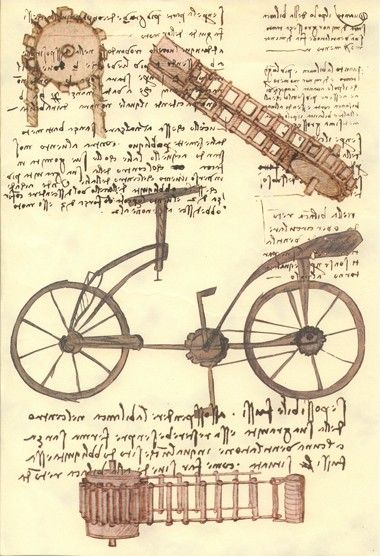
But a controversy erupted 100 years later (1967) when researchers discovered a sketch of what looks like an operational bicycle in Leonardo da Vinci’s Codex Atlanticus. The sketch, dated around 1500 AD, is attributed to Gian Giacomo Caprotti, one of da Vinci’s many students. Scholars have since either vigorously defended or discredited the notion that this device is an early precursor to the modern bicycle. Considering that da Vinci himself sketched prophetic images of modern-day flying devices (aka “airplanes”), the idea that his hand was involved isn’t that weird.
Like other foreign items, such as coffee or cars, the Italic people quickly mastered this new-fangled one. The Bianchi company, for example, was founded in Milan in 1885 and remains the world’s oldest bike-producing business.
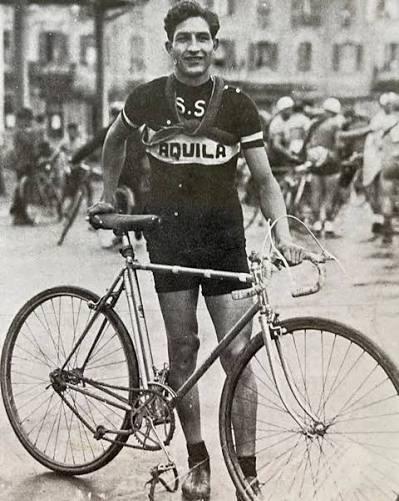
Italy also produced major bicycling champions, such as Fausto Coppi, who won the Tour de France twice and Giro d’Italia five times; Gino Bartali, who dominated cycling before and after WWII (two Tour de France wins, three Giro d’Italia); Marco Pantani, who won both races in one year (1998); and Vincenzo Nibali, one of only seven cyclists to win all three racing events (Tour de France, Giro d’Italia and the Vuelta in Spain). Indeed, Bartali’s fortitude even went beyond the cycling track: During WWII, he secretly delivered fake passport documents to help Jews hiding in Italy escape the invading Nazi forces. Schindler’s List? How about Bartali’s Spokes?
The average American knows Italians in cycling via the popular 1979 film Breaking Away. Sadly, this otherwise witty and well-balanced look at small-town American life caricatured a visiting group of famed (fictional) Italian cyclists as cheaters. Talk about a flat tire!
Today, you see Italians riding bicycles everywhere, either out in the countryside or doing errands in city streets—but not, for now, in downtown Como. Maybe actor Giorgio Clooney, one of Como’s more famous residents, can set an example by trading in his motorized scooter for a bike. While vacationing in Sardinia in 2018, Clooney’s scooter ran into an oncoming car, throwing him onto the asphalt. Luckily, no major injuries.
How Clooney now gets in and around Como, I have no idea. Hopefully, he follows Saint Augustine’s advice: Solvitur ambulando (“Solve it by walking”). –BDC
 John Mancini

Recent Comments