
Have you been to Manhattan’s Little Italy lately? It’s not so much a cultural enclave as a street bazaar at mealtimes. It’s three blocks of restaurants, each with a pitchman out front luring you in. These eateries are lined up tooth-by-jowl, every tenement has an Italian restaurant.
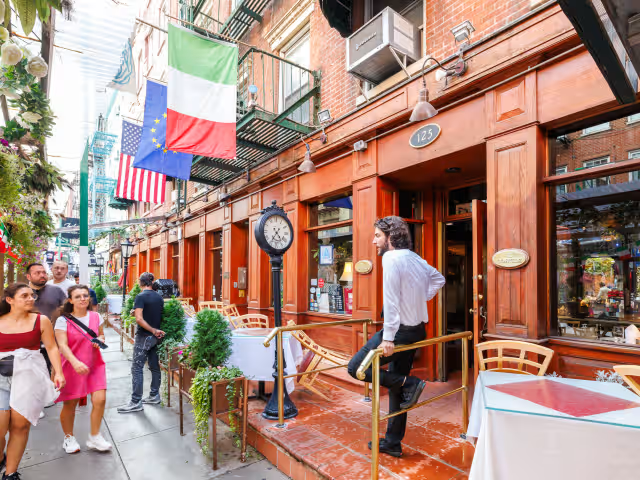
They are so close that the overhead signage can confuse two restaurants. In fact, we walked into the wrong one looking to rendezvous with our daughter. When I asked if she was already seated, the waiter ignored the question and sung the praises of his food. A quick look around and I realized my mistake and went next door.
Many Italian restaurants and pizzerias—urban and suburban—are Italian in name only. In the kitchen, behind the counter, and waiting tables you’ll find mostly Hispanics. Our waiter in Little Italy was Abel and the cook also looked South of the Border. The food was very good, though! But with a few exceptions Little Italy is a tourist trap: small portions and wine at $17 a glass.
However, I learned a rare lesson: you cannot twirl spaghetti with a round fork. In all my years I’ve never come across a fork I could not master. But I was given one with a round handle that defied the one-hand twirl. Abel went missing, so I ended up scooping and wolfing down the saucy strands Chinese style.
For the Boomers among us, we’ve seen Italian food in America go from a proprietary cuisine of home cooking and family restaurants to a corporate free-for-all. Pizza went from an exotic foreign concoction—carmaker Lee Iacocca noted how growing up in Pennsylvania during the 1940s his friends first tasted pizza when his mother made it—to America’s most popular fast food. Americans eat about 3 billion pizzas every year, averaging roughly 23 pounds of pizza per person annually! On a recent cruise we took, the free pizzeria (“Sorento’s”) was open 15 hours a day churning out cheese and pepperoni slices on pre-fab (aka “cardboard”) pie dough—always a line, no matter the hour.
But pizza got away from us bigtime. Little Caesars, Jets, Pizza Hut, Domino’s, Papa John’s, and Sbarro’s are all non-Italic national pizzeria corporations. Who remembers the 15¢ slice? An entire pie for $1.20! Today, the pizza box costs more than that.

And look what happened to tomato sauce. There are hundreds of jarred sauce brands available with maybe 15 big-sellers, quality ranging from yuck to pretty good. Victoria, Rao’s, and Buitoni topped one critic’s list. All styles of sauce are now marketed, something we didn’t make at home in the olden days: Vodka, Alfredo, and Carbonara, among others. Then there are the short-lived celebrity brands to inflate the egos of minor mob-stars from The Sopranos. The late-Vincent Pastore (“Big Pussy”) and Judeo-Italic Steve Schirripa (“Bobby Baccalà”) market their own brand of “gravy” for their fans.
Pasta, or macaroni as I still call it, has been revolutionized with dozens of new shapes (Wagon Wheels, Radiatori, Campanelle, and Cascatelli/waterfall) and manufacturing gimmicks like the “Bronze die” method that roughs up the surface to hold more sauce. Dozens of Italian imports like Rummo, Garofalo, Colavita, and DeCecco all have a noticeable al dente and mouth-feel difference than American brands. To think that I was raised on mostly Ronzoni spaghetti, ziti, and rigatoni.
Before closing, we should acknowledge the recent death of Carlo Petrini, at 74, the man who founded the Slow Food Movement in 1989. He famously objected to a McDonald’s being planned for Rome’s Spanish Steps and later founded the University of Gastronomic Sciences, the first-ever university dedicated solely to the food chain. Strangely enough, the place is not a culinary school; students do not learn how to be a line cook or master restaurant kitchen techniques. The curriculum focuses on how food is produced, distributed, and sustained globally. Students take global study trips to meet farmers, producers, and artisans to understand the entire food supply chain.
Wonder if the school has a cafeteria or they order in? –JLM
 John Mancini

Its a timely blog in that the Italian American Museum of Los Angels, is presenting a special show called “Mangia!”, the evolution of Italian Food in the U.S. Its on my to visit list, but all reports I have received found it extremely engaging….To some extent assimilation is a two way street….and no more so than foods. But it is more than food, for many of our immigrant ancestors. Its all about industry too, as they were amazingly quick to establish culinary outpost that became economic engines for our whole society…I am thinking of the canneries’, orchards, truck farms and vineyards that merged with an impressive nation wide distribution network to the point it is part of today’s national landscape…Yet among the shards of this dynamic industry you can still find parts of our immigrant roots.
I think the IAMLA museum did a great job in framing the relevancy of our culinary heritage. But, an all time favorite movie, The Big Night, is another one of those culinary gems to contrasted what has metamorphized into Italian restaurant food, and the older reality of Italian cuisine from Italy…I was raised in an era, if you could not grow certain herbs and vegetables in a home garden, you were not going to find those products in your local grocery story…..it now seems a very distant past, given the culinary explosion one finds in the so called Little Italy culinary destinations found in many parts of the US.
Rule #1: It is NOT a custom in Italy to have pitchmen outside of a restaurant, trying to herd people in to eat. Total amateur hour. One should also avoid places with pics of food.
On the “Jeopardy” show yesterday, one question asked the three players to name an Italian immigrant who “phoneticized” his name to make it easier for Americans to say. To my surprise, a contestant correctly asked, “Who is Chef Boyardee?” (Hector Boiardi).
In 2020, the “face” of Prince Spaghetti, Anthony Martignetti, passed away. A generation of TV viewers remember the 1969 ad which made that brand famous: A woman in Boston’s North End sticks her head out of a window and cries out, “Anthony!” Whereupon we see the 12 year-old Martignetti hurriedly rushing home to eat his favorite pasta.
In Chicago, “Mamma Celeste” Lizio pioneered her famous frozen pizzas. The 1978 TV ad for them introduced her famous catch-phrase: “Abbondanza!” (Abundance!).
The most intriguing food success story is of the famous celebrity restaurants which existed on both coasts at one time: Sardi’s in New York and Musso and Frank’s Grill in LA. The irony is that the Hollywood industry repaid the favor by forever stereotyping Italians!
The lists go on and on. The point is an obvious one: Italians rule food, here and in Italy.
My hope is that people eventually get their fill of such foods so that we can replace them with “food-for-thought.” It’s hard to appreciate Italic genius when you have “abbiocco”
(the Italian word for that half-awake/half-asleep feeling after eating too much food).