
the cod-rich Grand Banks
There’s a 9-mile stretch of the Belt Parkway in Brooklyn leading to the Verrazzano Bridge with a small sign designing it as “Leif Ericson Drive.” It was so named by the New York City Council in 1969 to honor (or pander to) Norwegian Americans who lived in the adjacent neighborhood. That was five years after President Lyndon Johnson proclaimed October 9 as “Leif Ericson Day.”
It’s quite interesting how little controversy surrounds the probable Viking arrival to American shores. Despite the 1965 hoax of the Vinland Map, purported evidence of a Viking landing 500 years before Columbus, only positive vibes radiate in history books and the media. The tale is intended to knock Columbus off his pedestal.
No sooner had the Vinland Map been announced by Yale University than critics questioned its authenticity. Among them was Judge Michael Musmanno of Pennsylvania, who was also one of the giants of Italian American leadership at the time.
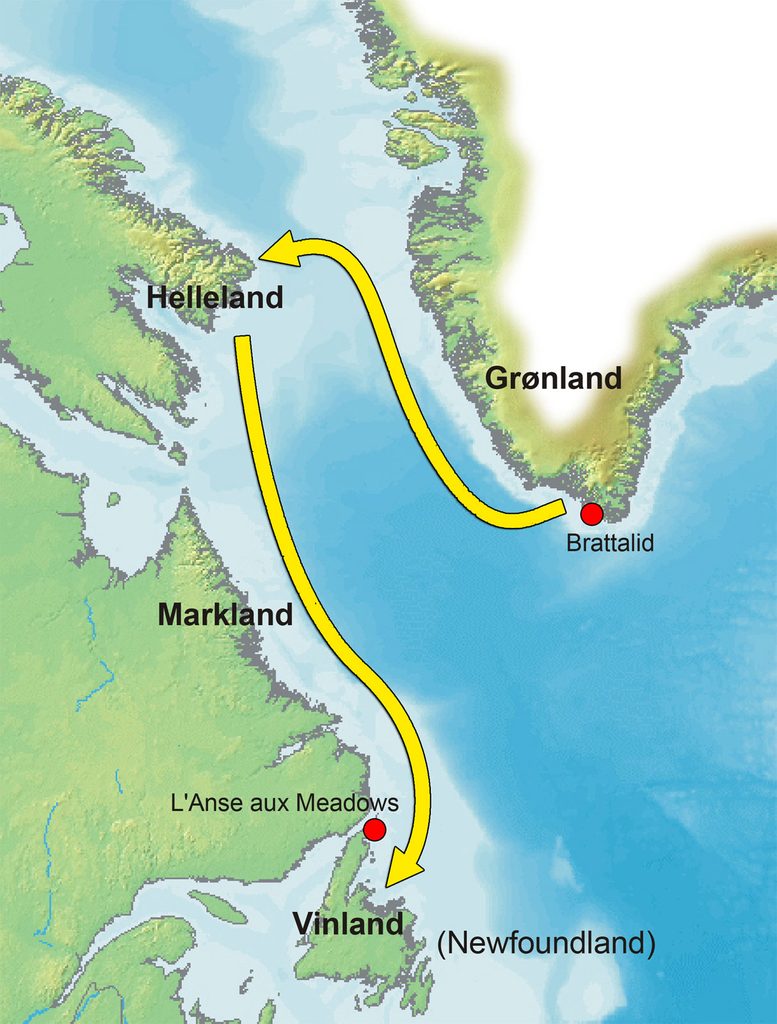
Even though the map was a hoax, earlier, in 1960, archeologists uncovered evidence of a Norse presence at L’Anse aux Meadows in Newfoundland—some bronze and iron items that Indigenous people never had. It was this discovery that led to the naming frenzy in the U.S.
It took eight years and specialized science to prove the map a hoax. Beside some glaring errors like Greenland being depicted as an island—which no one confirmed until the 20th Century—it was the ink that exposed the scam. A complex analysis revealed it contained a pigment only available after 1917.
Nevertheless, who first discovered America became a contentious battle, on the one hand by Indigenous people who considered “discovery” by Europeans to be an insulting term, and on the other hand by Europeans who denied Columbus was Italic but rather Jewish, Catalan, and even Polish.
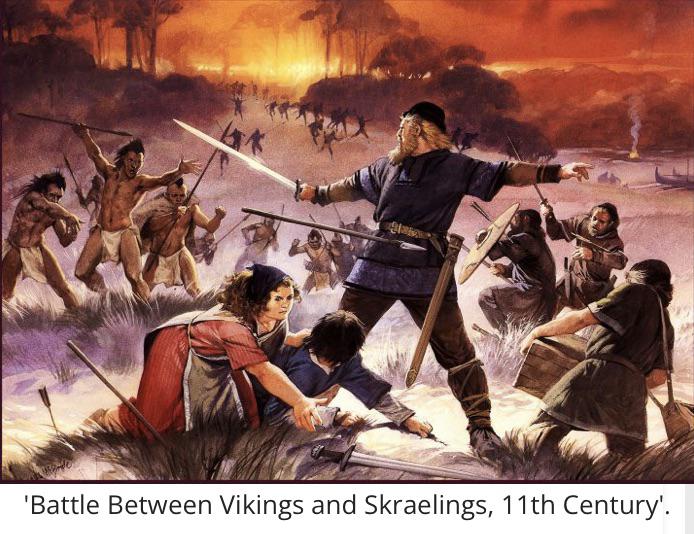
The Viking claim is grounded in archeological evidence (cited above) and in Norse sagas. Accordingly, Leif the Lucky made three voyages to the New World around the year A.D. 1000. The L’Anse aux Meadows settlement has been dated to around AD 900. Researchers believe he landed on Canada’s Labrador and Newfoundland which he named Vinland where he found wild grapes. The sagas also mention that Leif’s brother Thorvald returned to Vinland where he encountered some Indigenous people that he called “skraelings” meaning barbarians. That meeting didn’t go so well, and the Vikings killed eight of them, but Thorvald was also killed in the melee. So, why isn’t this Viking “discovery” not considered a hostile invasion or “genocide”?
What archeologists determined at the L’Anse aux Meadows site was that it may have been “occupied at least sporadically for perhaps 20 years.” Indeed, it was probably just a temporary waystation or boat repair facility. There is no evidence of burials, tools, agriculture or animal pens—markers of a real settlement. Unlike the voyages of Columbus to the Caribbean, the Vikings found nothing of interest in these Atlantic islands. Once Leif’s brother got whacked the whole Viking taste for conquest and settlement faded.
From the Indigenous perspective, these hairy, horned seamen brought nothing in the way of trading goods. At least Columbus stocked his ships with consumer delights: Venetian glass beads, hawk bells, knives, iron pots, spices, combs, fishhooks, sewing needles, and wool. The Vikings only brought dried fish—like bringing coal to Newcastle. You would think that during the 10- or 20-years Vikings had a settlement on Newfoundland some commerce with the Indians would have occurred. In fact, neither party got anything out of the sojourn.
Importantly, the Vikings brought nothing back from the New World—no corn, beaver pelts, or even snowshoes. Either they were poor businessmen or just anti-social. Nor did they discover the cod-rich Grand Banks on their northerly way over. The Italian explorer Giovanni Caboto had to gift this food source to a hungry Europe in 1497. So, the Viking claim to being “first” is a meaningless assertion.
Instead of magnifying the meager Viking artifacts, historians and the media should be confirming that “discovering” America was largely an Italian enterprise. We found it, claimed it for three European countries, and named it. Not bad for a bunch of lowly spaghetti-benders. –JLM
 John Mancini

Recent Comments