
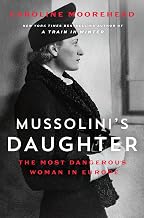
The Mussolini family was quite the target of gossip during the Fascist Era. But recently, British author Caroline Moorehead devoted a book on Edda Mussolini, the dictator’s controversial daughter. Subtitled “The most dangerous woman in Europe,” this biography alludes to her threat to release her husband’s diaries during World War II to stay his execution by her own father, il Duce.
Count Galeazzo Ciano married Edda in 1930 at the apex of her father’s regime. It was a media delight, the mating of eagles—a minor aristocrat to the peasant Mussolini family—think of Prince Charles and Diana of their time. The Duce was then considered a benevolent dictator by most of the world and his daughter a chip off the old block, so the wedding was a media event with 4,000 guests. In fact, Edda was the favorite of his eight children (five legitimate and three not quite). Soon after the wedding the couple was posted to the Italian consulate in Shanghai to further Galeazzo’s career in the diplomatic corps.
Edda was only 20-years-old and allegedly had her first affair, with a Chinese general no less. Clearly, Duce’s “chip” inherited the Mussolini libido. (Galeazzo was also on the prowl throughout their marriage.) The couple was ordered back to Rome in 1932 where the Duce enhanced his son-in-law’s Fascist credentials with plum jobs. In 1935, Galeazzo flew bombers in the Abyssinian War achieving the rank of Captain and a place in Duce’s warrior heart. By 1936, he became Italy’s Foreign Minister. That’s when the diaries began.
Meanwhile, Edda was picking up a reputation for drinking and carousing, at one time linked with future fashionist Emilio Pucci. She was strong-willed like her father and often had shouting matches with him over her lack of discretion. Still, she performed her wifely duties bearing three children for Galeazzo.
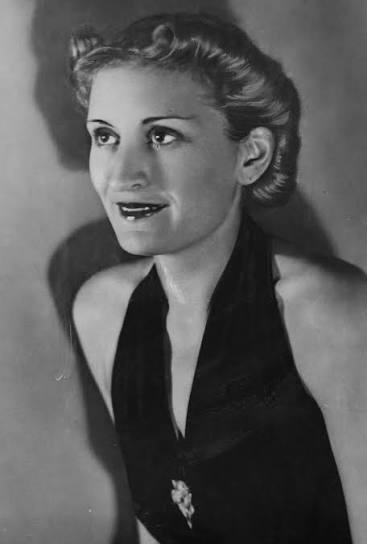
treated her like a princess.
In 1940 when the war stared, she volunteered as a nurse in Albania. Her hospital ship was sunk by a British warplane in the Adriatic. Twenty-three nurses and crew perished that night, and Edda clinging to wreckage prayed to Saint Rita of lost causes. She was rescued and hailed a hero in Italy. Back in action, 1942 found her on the Eastern Front nursing wounded Italian troops and seeing firsthand the misery Hitler and her father had caused.
Known for her earlier pro-German attitude—she had met privately with Hitler, Goering, and Goebbels—she became appalled at the treatment of Italian workers in Germany, personally protesting to Hitler. Galeazzo too had had enough of the one-sided Axis partnership and by 1943 secretly solicited support among Fascist Grand Council members to end Mussolini’s dictatorship and to return power to the King.
This internal coup led to Mussolini’s arrest and the chaotic surrender by the King’s new Prime Minister Pietro Badoglio resulted in a full German occupation of Italy. Had the King immediately surrendered Mussolini to the Allies as was ordered by them, the dictator would have never been rescued by Hitler and restored to power as a puppet in northern Italy. Mussolini’s survival now caused a civil war and marked Galeazzo Ciano for death.
In 1944, Mussolini ordered a trial for those on the Grand Council who precipitated his overthrow. Four of those Fascists, including Ciano, who weren’t lucky to escape German arrest were sentenced to a firing squad. Edda begged for Ciano’s life but her father refused. That’s when she threatened to give the Allies Galeazzo’s diaries, something her father feared.
The diaries, which weren’t published until after the war, contained nothing surprising to the Allies. What Mussolini had feared was all the anti-German and anti-Hitler comments that he had expressed to Ciano over the years. Nevertheless, Ciano was shot and Edda rejected all that her father stood for.
Later in life, she recounted to friends how she hated him for killing her husband, yet she kept a photograph of daddy on a grand piano. To quote the Moorehead book, “But then one day, to a writer who came to interview her, Edda said that her father ‘was the only man I ever loved.’”
Edda’s son Fabrizio became a neo-Fascist after the war and wrote a book that summed up the family tragedy, When Grandpa had Daddy Shot. –JLM
 John Mancini

As fascinating on her end of the political spectrum as Oriana Fallaci was on hers.
Who says that Italic women are bimbos? Answer: The American media.
And they’re wrong.
Just look at how they’ve ignored Prime Minister Meloni the past four years, merely because of their “perception” of her as conservative (which is different than our brand).
The only time she was given major press in America was when she stood up to Trump (!).
Yet another example of how American journalism has been infected by political machinations. The press shouldn’t be covering for ANY political party. But, there you go.