
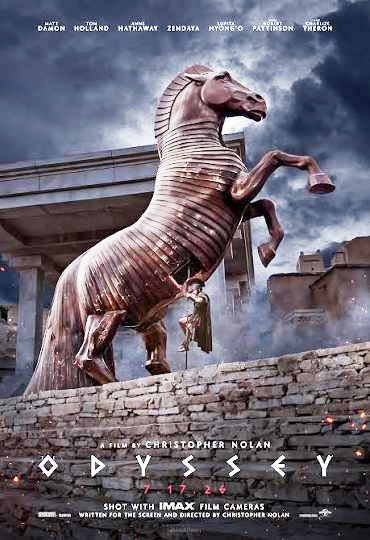
An Institute colleague and I saw the much-ballyhooed The Odyssey last week in an IMAX theater necessary for the full dramatic effect. We both agreed that it was too long, too loud, and too Woke.
We knew of the controversy in filmmaker Christopher Nolan’s casting of Lupita Nyong’o as Helen of Troy, but he also sprinkled in enough Black actors throughout the movie to make a mini-sequel to Porgy & Bess. There was the Black storyteller (perhaps Homer himself), a Black suitor vying for Odysseus’s “widowed” wife Penelope, and a Black veteran of the Trojan War homebound with Odysseus. Also in the cast was biracial actress Zendaya as the goddess Athena and what looked to be a Japanese shipmate along for the ride home. Clearly, Nolan had his sights on box office diversity and Hollywood’s need for multi-culturalism. However, the Woke taboo of “cultural appropriation” didn’t faze him. But it has raised hackles in the pan-Hellenic community, including calls for a boycott.
Nolan, you will recall, wrote and directed Oppenheimer in 2023, the story of the atomic bomb, wherein he relegated scientist Enrico Fermi to a pathetic walk-on appearance with one line. Both history and the 1947 docudrama The Beginning or the End, when Fermi was still alive, gave the pioneering nuclear scientist the ample credit he deserved for the Atomic Age.
Returning to The Odyssey, it is an impressive product of today’s AI technology linked with percussion-fueled action that is unrelenting—three hours without an intermission is doable, even for bladder-challenged seniors. The scenes aboard the ancient vessels as they endured the terrors of the Aegean Sea definitely hold your attention. I had some doubts about the Trojan Horse episode, though, questioning why the steed looked like a Michelangelo original and held together as the naïve Trojans dragged for miles after being half-buried in sand and eventually into the city.
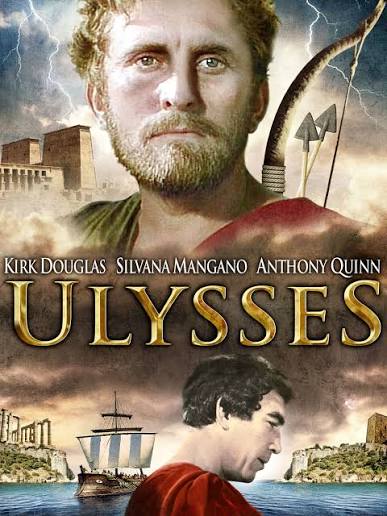
There were expository episodes of dialog trying to explain the adventure tale for those who never read The Odyssey or saw the 1954 Italian-made version Ulysses (the Roman name for Odysseus) with Kirk Douglas. It too was an epic and much truer to Homer’s work.
The Odyssey poem was a sort of combined King Kong and Ten Commandments for ancient audiences. It was originally an oral poem that followed up The Iliad, another epic poem that covered the Trojan War. The Greeks passed these gems onto the Romans in written form, and they were required reading in a good Roman education. “Beware Greeks bearing gifts” was penned by a Roman to sum up The Iliad and reflect the attitude of his fellow Italic people about Greeks in general.
A major change in Roman reverence for the Iliad and Odyssey came about with the defeat of Cleopatra and Mark Antony by Octavian Caesar in 27 B.C. Romans had had enough of the double-dealing Greek orient. (The lovers wanted to split the Roman domain with a rival capital at Alexandria, Egypt.) That victory and Octavian’s founding of the Roman Empire made Italy supreme. Now, it needed its own epic poem. By 19 B.C., Marcus Virgilius Maro produced one titled The Aeneid.
“Of arms and the man I sing …” began Virgil’s epic. Instead of victorious Odysseus heading home, it is the defeated Trojan prince Aeneas (eye-Knee-ess) who escapes his devastated city in search of a new home. The adventures of Aeneas parallel those of Odysseus: seas fraught with danger, stranded on a foreign shore, monsters to defeat, and gods battling for his future. All the while he can only lament “Italiam non sponte sequor.” (“Not of my own free will do I seek Italy.”) The gods are driving him there.
Unlike Odysseus, who journeys to reclaim his wife and throne, Aeneas carries the future of Troy as well as his father and son, ancestors of Romulus and Remus. The epic asserts Rome is heir to Troy (take that, Greeks!) and “foretells” the future of Octavian’s victory and the key to Rome’s imperial success: “Sit Romana potens Itala virtute propago” (“Let Roman power spread with Italian valor.”)
Aeneas has a cameo in the Brad Pitt movie Troy (2004), but there hasn’t been an American movie version of The Aeneid. I guess Hollywood hasn’t run out of ideas for crazy Roman emperors yet. –JLM
 John Mancini
You forgot Himesh Patel as Eurylochus, Odysseus’s second-in-command. He is quite good, but yes, it’s a bit jarring to see a dark-skinned, South Asian Brit playing a “Greek.”
In academia, there is a new school of thought that such racial casting is more accurately reflective of the classical past–that the peoples of ancient cultures didn’t think in terms of “race.” I’ve yet to read anything to fully convince me. I’m fairly certain that when they put their myths and stories together, classical Greeks did, indeed, “think Greek”; that is, create characters from their own culture. As today’s multi-culturalists are fond of saying, “People want to see their own reflected in the culture.” Exactly. It applies to ancient Greece, too.
Nolan, a buttoned-down Brit, is entitled to his own version of the story but he is probably TOO buttoned-down culturally to fully reflect Mediterranean sensuality, The whole tone of the film is blase’ modernism: Grey skies, no heroism, lots of London fog. In short, a drag.
Also: He deliberately deglamorized and/or desexualized many of the main female characters, perhaps to cover himself from cries of sexism. Calypso, Odysseus’s lover (yes, he cheats on Penelope–for years!), looks and sounds like his sister. The witch Circe is turned into a dowdy-looking feminist, filled with contempt for men. The sirens are seen
as blurry figures in a mist. Athena is more like a worried social worker, not a goddess.
The take on the Trojan Horse is borderline absurd. As you say, a two-ton structure…?
There is a 1997 cable TV version which I never saw but which, in YouTube clips, looks both uneven yet highly interesting, and much more faithful to the text. And it features a number of Italic actors: Armand Assante, Greta Scacchi, Bernadette Peters (born Lazzara), Isabella Rossellini, Christopher (Corradini) Lee, and Vanessa Williams (1/4 Italian).
Final point: Actor John Leguizamo (Colombian/Puerto Rican descent), as the blind shepherd, is calling his experience on the film “the highlight of my career.” Funny comment coming from a man who, as of late, has openly trashed Western Civilization.
Why does the term “cultural appropriation” not go both ways?