
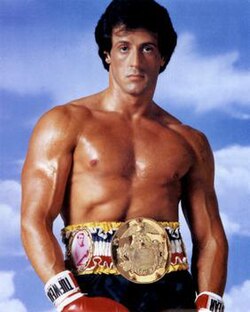
the Spanish surname
Among the anniversaries to be celebrated this year will be Rocky, the Hollywood blockbuster from 1976 that was top grosser of the year. Italian Americans were on a roll that decade. The Godfather premiered in 1972, Godfather II in 1974. All three movies exploited our stereotypes with abandon, but their “deeper” message was about making it in America against the odds.
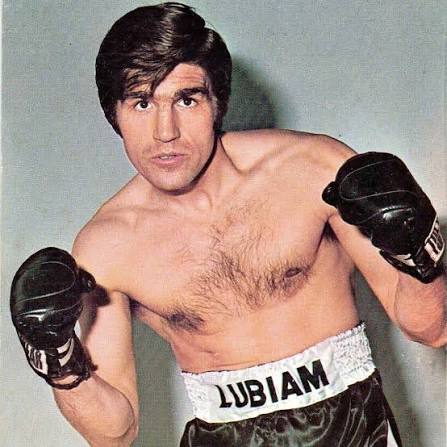
Unlike Don Corleone, Rocky Balboa made it legally by sheer force of will. His fictional self-discipline and victories in the ring mirrored the real-life stories of Rocky Marciano, Rocky Graziano, and a host of Italian American boxers that included Jake LaMotta, Carmine Basilio, Willie Pep (née, Guglielmo Papaleo) and later Ray “Boom Boom” Mancini.
I went to see Rocky when it first came out. It made me proud; I’ll admit. It was a seductive rags-to-riches tale, as I was 29 years old and struggling with a career in a multi-ethnic field, that easily hit the right notes. Bill Conti’s driving score (“Gonna Fly Now”) clinched the excitement, and the fight scene added a racial component that raised a darker reality. (This was the time of unsettling Italo-Black relations. It was a time when many still dreamed of a “White hope” in the ring; and Italian Americans still had that reputation from the 1950s.)
Just before the 70s, Italic people had a champ in Italian boxer Nino Benvenuti who held the middleweight title during his ten-year career (1961-1971) with a record of 82 wins in 90 bouts, 35 by knockout. So, the material was still there for a fictional Italian hero.
The man who created Rocky Balboa and played the part was Sylvester Stallone. According to Wikipedia, his mother was Jacqueline Labofish of Celtic French and Ukrainian Jewish ancestry. His father Francesco was an Italian immigrant from the region of Puglia who moved to the U.S. in the 1930s. Like most paesani, Stallone was “Italian” by osmosis, carrying an Italian surname and absorbing bits and pieces of heritage from family, the street, and the media.
He freely admits his first acting goal was to play a goombah extra in The Godfather, but he didn’t have the heft or street look of a Clemenza or Luca Brasi. No problem. He made his Rocky character a mob debt collector in south Philly. However, his naming the character after Spanish explorer Vasco Núñez de Balboa—which he actually took from a street sign in Los Angeles—again demonstrated his shallow knowledge of heritage.
Many years later in 2016 when asked on a British talk show why he turned down the role of Han Solo in the first Star Wars, Stallone answered that it wasn’t a good fit; there’s something wrong with Italians (i.e. Stallone) in a space movie: “What are they gonna do, deliver pizzas?” Such is the proud Italian who pumped up our spirits in 1976.
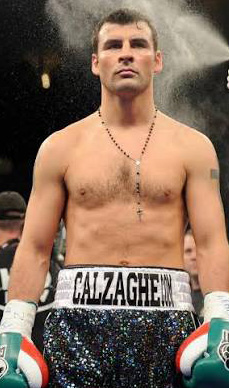
with his tricolor gloves
Speaking of British, another real “Rocky” surfaced in Wales two decades later. Born Joseph William Calzaghe (kal-ZA-gee) in 1972, he was the son of Italo-Welshman Enzo and a Welsh mother. At age 11, Joseph suffered verbal abuse at school from which, he says, he never recovered. Amateur boxing was a form of release as he grew up. Professionally, his career covered both the super-middleweight and light-heavyweight classes, retiring in 2009 with a stellar record of 46 wins and zero losses. Calzaghe ranked as one of the greatest European boxers of all time. His nicknames were “The Pride of Wales” and “The Italian Dragon.”
As you see, the fictional Rocky wasn’t a stretch of the imagination. Like the gladiators in our distant past, the Italic people still carry the gene for pugilism and sports in general. Hollywood will always find a way to “dramatize” that talent with varying results affecting our public image. The Rocky series can be considered a net positive and the Balboa moniker “The Italian Stallion” a lot more endearing than say “the godfather.”
But the 1970s weren’t finished with us. Rocky was soon followed by another blockbuster about us: Saturday Night Fever in 1977. Not only could we organize crime and rule the boxing ring, but now we could tear up the dance floor as well. –JLM
 John Mancini
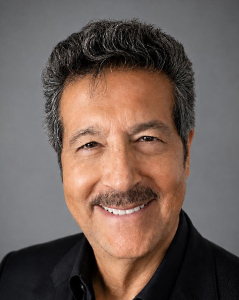
Stallone himself had a rags-to-riches career. Speaking for myself I never subjected myself to rejection though I worked very hard. But I have an admiration for Stallone who could throw himself into boxing ring of rejection from the movie industry for a project he really believed in to make it to the big time… Prior to Rocky, he was type casted in some short scenes with Woody Allen and Neil Simon’s Prisoner of 2nd Avenue. He avoided the organized crime image until recently. And despite decades of spiritual and New Age books I’ve read, Sly slam dunked the whole process and how I get through the day with this, to wit..“But it ain’t about how hard you hit. It’s about how hard you can get hit and keep moving forward. How much you can take and keep moving forward. That’s how winning is done!”
In the summer of 76, I was 9-years-old and my older sister took me to a local theater to watch Rocky and it was packed with people and probably without exaggeration, it was 90% Italian people in the theater because that was the makeup of the neighborhood. At the end of the movie with the boxing match, it was as if we were at a live boxing match, people were clapping and screaming and very emotional. When I left the movie, I was beaming with pride and ready to run through a brick wall. I saw Rocky at the Montclare Theatre in Chicago on Grand Avenue and I will never forget it.