
I just read an interesting story about the passing of 91-year-old Salvatore Lanzilotta. He was born into a family with 19 children! The accompanying photo of that family from the 1930s looked like a military formation. The kids appeared to be one year apart, and mamma was holding an infant. The kicker was I only counted 15 offspring; another four came after the photo was taken!
I’ve heard stories about such large families. My father-in-law had seven siblings; but 19 is beyond comprehension. Even Mussolini set a lower goal for Italy’s harried mothers. He once hosted Italy’s most prolific mothers who together produced 1,300 children with an average of 14 each. To spur on this population boom the Fascist government offered free medical care to the mom-to-be, free meals and clothing for poor families, summer camps for the children, and protection of unwed mothers.
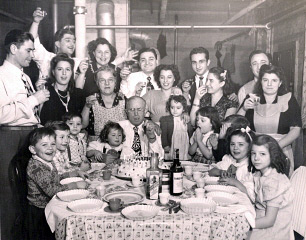
I’m sure the Lanzilotta family only received a pittance of these benefits in the Depression-era U.S. Large American cities had what was called “Home Relief” which provided a small amount of funds, usually only if the father was unemployed. According to the NYC Tenement Museum, those on relief received $13 a month for rents that averaged $18 a month. It also provided a clothing allowance of roughly 27¢ a month.
So how did such a large family survive? I imagine that papà Lanzilotta was the breadwinner and remained well enough to work tirelessly. The older kids no doubt chipped in with part-time jobs, and mamma could feed the brood for pennies (or nickels) a day. Of course, hand-me-down clothing and toys were mandatory. But think of the complexity of having only one toilet and seating 21 mouths to feed for dinner. Anyone complaining about “affordability” today would never make it back then.
Besides housing costs, today’s social values have put many a family in dire straits. I can rattle off the insane changes that are making life unnecessarily expensive: the children’s parties and sports programs, the luxury vacations, divorce and single parent homes, the outsized and multiple cars, the deluxe entertainment and communication needs, and living on credit card debt, among others. Who has the courage to rein in the social pressures that feed these addictions?
My father used to say, “It’s not how much you make, but how much you save [that makes life affordable].” He shared Old World values that seem impossible today. We are bombarded daily by Madison Avenue and Hollywood to match whatever the “better half” is doing, whatever the cost. The sad part is we can control much of our discretionary spending by readopting some traditional values.
It seems ridiculous to me when a TV reporter explains affordability by interviewing people at a supermarket. What we spend on food is not what’s putting us in the poor house. Rather, it’s real estate taxes and rents driven by skyrocketing school costs and public pensions. It’s driven by government debt as a consequence of welfare and Medicaid fraud, lately exacerbated by illegal immigration.
New York State recently passed its budget allocating an additional $4 billion to NYC to help ease its $12 billion deficit. And what caused this deficit? Between 2022 and 2025 the city spent $10 billion to care for illegals. And breaking news! Today’s Newsday reports a surge in prostitution on Long Island staffed by illegal Chinese aliens plying their trade in “spas” popping up in nearly every community. At a cost to “consumers” of $100 – $140 a trick, you may add “massages” to the affordability issue, as well as the costs to taxpayers for police busts and court time.
What is rarely reported is the rising cost of homes caused in good part by LEGAL immigration. I’ve written about “chain migration” previously, that 1965 federal law that allows extended families to immigrate here legally. New York City alone takes in nearly 140,000 of these newcomers EACH YEAR! These numbers obviously put pressure on housing and rents. With near zero vacant land to build on, this drives up prices on existing living spaces causing people to scream about “affordability.”
Reporters should be going to the international arrival terminals at airports not to supermarkets to look for “root causes.” –JLM
 John Mancini

I read this article with intense interest. My family immigrated from Sicily as fishermen. No government handouts in those days. To ask for assistance from third parties was a “vergogna”. The strong work ethic was necessary. We ate a lot of fish and breadcrumbs went a long way. Vacations were not in our vocabulary. We survived with dignity.