
Frank Sinatra lived to 82, Connie Francis to 87 and Tony Bennett to 96. Like many other Italian-American singers they were blessed with longevity. At least three, however, were not. They apparently were under a maledizione (Italian curse).
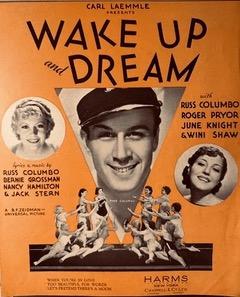
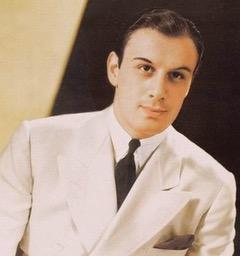
Mega-stars Russ Columbo, Mario Lanza and Bobby Darin enjoyed great fame … but only briefly. Each could have had “Tragedy” for a middle name as none lived to 40 and Columbo didn’t even make it to 30.
Not many are aware of Russ Columbo today but he was big in the 1920s and early 1930s, a pioneer “crooner” well before Sinatra. Born Eugenio Colombo in 1908 in Camden, NJ, he was raised mostly in California. The spelling of his surname was changed—from Colombo to Columbo—by publicists.
Twelfth child of Italian immigrants Nicola and Giulia Colombo, he was a hit songwriter and jazz violinist as well as a singer, and like Lanza and Darin, a movie star. Vocally he was often compared to Bing Crosby, his friendly rival.
Touted as the “Singing Valentino” because of his resemblance to the early film heartthrob, Rudolph Valentino, Columbo never married but did have a brief Hollywood romance with actress Carole Lombard.
Several of Columbo’s movies are available on YouTube. They’re primitive in both picture and sound but worth watching as period classics. I’d recommend Wake Up and Dream (1934), arguably his best.
Known for romantic ballads, many of which he composed, Columbo’s hits include Prisoner of Love, Too Beautiful for Words and his theme song, You Call It Madness, But I Call It Love. Sung in a syrupy baritone they were said to make women swoon and men jealous.
At the peak of his popularity Columbo went to visit a friend, Lansing Brown Jr., on Sept. 2, 1934. Brown was showing him a collection of antique guns when one accidentally went off. The bullet bounced off a desk and hit Columbo in the head. He was rushed to a hospital where he died six hours later. Just 26-years-old, he was interred in Forest Lawn Memorial Park in Glendale, CA.
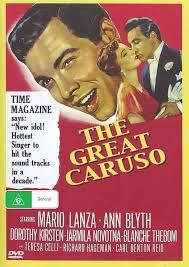
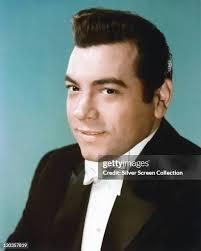
Mario Lanza, whose popularity straddled the 1940s and 1950s, was born Alfred Cocozza in 1921 in Philadelphia. The only child of Italian immigrants Antonio and Maria Lanza Cocozza, his professional name was a male form of his mother’s first name coupled with her maiden surname.
Lanza had hits in the pop field, including Because You’re Mine, The Loveliest Night of the Year and Be My Love but was best known for operatic arias and the film roles in which he sang them. He starred in eight movies, including Seven Hills of Rome, The Toast of New Orleans and the 1951 blockbuster, The Great Caruso, which was about his vocal idol, Enrico Caruso, and premiered to great fanfare in Radio City Music Hall. I was 12-years-old then, and among the thousands to see it there and to become a life-long fan.
Although Lanza was generally thought of as an opera singer—opera stars Luciano Pavarotti and Placido Domingo both claim to have been greatly influenced by him— he actually performed in only two operas. His fame came from Hollywood, where he was considered a leading man, and his recordings, where his powerful tenor was immortalized as among the best of the 20th century. Soprano Maria Callas, in fact, called him “the greatest tenor who ever lived.”
Like many classical singers Lanza had a knife-and-fork problem. He loved his Italian food, especially pasta. Frequently, he’d have to go on crash diets to get ready for a film. This affected his overall health.
Early in 1959 in Rome, where he was then living, Lanza fell ill with heart problems. In September of that year he entered Rome’s Valle Giulia Clinic, allegedly for the purpose of losing weight but on October 7 died unexpectedly of an apparent pulmonary embolism. He was 38.
Some suspected that there was a more sinister explanations to his death but none was ever proven. Lanza is buried in Holy Cross Cemetery, in Culver City, CA. Ironically, his last film, which also came out in 1959, was entitled For the First Time.
Lanza’s death was followed by additional family tragedies. His wife, Betty Hicks Lanza, died only five months later, largely of a broken heart. The Lanzas had four children and three of them died young.
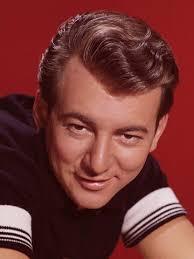
Bobby Darin, who was born Walden Cassotto in 1936 in Italian Harlem and raised in the Bronx, emerged in show business shortly after Lanza’s demise.
His tragedies started with birth. He was illegitimate. Furthermore, his father disappeared and Polly Walden, the woman he thought was his mother, was actually his grandmother, and Nina Cassotto, the woman he thought was his sister, was actually his mother. Darin didn’t learn these facts until 1968 when he was 32 … and they devastated him.
A multi-genre singer-songwriter, Darin had hits in the rock, jazz, gospel, folk, country and Sinatra-esque ballad fields from 1958 to 1973. Among them were Splish Splash, Dream Lover, Mack the Knife and his theme song, Beyond the Sea. He has been installed in both the Songwriters Hall of Fame and the Rock and Roll Hall of Fame.
Darin had a romance with another Italian-American singing star, Connie Francis (nee Concetta Franconero). It started when he wrote a song for her and was ended by Francis’ father, who intensely disliked Darin and came after him with a gun.
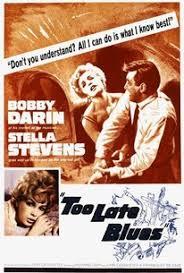
Darin made his mark in Hollywood, winning praise for his acting. Besides good notices as a newcomer in Come September, for which he won a Golden Globe Award, he received plaudits for roles in Too Late Blues and Pressure Point.
Darin’s life is currently being recounted on Broadway in the show Just in Time. Labeled a “jukebox musical,” it stars Tony Award winner Jonathan Groff as Darin. There was also a 2004 movie biopic, Beyond the Sea, that starred Kevin Spacey as Darin.
In 1960, Darin met Sandra Dee while both were in Rome filming Come September. They wed shortly after but the marriage was rocky from the start and they divorced seven years later. They had one son, Dodd Darin, who acted in several of his mother’s movies.
Unlike Columbo and Lanza, Darin always knew he was not going to be around long. Sickly as an infant, he had many childhood bouts of rheumatic fever. They left him with a weak heart. As an adult he often had to be administered oxygen before and after performances.
Darin had open heart surgery in 1971 and two years later it needed repairing. He had a six-hour operation in Los Angeles’ Cedar-Sinai Hospital but did not recover. He died Dec. 20, 1973, at the age of 37. According to his wishes his body was donated to the UCLA Medical Center for scientific research.
Columbo, Lanza and Darin gave the world tons of great music and many cinematic delights. But like all talented people who died young they left us to ponder the unanswerable question: What other gifts might they have given if they had lived longer? –BM
 John Mancini
I consider MYSELF TO BE FORTUNATE to have these great talents to be part of my love for music and films. They brought many moments of pleasure making lifes struggles easier to absorb. Grazie tante!
Our community had an inexhaustible supply of vocalists. Apparently, even a glass ceiling was permeable with a change of surname.
I always had great respect for Sinatra because he refused to change his name!
Colombo/Lanza/Darin, then Sinatra/Francis/Bennett. Modern Roman triumvirates all!
As for Darin: Like Tony Bennett, who was an accomplished watercolor painter as well as a great singer, he was also multi-talented, something which many Italic people often are (except one-trick pony mob actors). Darin played drums, piano, guitar, xylophone and harmonica; sang in many different styles–pop, rock, folk, and jazz; and was nominated for an Academy Award for Best Supporting Actor for Captain Newman, M.D. (1962).