
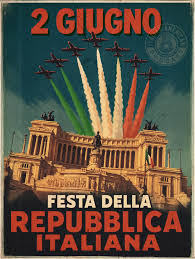
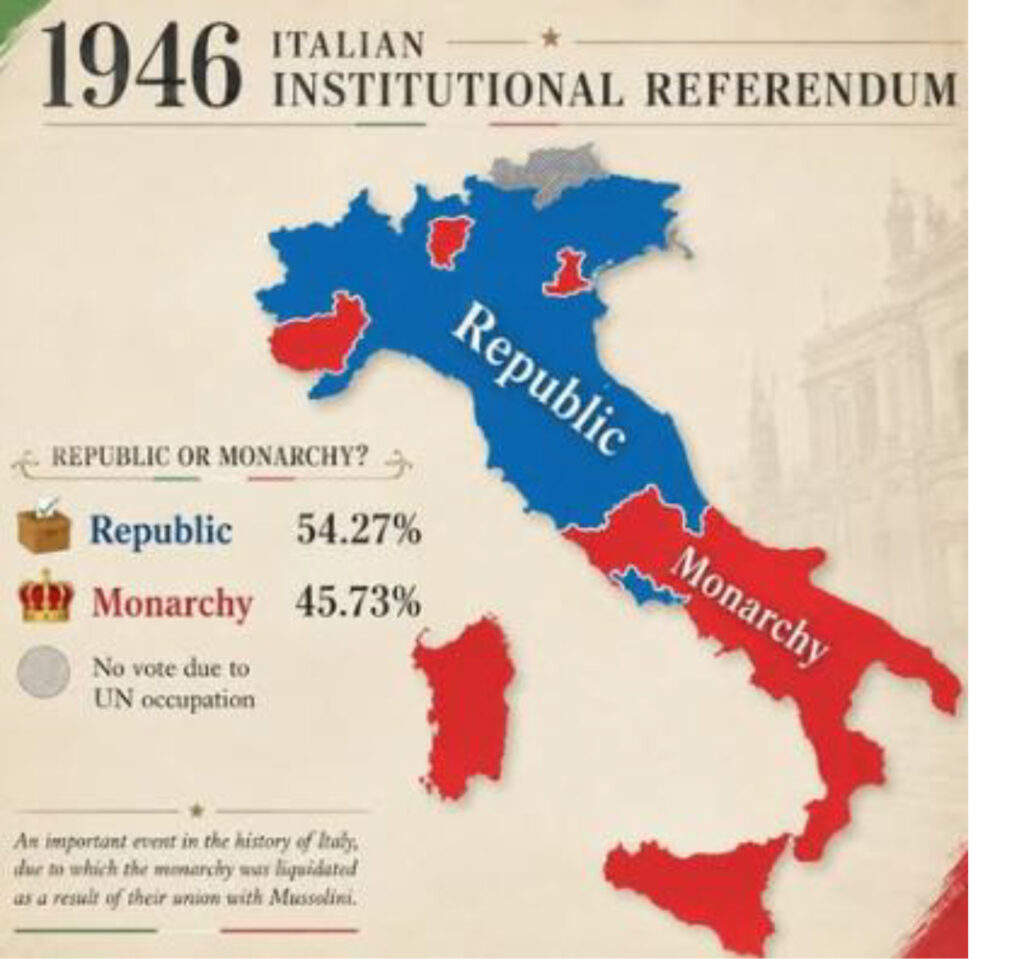
Today is a national holiday in Italy, la Festa della Repubblica, celebrating the referendum in 1946 that dumped the Savoy monarchy and made Italy a republic. It was a close vote—54% for a Republic, 46% for Monarchy—but not without irregularities.
Many Italian soldiers still stranded overseas did not vote. Also, Allied-occupied districts in the north did not vote as these territories were promised to Communist Yugoslavia. Still, 89% of registered Italian voters cast ballots.
The nation was split north and south with the southern regions opting for continuing the monarchy. Major southern cities were heavily monarchist: Rome 54% Naples 80%, Palermo (60%) Reggio Calabria (60%). This may be attributable to the innate conservativism of southerners and lobbying by the Church. More importantly, the Communist Party—which favored a republic that they could dominate—had an overwhelming presence in the north.
Not only were Communists more numerous in the north but they had been the most violent of partisans in those Fascist-held and German-occupied regions known as the Salò Republic during the war. In fact, they executed Mussolini despite an Allied order to save him for trial. Furthermore, an estimated 50,000 Fascists and family members were liquidated by them and their Yugoslav allies at war’s end. The Communist threat was an existential one in post-war Italy. The USSR was funding it.
Southern Italy was spared the German occupation, but the Allied one was just as humiliating, despite Allied propaganda to the contrary. Sophia Loren’s Two Women (1960) is closer to the truth. Moroccan troops raped extensively, uncontrolled by their French officers; British and American troops turned Naples into a brothel, and the Mafia was invited back to Sicily as Allied collaborators.
Southerners had every reason to resent the Savoys. It was the King who approved Mussolini’s decision to enter the war in 1940, with its horrific consequences—the deprivations, the bombings, and the murderous Allied invasions. It was he who botched Italy’s surrender in 1943 and opened the door to German occupation. Historically, the House of Savoy was blamed for crippling the south as a result of the reunification in 1860 onward—the new taxes, the military draft, the political suppression, and the pillage of the Bourbon (the previous rulers) treasury.
Perhaps all of this paled in the southern mind when compared to the chaos and Communism a new republic would usher in. Even before the referendum was certified Neapolitans stormed the Communist Party headquarters in that city exchanging gunfire with police. Nine demonstrators were killed, scores injured after two days of violence.
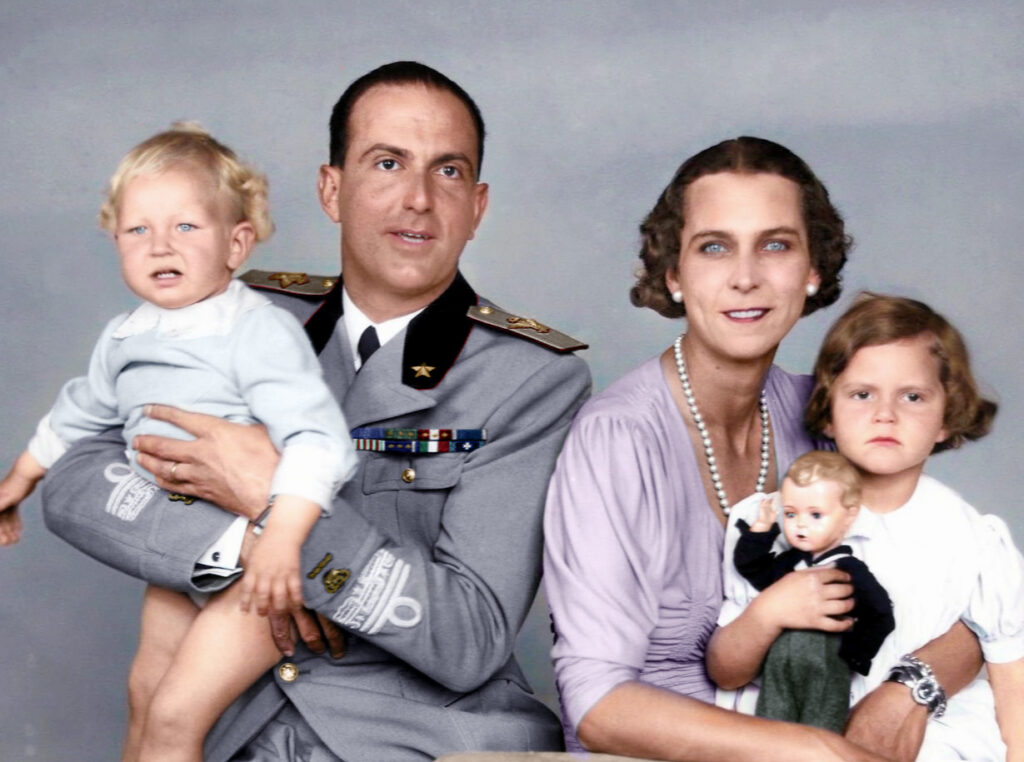
Such animosity hastened the need for a final certification of the referendum. To speed things up a provisional government proclaimed the republic on June 18th, before the mandatory judicial certification. The royal family, now led by King Umberto II, cried foul but abdicated rather than prolong the nation’s agony. Both the Italian flag had to be redesigned, without the Savoy coat of arms, and a new national anthem adopted to replace the Marcia Reale (Royal March).
The new Repubblica Italiana was in trouble from the start. Designed to have a weak executive (Prime Minister) so as to avoid another Mussolini, it was further weakened by a multiplicity of political parties. Italian governments fell regularly, making Italy the butt of many a joke. Its main objective was to keep the Communists from taking power. Eventually, this led to the Years of Lead (as in bullets) when the Red Brigades and right-wing reactionaries made Italy a battleground for twenty years (1968 – 1988). Communists fomented labor strikes that almost led to the collapse of FIAT until CEO Gianni Agnelli rallied his thousands of white-collar workers to counter the Communist threat.
The republic is now led by a center-right coalition with Giorgia Meloni as Prime Minister, and enjoying a period of calm coupled with economic prosperity. Italians have known the extremes of politics and always strive for a conservative path. One can wonder if monarchy had won out in 1946 would Italy have avoided the wrenching years that followed?
And might we be prouder if an Italian royal family represented our ancestral homeland? –JLM
 John Mancini
I think the trauma of ever having an “il duce”, paralyzed the country’s constitutional conventions to the point it diluted any strong central government when establishing a Republic. While there were many post war governments so many of them had a variation of a tenacious group of people who popped up and into and out of coalition governments.
As to Mussolini’s untimely end, the symbolism of his displayed death was at the site of many a partisan execution by “i fascisti” in Milano who were not nice people.. To some extent the brutality of the Italian Fascist was never truly acknowledged….compared to the Nazi at Nuremburg, or even the Vichy French. Post war history has moved on at record speed, so not sure how one can come to terms with the excesses of the war years. Whether elephants make love or fight , its the grass that suffers, and so it was for many “contadini”
The brutality of the Fascists during the Salo period was mainly due to independent bands of Fascists that teamed up with German SS units rather than Mussolini’s direct involvement. You can see our research on that subject in our Italy and the Holocaust report. What needs more light to be shed on is the Communist Party’s role in atrocities and destabilizing the republic after the war.
As far as designing a weak government, the French had the same problem which DeGaulle rectified with the Fifth Republic. Italy is still working on republic #1.
In a documentary aired on Italian television, alleges that Mussolini was not killed by Italian partisans, but by secret agents acting on orders of Churchill. It was long suspected that Churchill ordered-the assassination of Benito Mussolini in 1945 to prevent the secret correspondence to come to light. These letters were offering Mussolini a separate agreement to end the war in defiance of FDR‘s Casablanca agreement.
That’s an old story and there is even a book with correspondence between Mussolini and Churchill you can buy on Amazon. But the evidence is overwhelming that the Communists wanted Mussolini dead so he would not be around for their postwar takeover. The order came from the leader Togliatti while still in the USSR. The depth of Togliatti’s hatred for Fascists included letting Italian prisoners of war in Russia suffer horribly to foment revolution in Italy. He refused to intercede with Stalin for their better treatment.