
Part of our mission at the Italic Institute is to monitor the various media – TV, movies, newspapers, books, et al. But watching television doesn’t mean being glued to the screen all day. Cable service comes with recording features that eliminate countless hours of commercials.

Just this week the Nicole Kidman movie To Die For was on cable, not a frequent event. My colleague Bill Dal Cerro highlights this movie in his groundbreaking Film Study—a well documented indictment of Hollywood’s anti-Italian bias. In the 1995 film, To Die For, based on the true story of Pamela Smart. Nicole Kidman’s character tricks three teens into killing her low-brow Italian husband whose family gets even by hiring a mobster to kill her (surprise!). In real-life, however, the only Italians involved in the case were Pamela Smart’s defense attorney Mark Sisti and the two New Hampshire state prosecutors, Paul Maggiotto and Diane Nicolosi, who convicted the murderess to a life sentence. This film is a typical example of how the facts of real-life incidents are often distorted or misinterpreted to put a “negative” spin on Italian Americans. (Bill’s Film Study is available in our Research Library (www.italic.org)
We all know how the media and academia have butchered Christopher Columbus’s reputation. Long-time subscriber Lina Cernigliaro wrote me this week about a YouTube video on Columbus she felt corrected the historic record and suggesting that it be utilized to educate misguided Americans. Unfortunately, we can’t force schools or the general public to watch such videos. A major drawback of this particular one is that it was produced by the Epoch Times, a very conservative media group founded by the quasi-religious Falun Gong, anti-Communist emigres from Red China. However historically accurate this source is not generally respected.
Around June’s D-Day commemoration, cable television had a slew of World War II documentaries. Viewers would be hard-pressed to find anything about the Italian armed forces during that struggle. They might see Mussolini ranting on a balcony but nary a mention of how Italy lost over 300,000 servicemen. (Compare this to the British who lost 264,000 from their home islands). North Africa is always about Rommel and his panzers, even though 2/3s of his army were Italians. The word Axis is mentioned but maps only show swastikas. I can safely say that Italy has been written off as a combatant in new documentaries of the Second World War. Forget the horrors of the Eastern Front where Italian troops served heroically or the Atlantic where Italian submarines sunk a million tons of shipping, or how Italy lost its entire merchant fleet in supplying Axis forces in the Mediterranean. Likewise, Holocaust documentaries skip over Italian Army rescues of Jews in the Balkans and France. In short, Italy has been expunged.
The story is no better for the thousands of Italian Americans evicted from the coastal suburbs of San Francisco in 1942. Neither documentaries on the Japanese internment nor public museums even mention the 6-month exile or the wholesale confiscation of the Italic fishing fleet. The U.S. Congress has yet to apologize for the maltreatment or has allocated any funds for a film on the subject. Our attempt in 2000 to steer some of the Japanese reparations money for a film met little sympathy. Our community had to memorialize the shameful episode among ourselves as “La Storia Segreta.” Secret, indeed!
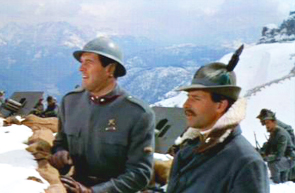
The brutal war in the Italian Alps
Some years ago, we reported on a high school textbook in Yonkers, NY that contained a pie chart of Allied forces engaged in the First World War. Italy was missing on the chart despite losing 650,000 soldiers in defeating Germany, Austria and Hungary. If it weren’t for Hemingway’s Farewell to Arms, few Americans would even know that Italy was in that war and on our side.
Disheartening as it was for Italy to fight alongside Nazi Germany, to be counted out as a combatant in the world’s worst conflict or portrayed as mass surrender artists distorts and insults an entire nation. I have always believed that the propaganda image of Italians in the Second World War had a direct bearing on the rise of mafiosi as “men of honor” among Italian Americans like Mario Puzo and his ilk. -JLM



It all adds to the invaluable importance of sites such as the Italic Institute as a counter source and or network of information, particularly if it’s well documented and accessible. A major problem with the generalities floating around is that they then tend to discredit legitimate history as well as turn people off about “drilling down” into the story.
The other part of this misinformation is, its USA-centric. I know every nation skews their history, but from my travels, Italian history takes on a different meaning outside of the USA, as I might add, do all sorts of national viewpoints.
Yet given the unique nature of American history, from slavery, Native American subjugation, to westward expansion, the contribution of immigrant groups from the 1850’s on to the building of the nation, is extremely ambivalent. At times it does not fit well into national myth-building, which is still very much WASPish and Puritan based. And once you deviate from that norm, you open up Pandora’s box. The more assimilated you become the more you go with the program. Also, it does take “work and curiosity” to move beyond the stereotypes.
This past Sunday, CBS This Morning did a segment on the Statue of Liberty, noting how the “mass migrations” of the late 1880s gave the monument its iconic status as a symbol of freedom. Ironically, these new immigrants were anything but lovingly welcomed; with their different religions (Catholic, Jewish, some Muslim) and their eccentric ways (from food to family-raising), they were seen as a threat to the purity of WASP America, though that same America was eager to exploit their labor skills.
Mo Rocca, the interviewer, said that many Americans at the time “didn’t think that Italians would ever assimilate.” The Asian American woman agreed, then switched over to her own story about how now, as a second-generation immigrant, the future stories of her own family life would be “American” ones, not Chinese ones.
Sadly, Rocca wasn’t savvy enough to note that Italians have yet to assimilate into a very important part of American life: popular culture. Over 100 years later, Italian Americans are STILL being portrayed as bad Americans–i.e., morons and mobsters.
Our success stories–so positive and overwhelming–remain largely unknown or celebrated. Non-Italians continue to identify a (fictional!) mob boss as our symbol.
And, of course, one of the most famous images in American movie history is the shot of a young Vito Corleone looking at the Statue of Liberty as his ship pulls up to Ellis Island. The message is not subtle: Italians brought crime/violence to America.
We are not the American Dream but the American Nightmare–the evil people. Don Vito’s success is tainted from the start, and he’s more “cunning” than “admirable.”
Tell that to A.P. Giannini (Bank of America), Antonio Pasin (Radio Flyer Red Wagon), the Iacuzzi family in California (Jacuzzi), Anthony Rossi (Tropicana Orange Juice), and
Amadeo Obici (Planter’s Peanuts). These business giants exuded honesty and grit.
And, similarly, the millions (indeed, millions: Italians were the largest wave of immigrants over a century ago) of struggling newcomers exhibited the same traits.
Another topic that has been written off is the Allies’ bombing of Italian cities. People know about Coventry , Dresden and Tokyo but do not appear to know that the Allies bombed Italy causing thousand of deaths among civilians and the destruction of Italian cultural and artistic heritage.
That is the reason why Milan, for example, has a more “modern” vibe compared to other Italian cities. Consider that during one raid on Milan the Milan cathedral (Duomo) was designated as the ‘aiming point’ for the area bombing.
Citing Cornell professor Matthew Evangelista:” During the period when Italy was allied to Nazi Germany, and before the United States entered the war, it was the British Royal Air Force that determined the bombing strategy. Prime Minister Winston Churchill and his advisers favored what they called “dehousing” – attacking war-producing facilities in the main industrial cities, but at the same time destroying civilian apartment buildings nearby. The idea was to demoralize the working class as the most likely opponents of the fascist leader Benito Mussolini by killing and wounding and rendering them homeless”.
One of the worst massacre was the one in Gorla (Milan) in 1944 . The Allies bombed a school killing 184 children.