
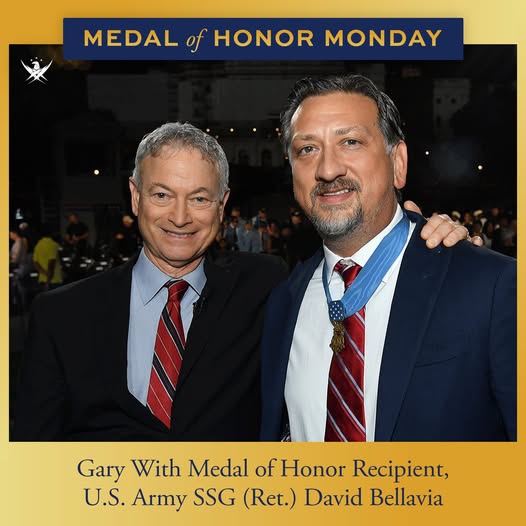
There have been 25 Medal of Honor winners with Italian roots. The most recent one is David Bellavia of Buffalo, NY. He’s been honored at the White House by President Trump and by the Gary Sinise Foundation, a nonprofit for veterans, launched by that Italian American actor in 2011. As far as I know, none of our national organizations has honored Staff Sergeant David Bellavia. (Can he sell tables?)
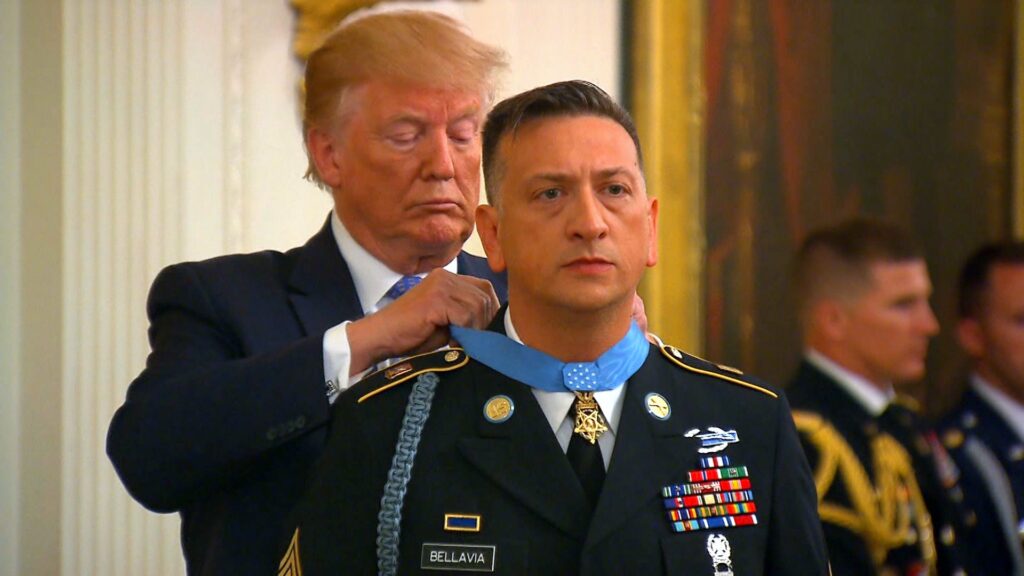
Bellavia won his prestigious award during the Second Battle of Fallujah in Iraq. The details of his heroism would be enough to cause anyone debilitating Post Traumatic Stress Disorder. Yet, he has thrown himself into local politics, public speaking, and frequent appearances on FOX News opining on the current Iran conflict.
You can catch him on YouTube addressing a VFW convention in 2024 (link below) and marvel at his remarkable extemporaneous speaking ability and sense of humor. His patriotism and belief in the leveling of society within the U.S. military is reassuring in this time of extreme partisanship. His sociable demeanor leaves one wondering how he became a killing machine during the hell-hole of Fallujah.
In 2004, on his 29th birthday, Bellavia was a squad leader conducting a house-to-house search for insurgents. Within minutes of entering one house, he shot and killed three insurgents and stabbed another to death. In a final act, to allow his squad members to escape the house unharmed, Bellavia wounded a fifth insurgent causing him to fall from the roof. This is literally hand-to-hand combat, the ultimate test of the infantryman.
His heroic acts were witnessed by an Australian journalist embedded with his platoon and later depicted on the History Channel in 2006. The following year, Bellavia published his memoir, which was chosen one of the best five Iraq War accounts. In 2012, he signed an agreement for the movie rights which apparently never went beyond the “development” stage.
It’s been the sad history of our community that the cinema rarely captures our heroic side; or when it does, it has little impact on our image. We are certainly grateful to Angelina Jolie for documenting in the feature film Unbroken the grit of Lt. Louie Zamperini, the airman who suffered and survived Japanese imprisonment during the Second World War. But the lead was played by an Irish actor. It was a box office success, earning $163 million worldwide, but it didn’t achieve the ethnic flavor that negative portrayals seem to wallow in. The only ethnic quote I can remember in Unbroken is about Louie loving his mother’s gnocchi.
If you recall, in the The Godfather Michael Corleone is a “war hero.” He is introduced to us wearing his Marine uniform at a wedding in the opening scene. Even online, this fictional character is treated like a real person: fought in the Pacific, wounded, awarded the Silver Star. His killer instinct is further enhanced when brother Sonny eggs it on with the challenge to avenge his father’s ambush: “What? You think you’re going to shoot them from a mile away, like in the military? No, you gotta get up close and go badda bing! getting the blood all over your nice Ivy League suit!” (More cinematic Mafia valor.)
The 2005 movie The Great Raid depicted the true-life rescue of 500 American prisoners in Japanese-occupied Philippines led by Col. Henry Mucci. Zero ethnic reference; and Mucci is played by an Anglo-Peruvian/Inca actor.
If ever the David Bellavia story is made, it will be an Italian American one. He learned honor and duty at his maternal grandfather’s lap. Joseph Brunacini was a World War II Army veteran who served in the Normandy Campaign. His combat stories inculcated a sense of duty in his grandson and encouraged him to enlist.
Such a movie would have an interesting sidebar on nonno Joseph. Married for over 67 years and fathering 13 children—including David’s mother Marilyn—he lived to age 104, long enough to see his grandson receive the Medal of Honor. Now, that’s a Hollywood scene!
I would suggest that David’s grandmother earned a medal for pregnancies beyond the call of duty. –JLM
 John Mancini
To add insult to injury the cinema will use a noble Italian character and give him a non-Italic surname. The one that has always irked me the most was the uber-conscientious lawyer in “And Justice For All” played by Al Pacino (1979). They assigned him the name of Arthur Kirkland and for an extra punch casted his acting coach and “Godfather” Jewish gangster Hyman Roth to play his always infirmed father. I’m not sanguine that the film industry could ever polish our tarnished history on their part, but this could have been a formidable plus.
JOE: Al Pacino also played “Mayor Pappas,” the Greek American mayor of New York in the 1996 film City Hall. The what? Greek American mayor of NY? Exactly. They never had one!
More infuriating: The mayor at the time of the film’s release was Rudy Giuliani, who was doing an excellent job of cleaning up the city for tourists–a legacy still holding today.
As if this diss wasn’t enough, an African American child is gunned down in the streets at the beginning of the film—not by gangbangers (the reality) but by a fictional dago thug.
Danny Aiello also played a corrupt It Am politician–though he was based on a non-Italian American one (I won’t specify the ethnicity so as not to be called an anti-Semite).
Yet the vast majority of Italian Americans who attend big galas never notice, and certainly don’t think about, these Hollywood distortions. And this is why they continue in 2026,.