
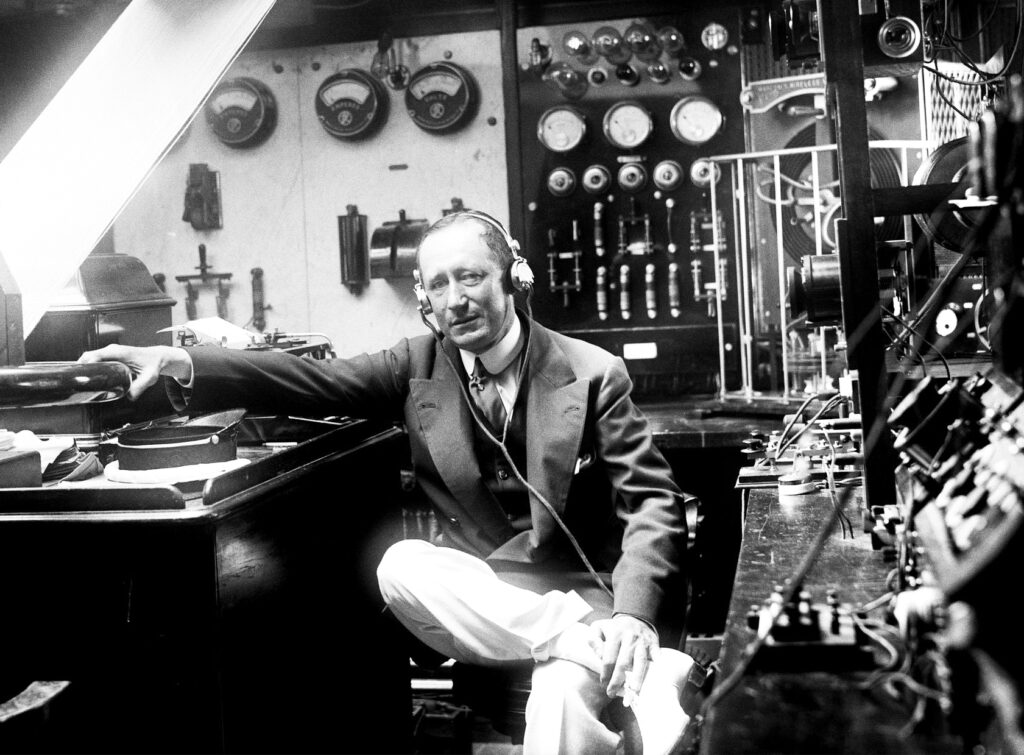
December was a lucky month for inventor Guglielmo Marconi. On 12 December 1901 he proved that wireless transmission—what we call Wi-Fi today—was possible across long distances. What’s more, he demonstrated that despite the curvature of the Earth wireless signals didn’t need flat line-of-sight transmitters and receivers. Marconi’s receiver was located on Newfoundland that day and received signals from his associates transmitting from England, 2,000 miles away or 4 time zones.
Skeptics claimed the signals were faint and questionable, so Marconi built a stronger transmitter on Nova Scotia sending a message to England on 17 December 1902. The skeptics conceded. From then on, the inventor’s fledgling Marconi Company expanded into ship-to-shore and ship-to-ship communication. The radio operators on the Titanic worked for Marconi not the White Star Line. That disaster in 1912 and the survival of hundreds of passengers because of his wireless made Marconi a superstar… and richer.
Lately, there has been a resurgence of Nikola Tesla’s claim to the invention of wireless transmission. They cite his early patents for equipment that Marconi incorporated in his own transmitters. Perhaps we should apply the Meucci “Rule” to these revisionists. Inventor Antonio Meucci was denied credit for inventing the telephone by powerful forces allied to Alexander Graham Bell. In fairness, Tesla so too lost the race to wireless.
Marconi’s development of wi-fi is just one of many lasting contributions attributable to the Italic people. From the republican form of government to nuclear energy there are so many things in between that elevated humanity and made quantitative leaps in the pursuit of happiness. Italians may not have invented the light bulb or air conditioning, but the birth of Western Civilization and the opening of the Americas are nothing to sneeze at. Would the world be the same without the Renaissance or Galileo’s “scientific method?” Would Christianity have flowered without the Roman Empire? When you think about it, very little about our modern world would exist without Italy.
The Scottish people pride themselves on their inventive contributions from the steam engine (Newcomen and Watt) to capitalism (Adam Smith) and the telephone (Bell again!). No question the Scots made Britain great and America strong. They know it and they make sure their children know it through their annual Highland Games and the Presbyterian church (Donald Trump was raised Presbyterian by his Scottish mother). Not so our people.
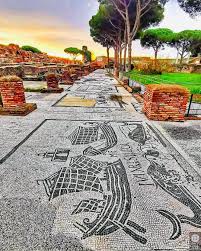
Forum of Corporations,
Ostia, Italy
Were we to quiz Italian Americans on the deeds of a few historical names like Caesar Augustus, Marco Polo, Galileo, Columbus, Garibaldi, and Fermi, the results would be disappointing. Our heritage is far too complex for the average person – I venture to say that there is not a single decade in the last 2,500 years of world history during which an Italian has not made a mark.
Adam Smith indeed wrote the book on capitalism (The Wealth of Nations, in 1776) but the Romans were perfecting it two millennia before. At Ostia, the port of ancient Rome, one can stand in the Forum of the Corporations, a place where the commerce of the Empire was centralized. Here you could secure shipping, import elephants for the arena, export Italian products across the Mediterranean, buy marine insurance, or shares in business ventures. These skills were passed on to the Italian city-states after the fall of Rome, continuing Italian dominance in trade throughout the Middle Ages and onto Columbus.
In science, there is also a straight line from Roman engineering and the Calabrian mathematician Pythagoras and the Sicilian genius Archimedes to da Vinci and Galileo, eventually producing Enrico Fermi, Father of the Nuclear Age, and Guglielmo Marconi.
It’s sad that our legacy has been boiled down to cuisine and fictional movies when so much else elevates our heritage. Of course, it is our own fault for not understanding where we came from. –JLM



To put some flesh on your already powerful bone-words, I had the great pleasure of visiting Ostia a decade ago. It’s fairly amazingly well-preserved. And the first thing that greeted me were air breezes from the ocean not too far away. Ostia, like Pisa and Amalfi and Genoa and Venice, benefited from being close to the sea via trading.
When you see those gigantic, modern tankers pulling into various US ports, all they are missing are the letters SQPR (from classical Rome) on their sides.
The roads, as well as the seas, all lead to Rome.
So, does anyone have a suggestion on how to educate & instill pride in fellow first, second etc. generations of Italians on the history, culture and scientific achievements that Italians gave to present day society or will our legacy be only pizza and Capone?
Our Institute tried to direct young minds to the proper heritage with our Aurora Youth Program some years ago. Watch the video on our homepage (italic.org) in the Galleria section. Unfortunately, none of the national organizations contributed to that effort and we had to shut it down. The short answer to your question is NO, the future generations are on their own and will be shaped by intermarriage and the media. The only way to inculcate youth is with a proprietary religion like Jews, Greeks, Hindus, Moslems et al. Only mandatory instruction that combines religion with ethnic identification can introduce knowledge onto succeeding generations. Catholicism actually denies Italians their classical legacy because we were pagans and considered enemies of the Church, even though the Church inherited the Roman Empire and all its wealth and structure.
Back in the 1940’s trying to instill pride and awareness of Italian heritage, an Italian social club funded 2 statues, through publics subscriptions, meaning no public money, just donations in San Jose….one being Columbus and the other Marconi. The grandson of one of the members of that org, became mayor of San Jose…..and part of the group that removed the Columbus statue from city hall……in addition for some unknown reason, i think citing remodeling, the Marconi statue did not fit the decor of a new library , so as an Italian American Organization we became the recipient of both statues. Really no debate or public discussion. Pretty sad observation, especially in light of your post, of which , as an org will try to have some sort of write up associated with the statue…..This blog will be very helpful to at least educate those who come into our foundation.