
Today marks the anniversary of Garibaldi’s landing in Bourbon Sicily in 1860 with his 1,000 Redshirts.
That bold adventure led to the addition of southern Italy and Sicily to what would become the Kingdom of Italy nine months later. It was a remarkable course of events that reassembled Roman Italy within the amazing span of only eleven years (1859 – 1870). Italy had been fragmented for 1,400 years after the fall of the Empire—invaded and occupied by foreign powers, divided into city-states, ruled as theocracies by popes and Muslims, pillaged by pirates and Turks—yet born again in a decade. I would call that miraculous.
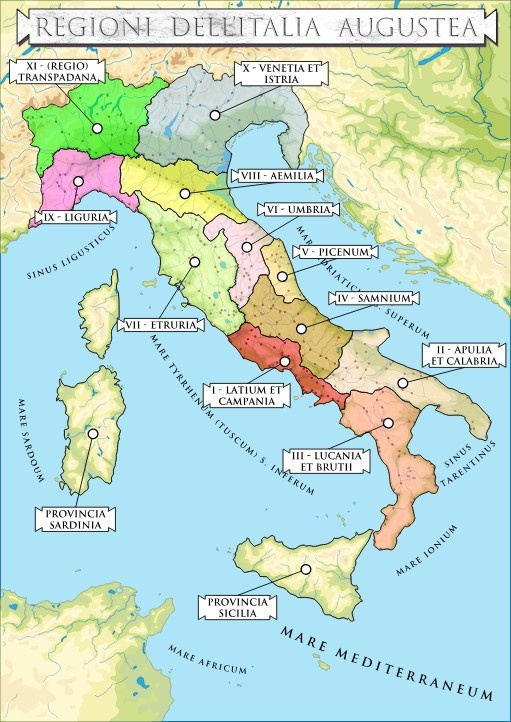
Regionalism still abounds in Italy as it does in every nation under the sun, the Romans recognized that in the five centuries it took them to unify the peninsula. Check out the map (right) to see how Emperor Augustus organized Roman Italy into administrative regions, based on ethnic and geographic realities. Those regions still exist! But so does the unified Italy that Rome created.
It often pains me to hear educated Italian Americans speak of Italy as a “young” nation or how glorious Sicily was under Islamic rule, or how the Romans were “invaders.” Do these people seriously believe that Garibaldi and the men of the Risorgimento invented “Italy?” Look at the word, it means “rising again.” We know the very day the Romans marked the first unification of Italy—from Sicily to the Alps—on 1 March 222 B.C. We know when all free male inhabitants of Italy became Roman citizens: 87 B.C. We know that Rome, as a city, could never achieve an empire and hold it for 500 years without a pool of 6 million “Italians” manning its legions or colonizing three continents.
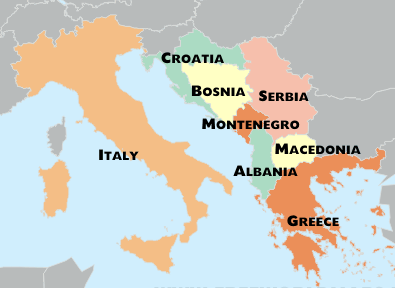
Those who extol the collapse of Rome and foreign occupation would do well to understand the consequences. Italy was fortunate in being Roman Catholic at the fall of the empire. The popes were given much civic power by the Roman emperors before they relocated to Constantinople. It was also “fortunate” that the 1,400 years of invasions that followed were carried out by pagans or fellow Catholic countries. Witness the Balkan peninsula (right), adjacent to Italy. Nine small countries divided by four major ethnic groups, innumerable sub-groups, and five religions, all barely coexisting. Their good ole days were under Roman rule.
Can you imagine what Sicily and southern Italy would be like today had Islamic rule in Sicily continued and spread? Name one Islamic country today that you would live in. Indeed, Islam had a 200-year period of enlightenment, which coincides with the occupation of Sicily, but it did not last. Thankfully, the popes urged the Normans to retake the island for Christianity. It had already been Romanized with colonies of Italic veterans by Augustus beginning in 36 B.C.
Another Mediterranean land that underwent historic trauma is the Iberian Peninsula. Unified under the Romans, who first planted war veterans in a colony still named Italica, this peninsula was later conquered by North African Muslims. It took 700 years to reconquer it for Latin Spain and Christianity. Although still Catholic, it contains two separate nations with their own languages (Portugal and Spain) and essentially four cultures, if you count the troublesome Basque and Catalan regions.
Be thankful that what Rome put together survived despite all the ensuing turmoil of history. Stand in awe that during those 56 generations since the fall of Rome, a handful of Italic people like Giuseppe Garibaldi remembered that Italy was one, and said so: “Rome…was the dominant thought and inspiration of my whole life.” –JLM
[I want to thank my colleague Joseph Graziose for suggesting the subject and providing the regional map for me.]



Well done tapestry, and such a rich account of our heritage…and also a tribute to the thinkers and visionaries who in spite of such horrific obstacles they endured ….somehow manage to recreate the Italy we know today. “Fratelli d’Italia” as the national hymn goes….
Thank you for this article. A neccessary read for any Italofile, friends and family .