
Among the traits we inherited from our Roman ancestors was a grasp of reality. It’s not always pretty but it has made us a very pragmatic people.
We don’t often mince words or suffer fools. It may be linked to our peasant roots; rose-colored glasses don’t keep the farm going or bring in more fish. In truth, the early Romans were peasants before they become decadent. Their values were based on hard necessity: Simplicity (frugalitas), Responsibility (gravitas), Hard work (industria), Respect (pietas), and Pride (dignitas). Those traits won them an empire and were reflected in their art.
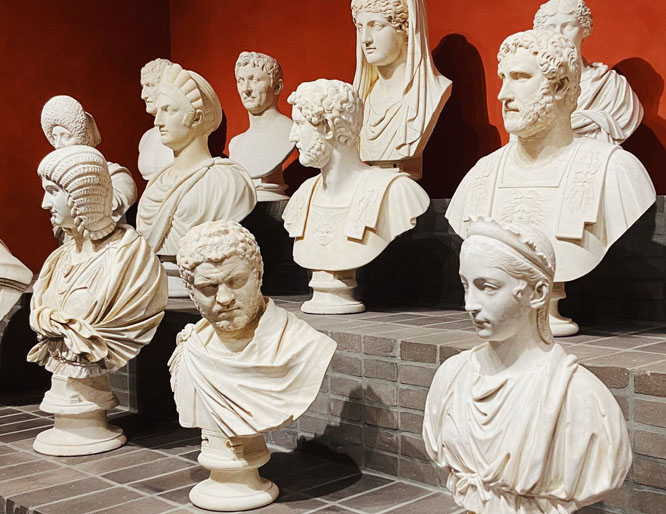
Currently touring the U.S. is the Torlonia Collection, sculptures and stone reliefs assembled by Prince Giovanni Torlonia in the 19th Century. It was a private collection that went into storage with the Second World War, not to be seen in public until 2020. (The Torlonia Family were bankers who handled the Vatican’s investments. They loaned their palace, Villa Torlonia, in Rome to Mussolini for the dictator’s family residence.)
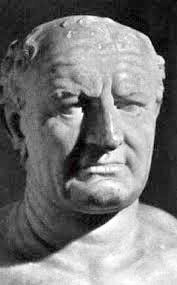
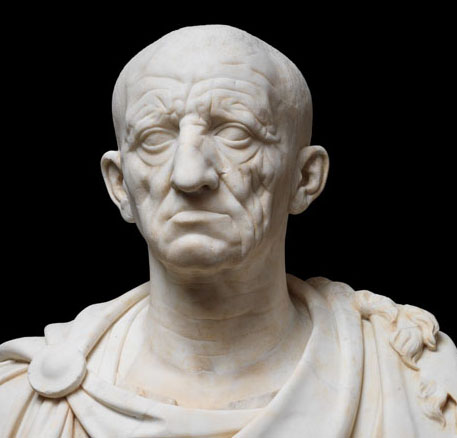
While much credit goes to classical Greece for sculpture, it is generally conceded that the Romans contributed two major changes to the Greek way. The most significant was portrait sculpture, busts of actual people with warts and all. The Greeks embraced the ideal rather than the reality. Their figures were aimed at beauty and perfection, not real life.
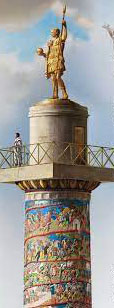
The second change was telling real life stories, not just myths, in sculpted reliefs. The clearest example of this is Trajan’s Column in Rome. Sculpted and painted to tell the story of Emperor Trajan’s conquest of Dacia (modern Romania) this column still stands. One hundred-twenty-five feet tall, a sculpted story spirals around the column for 800 feet. There must have been a spiral observation deck built around it for visitors to ascend and view the whole campaign in vivid color.
Trajan was a tough military man, like many of the emperors. One of the Torlonia busts can intimidate today with its austere visage. Labeled The Old Man of Otricoli, it is assumed to be Emperor Servius Sulpicius Galba who only ruled for a few months. If you ever wonder how the ancient Italic people conquered and held an empire for 500 years, just look at that face. He was probably 72-years-old at the time of this sitting, but someone must have overcooked his macaroni. That’s an Italian look!
His successor Flavius Vespasian Sabinus was the general who put down the Jewish rebellion in Judea and built the Colosseum with the spoils. Vespasian was the epitome of Italian pragmatism. He famously sold urine from Rome’s public toilets to laundries and tanneries (urine was valuable for its ammonia content). When Vespasian’s son Titus complained about the dirty business, Vespasian informed him that pecunia non olet (“money doesn’t smell).
So famous was this quote that in the 19th Century, Paris installed some 1,200 public urinals and nicknamed them les Vespasiennes. Some survived into the 20th Century.
The emperor would have been proud. -JLM



Excelsior! And here’s a quote from Cicero, from which a majority of Italian Americans could benefit if they took it to heart: “A room without books is like a body without a soul.”