
It’s been nearly a year since a papal conclave elected a new pope: Cardinal Robert Prevost—from Chicago, no less. Both of his grandfathers were Italian.
The Italic Institute of America had its own informal conclave recently at Grotta Azzurra Ristorante on New York’s Mulberry Street. Actually, it was a friendly luncheon with many of the board members. Myself and another Chicagoan, local podcaster and community activist Frank DiPiero, also attended.
In addition to getting a Vanguard Award from our chairman, John Mancini, DiPiero shared the table with two other honorees: filmmaker Frank Vitale and IIA Concert Band manager Frank Cardone. Yes, “the three Franks,” a nod to the Three Tenors. No witty pun ever escapes the nimble minds of our board members.
The other attendees included Rosario Iaconis, Tony Vecchione, Al Cardone (Frank’s brother) and Joe Graziose. A fine time was had by all. Salute!
This wasn’t Frank DiPiero’s first time in New York, nor mine, but both of us made it our mission to do what many Italian Americans, alas, do not do: actively scout examples of the Italic heritage. They’re literally all around us, no matter which city you visit. The trick is to care and make an effort.
To save money, we booked a hotel on Staten Island, where examples of the fine Italian hand were on display.
There was food, of course, represented by a night at Joe and Pat’s Pizzeria and Restaurant, open since 1960. Pizza was top-notch, and the restaurant was the nicest-looking place in an otherwise so-so neighborhood. It wasn’t a ghetto, but it did fit the New York stereotype of “shoddy” Staten Island.
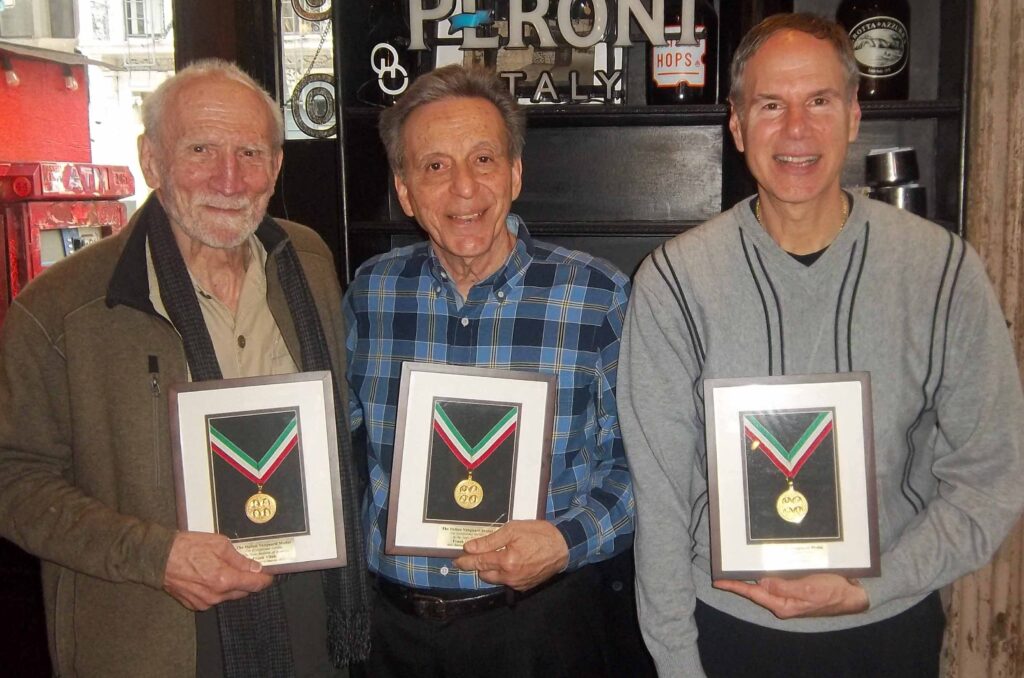
Frank Vitale (Film production), Frank Cardone (Concert Band),
Frank DiPiero (Podcast & YouTube Minutes)
With pizza out of the way, there were way more substantive places to experience.
First, we drove to the Our Lady of Mt. Carmel Grotto, recognized as a National Historic Landmark in 2000. Begun in 1937 by Vito Russo, he and fellow Italian immigrants sought to build a shrine honoring Mary, the mother of God. As Simon Rodia did with his amazing Watts Towers in Los Angeles, Russo and crew used shards of local materials—rocks, pebbles, brick, small statues—to create a coherent whole, a piece of folk art for the ages.
We then went to Casa Belvedere, a restored Italianite mansion way at the top of Staten Island, used for events, lectures, language and art classes, etc. The area itself was not the New York stereotype of Staten Island; it’s a pristine piece of real estate dotted with beautiful, old-money mansions. Think of Jay Gatsby’s party province on Long Island, but located in a NYC borough. The manicured grounds and elegant rooms were highlights, not to mention the views of Manhattan on a good day. There was also an Enrico Caruso Museum, featuring items donated to the Casa by the late collector Aldo Mancusi.
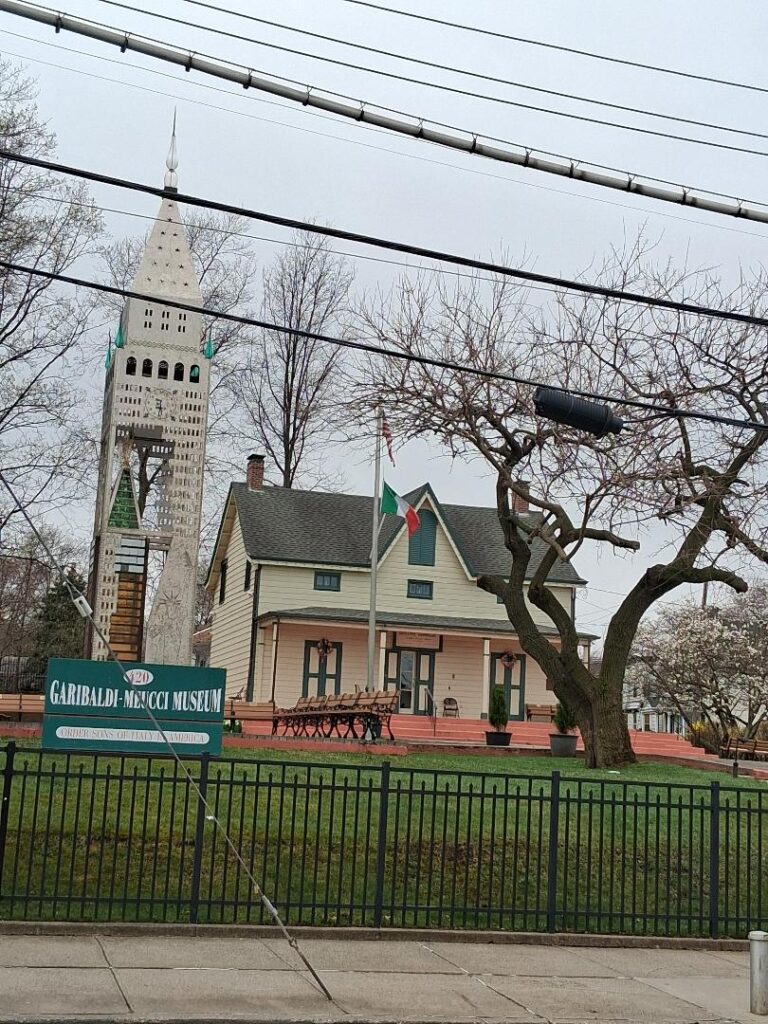
Driving back down the serpentine streets around Casa Belvedere, we stopped at the Garibaldi-Meucci Museum, honoring the unofficial creator of the telephone Antonio Meucci and his good friend, the Italian freedom fighter Giuseppe Garibaldi, who stayed with Meucci for a few months in-between his attempts to reunify Italy. The museum has paraphernalia of both historical figures, from one of Garibaldi’s stained red-shirts, which he wore in battle, to sketches of Meucci’s ‘telettrofono.’ I learned something I hadn’t known before: though the house is original (Meucci bought it in 1850) its original location was around the block. It was physically moved decades later. In mid-April of 2026, official streets signs honoring the men will be installed.
Next up was a surprise bonus: the tour guide at the museum informed us that a statue of Father Vince Capodanno, a Staten Island native and Medal of Honor winner (killed in Vietnam), was located just a mile away on the grounds of Fort Wadsworth. Off we went in our rental car (Toyota Corolla) and there it was—an impressive bronze statue of the Catholic priest, also known as the “Grunt Padre,” “ministering to a dying soldier on the battlefield.” Fr. Capodanno’s cause for sainthood is currently in review.
As for our day trips to Manhattan via the Staten Island Ferry, plenty to see there, too.
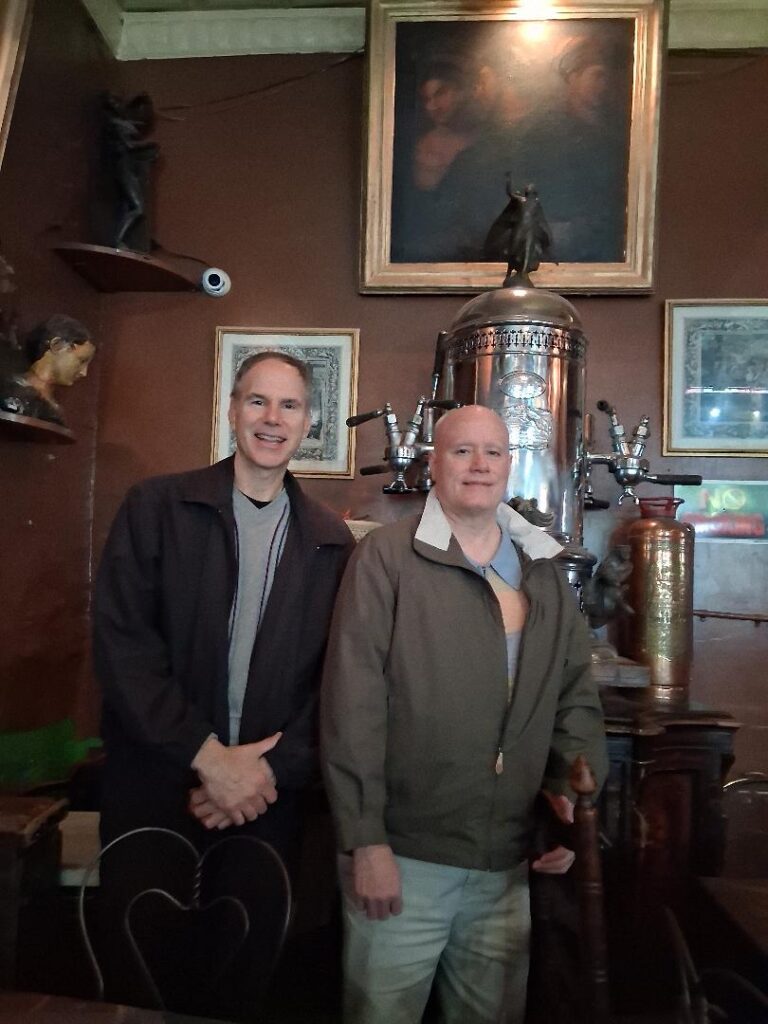
Before the conclave, Frank and I had breakfast at Caffe Reggio, opened in 1927 in Greenwich Village. A favorite of regular folk as well as filmmakers (Shaft, Next Stop, Greenwich Village), Caffe Reggio was the first place to serve cappuccinos in America. Its old-school machine is a selfie magnet.
We walked off our caffe and cornetti by visiting LaGuardia Plaza, featuring a statue of the city’s greatest mayor. Before you get there, though, you have to walk through famous Washington Square, where a towering statue of Giuseppe Garibaldi resides. It’s a nice Italy/Italian American linkage.
We took a tour of St. Patrick’s Cathedral, which is about as historically Irish as you can get. Yet why is it so beautiful? Carrara marble everywhere.
And walking past the New York Public Library afterward, we stopped and saw its famous lion statues, carved by the Piccirilli brothers of the Bronx.
That was a lot to see in two-and-a-half days. The point is that, as with the famous saying of Rome, “una vita non e basta” (a lifetime isn’t enough).
Imagine how much more Italic genius you can find on a longer trip. It’s up to you, dear readers. Andiamo! –BDC
 John Mancini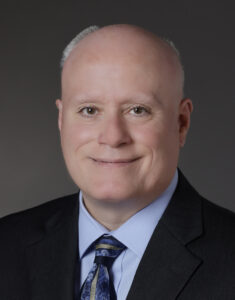
Recent Comments