
It was a Roman who penned the words everyone should live by: Mens Sana in Corpore Sano (“A sound mind in a healthy body”). The Greeks invented the 4-year Olympics but the Romans made sports a daily competition. When Italic settlers colonized Europe and the Mediterranean one of the first things they did was to build an amphitheater.
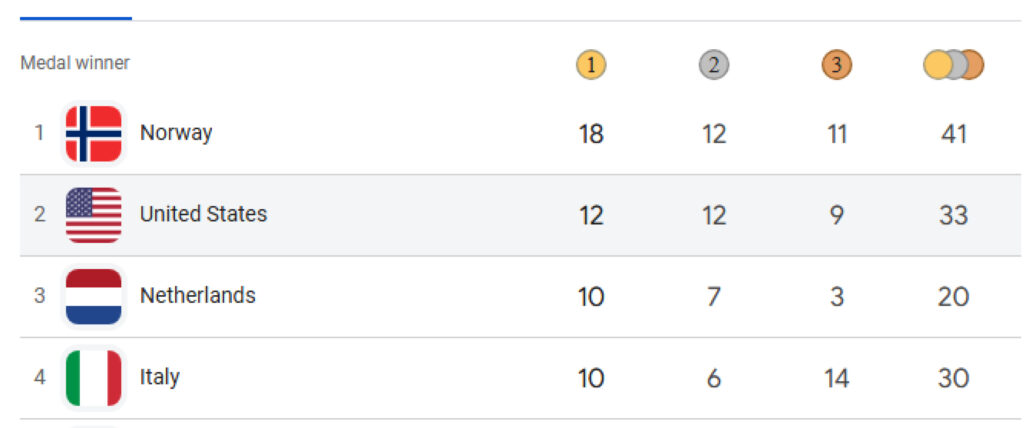
Now that the Winter Olympics of 2026 is history the medal count may surprise many people who rarely associate sunny Italy with snow and ice. Italian competitors earned #3 place in the medal count, after Norwegians and Americans. So, I was a little puzzled when I Googled “medal count” and found the Netherlands in 3rd place and Italy 4th. That listing (right) seems to be ranked by Gold and Silver medals not total medals. Italy and the Netherlands each earned 10 Golds, but the Netherlands one extra Silver. However, the Italians won 30 medals overall and the Dutch only 20. Shouldn’t Italy be listed in 3rd place? Why count only Gold and Silver? Is Bronze a “consolation” prize? The same happens with Japan (#10) and Austria (#9). Each nation earned 5 Golds and Austria an extra Silver, but Japan won 24 medals to Austria’s 18. Shouldn’t the Japanese be #9?
This may not be the official rankings, but whoever drafted this list is either confused or has an agenda. Let’s await the official Olympic Committee rankings before we get riled up.

Another question is how much did Italy depend on its Austro-Italian population to garner such high scores? Ethnic Austrians came under Italian rule when the Alto-Adige Region joined the Boot in 1918. The region was booty from the Italian victory over Austria-Hungary and Germany in the First World War. The southern half the region has always been Italic (the Council of Trent which launched the counter-Reformation against Martin Luther’s Protestantism was held in Trento 1545-63. Remember the old Tridentine Mass conducted only in Latin? Tridentinum was Trento’s ancient Roman name.) But the northern half was named South Tyrol under the Austrians. No doubt, most resentful Austro-Italians still refer to it as that.
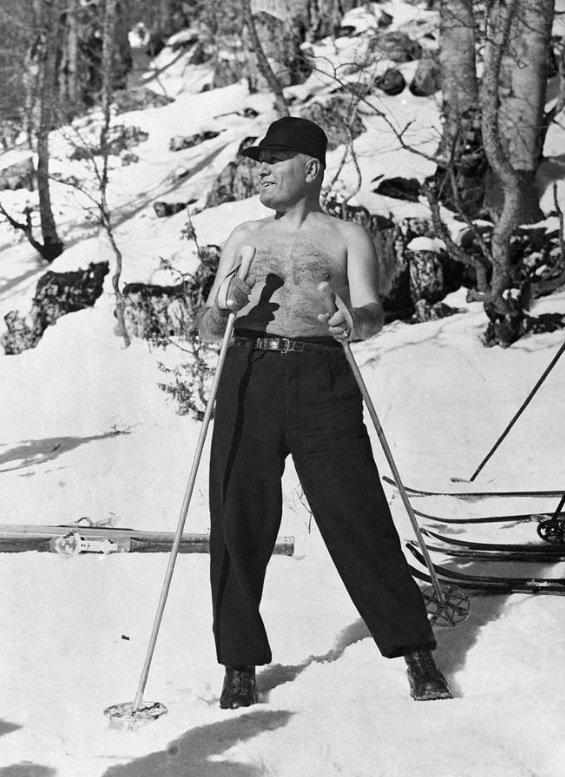
was not an Olympic category!
A listing of all the Italian medal winners shows a preponderance of Italian surnames which means that the Italic gene pool is still producing top winter athletes. And they can come from any of the Alpine regions—Valle d’Aosta, Piedmont, Lombardy, Trentino-Alto Adige, Veneto, and Friuli-Venezia Giulia. But let’s not forget the Apennines that provide winter sports even in the Sila district of Calabria in the far south.
But international competition also requires a national program to cultivate winners. The man who really regimented Italians into sports was il Duce, Benito Mussolini, no mean athlete himself despite his chunky appearance. It was under Fascism that sports became an Italian obsession as the leader took to the slopes, rode horses, and ran with his old Bersaglieri buddies, all caught on propaganda cameras. In 1927, laws were made to organize all sports clubs into thirty-two federations. This system produced 36 medals at the 1932 Summer Olympics. Italy placed second after the U.S. in medal count, an amazing feat. Italy then won the World Soccer Cup in 1934 and 1938. Even World War II didn’t stop Mussolini from hosting the 1941 Alpine Skiing World Championships, known as the “phantom world championships.” They were staged to show that Italy was still strong and untouched by WWII. Of course, only Axis partners participated.
Italians have been sports-minded since gladiators fought in the arena. Being listed 4th instead of 3rd is not good sportsmanship. –JLM



The Netherlands had one more Silver metal than Italy, and some rankings are based on Gold first, then Silver and then Bronze. The standings indicated by NBC had Italy third, after Norway and the U.S., based on the total number of metals.
regarding the Olympics. I have watched many of the past games in Spain, and Italy, and of course the US,.what I find frustrating is that the US broadcasting program follows primally the US athletes, so you get a skewed view of the games and players… you rarely see Italian athletes unless it’s in a completion with American athletes….given Italy scored fairly high in awards you would not have known that from viewing the TV programing. Likewise, if there are no Americans in the competition you don’t see any of the games. Would be nice to just survey all the games once in a while….
Somewhat related, Italy has also experienced a “rinascimento” via the sport of tennis. Two of the top ten male players are Italian: Jannik Sinner (yes, from up north; he speaks both Italian and German, though he’s a spokesman for Lavazza coffee), and Lorenzo Musetti (who won a Bronze medal at the ’24 Summer Olympics–he considers it his highest honor).
In addition to Matteo Barrettini, who finished 2nd in Wimbledon in 2021 and is finally returning after battling injuries, there is an unending sea of other up-and-coming young Italian players: Flavio Cobolli, Luca Nardi, Matteo Arnaldi, et. al. And female players like Jazmine Paolini and Sara Errani are also holding their own individually and in doubles.
KEN: All countries do the same, i.e, focus on their own athletes. But I share your concern.
It would be nice if the good ol’ USA (which still suffers from a “we’re-an-island-unto-ourselves” mentality, even though we border two other nations) could expand its media reach into spotlighting athletes from other countries, particularly Italy. I thought they were going to do this the first few days when Francesca Lollabrigida won the gold in women’s speedskating; however, it never went further than a quick shot of her husband and their two-year old son high-fiving each other in the stands afterward. It undercut the warmth.
Viewers could have learned that she was, indeed, related to the famous Italian actress Gina Lollabrigida (thus educating newer audiences) ,that a relative is current Minister of Agriculture, and that she won her gold medal on her 35th birthday–not an easy task!
Instead, NBC sent people out to sample foodstuffs or do segments on Aperol spritzes.
Even a brief segment I saw on the magnificent Duomo in Milano seemed cursory rather than revelatory. Not much on its history or its architectural intricacies. Che peccato.
I was fortunate enough to attend the Olympics in Milan. I would propose to award the Italians an additional Gold medal; in the category of courtesy, efficiency and cleanliness. This was not an easy task considering the throngs of tourists. The Italians were engaging and helpful. The Frecciarossa high speed train was spotless and punctual. I found no evidence of price gouging. I am hopeful the final review of the Olympics in Italy will reflect these observations.
Bravissimi tutti!