
This week the Irish celebrate an Italic saint while we celebrate a Jewish one.
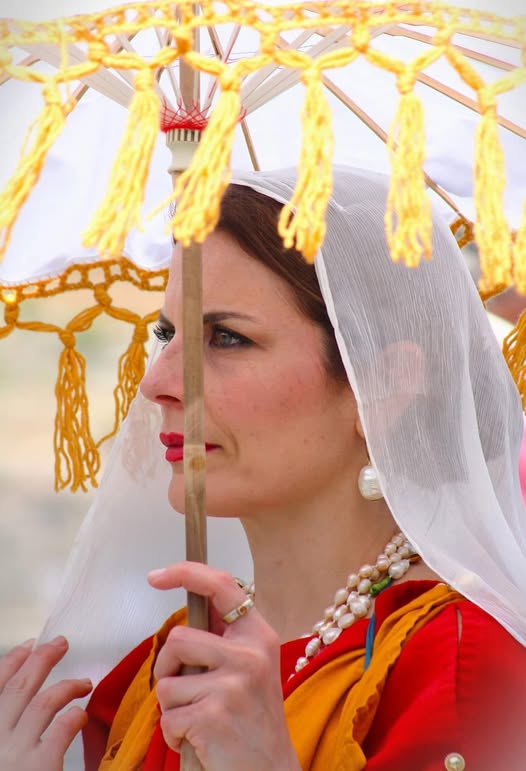
The Roman St. Patrick not only led the conversion of heathen Celts but taught them to read and write in Latin, which they parlayed into “saving civilization” in the Dark Ages. St. Joseph, on the other hand, went from an honorable mention in the Bible to be the icon of Father’s Day (March 19th) in Italy.
Fortunately, St. Joseph is not recognized in Islam—though Mary and Jesus are—so what I’m about to write will not open me up to a fatwa. But some Sicilians may consider me irreverent. Joseph and all the other saints that Italic people revere have diverted us from our classical heritage. It was planned that way by the Christian fathers who despised those pagan Romans who actually created the “Roman” Catholic Church.
You may know that the word pagan comes from the Latin paganus meaning a country bumpkin. It was these rural Italic people that clung to the old heathen ways while the city folk readily adapted to the latest “cult” in vogue. (An example was the mother-like Egyptian goddess Isis that swept Rome before St. Mary arrived.) Converting the rustics to Christianity meant swapping their Italic gods and goddesses for Jewish miracle-workers—both the Old and New Testaments were full of them. St. Joseph became the patron saint of families and fathers, owing to his acceptance of a pregnant Mary as his bride. Clearly, this act alone earned him sainthood. Otherwise, he performed no miracles in any of the four gospels and is only mentioned in three.
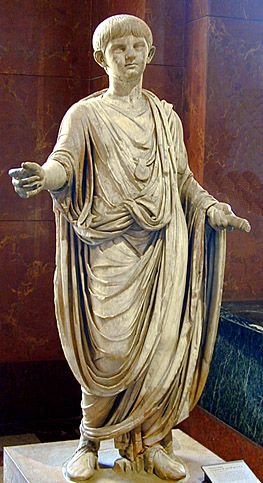
adult togas and registered to vote.
Not for nothing are Jews called the “people of the Book,” just as today their creative writing loomed large in comforting pagans in a tough world when their heathen gods fell short. St. Joseph took hold in Sicily during a drought and famine in the Middle Ages. Prayers to him opened the skies, ending the famine. Since then, he is honored by offering food to the needy by way of an abundant Tavola di San Giuseppe every March 19th.
Were we still a classical people and kept our ancient traditions as the Jews have done March would be full of special days. March 1st was Rome’s Mother’s Day (Matronalia), Of course, today (15th) is the Ides of March, the day Julius Caesar was assassinated, a day of mourning. As for St. Patrick’s Day it would be our version of Bar Mitzvah or Confirmation—the passage to manhood for Italic boys occurred every March 17th for those reaching sixteen that year. It was called Liberalia. Fathers took their sons to City Hall to register them as voting citizens and to don the adult toga. As the name implies, the boys were “free” to become men. Christianity converted this Italic family tradition from a civic function to a religious one.
And so it went, Christianizing pagan Italy, especially in the south, eventually led us from an enlightened classical people to one with no memory of our ancient past. Our grandparents came from villages with plenty of ornate churches but few schools or libraries, higher education was for priests. Imagine Jews without Torah, Talmud, Moses, David, or Solomon. They would still be wandering, Israel only a vague memory. Or today’s Greeks without Greek school, a photo of the Parthenon or a classical statuette in their homes—My Big Fat Greek Wedding wasn’t just a movie; it was a message.
This religious monopoly of our past reverberates beyond our classical legacy. We easily remember the traditions of St. Joseph’s Day down to the correct pastry, but what to do for Columbus Day? Not even Genovese pesto is on our menu. Traditions need symbolic acts and for Italian Americans only Catholicism has them.
Greek and Jewish Americans have struck the balance between their classical past and religious observance. It should not be a secret why the Renaissance began in the northern cities of Italy where the Church did not dominate. Those cities maintained their classical connections to a much greater degree.
It’s a lesson we shouldn’t ignore. –JLM
 John Mancini

I think it noteworthy to consider a book I read in the 70’s entitled “The Jewish Mystique” He posited that since rabbis were the most educated in the shtetl, were allowed to marry and encouraged to procreate, and had had knowledge of medicine (aka child survival) they produced a population of educated masses, not to mention that the Talmud, Mishna, et al were subjects of intellectual debate. Contrast that in rural S Italy where the genes of the most intelligent were (largely) siphoned out of the populace with the priestly vow of celibacy. And Greeks have ingenuously fused their classical and Christian history with their youth with no conflict.
Fascinating blog and equally fascinating comment by Joe Graziose. Bravi!
This is what the national Italian American community needs–less food, more “food-for-thought.” It would make a world of difference in terms of self-perception.
This has been a busy week with our celebration of the Festa di San Giuseppe on the 19th….in some ways many Italian Americans consider it part of folk culture…..and that should not be discounted……The largest St Joseph Day celebration is in New Orleans with its large Sicilian American population…..and I recall growing up, a family hosting an event in their garage….with all proceeds donated going to building an orphanage in Calabria.
Even today there is a certain pragmatism to the event including outreach to the poor in the form of donations and the symbol of the fava bean…and growing your own food. It is also quite amazing how a diverse community can still come together for this Festa.
While I am no fan of Fork and Spoon organizations many of the early immigrants had to migrate because they did not have food…and opportunity…and that is a totally different proposition…Also it is something many Italian Americans should have empathy with todays immigrants…Likewise there is a sense of sharing at this sort of event….since the St Joseph Day tables are welcoming to all, and giving , all values very important to a community and sorely needed in todays world. Likewise, in terms of todays latest dietary fads, especially around vegetarianism…a whole culinary fare is related to the the Lenten cuisine without all the attention about the meatless meals…big deal.
I am a long time student of the “great migration” especially of Italians throughout the world migrating after Italian unification …as we know, and the realities of that traumatic uprooting really has never been fully acknowledged…so we have some quite interesting reactions which goes a long way in understanding todays Italian American experience.
Have we grown intellectually as a community when our sole focus has been religious observance and immigrant nostalgia?
Though I fully agree that the Spanish Bourbon occupation of the south of Italy—along with the Papacy—-stifled civic-mindedness, education and independent thought, I must take issue with my colleagues’presentations.
A Magic Boot shorn of its Meridione would not be Lo Stivale. Nor would it even be called ITALIA, which is the original name of the region we now know as Calabria.
Caesar Augustus, Rome’s first emperor, made certain to officially call the entire peninsula— first unified in 222 B.C.—ITALIA. (Btw, Augustus traced his family origins to Thurii, Calabria.)
And here are but a few Calabrian contributors to the Renaissance.
The Italian genius responsible for creating the Gregorian calendar embraced by the entire world is Luigi Lilio.
Born in Cirò, Calabria (1510 -1576), he was also known as Aloysius Lilius in Latin. (Calabria, which forms the tip of the Magic Boot is the region whose original name in antiquity was Italia.)
Luigi Lilio is the physician, astronomer, mathematician and philosopher who– at the behest of Pope Gregory XIII—amended the calendar devised by an ancient compatriot, Julius Caesar.
Discovering that there were a few numbers missing in the number of days it took for the Earth to revolve around the sun, Luigi Lilio ascertained the precise date of Easter. This involved a complex calculation about the epact cycle—a measure of the age of the moon (i.e. the number of days that have passed since an “official” new moon) on a particular date.
As Dr. Francesco Vizza—Research Director at the Institute of Chemistry of Organometallic Compounds of the National Research Council, (ICCOM-CNR) Florence, Italy—has noted: “using imprecise astronomical data contained in tables from three centuries before, {Lilio} was able to elaborate a calendar that has stood the test of time. By the use of two equations, he was able to synchronize the solar and lunar cycles and to develop a useful tool, named the epact cycle, to determine without uncertainty the Easter date. Furthermore, the Lilian method offers the possibility to correct the calendar according to the variation of the tropic year.”
The crater Lilius on the Moon is named after Luigi Lilio, as is the asteroid 2346 Lilio. And in computer science, the Lilian date is the number of days since the adoption of the Gregorian calendar on October 15, 1582.
Here are some more notable Calabresi of the Renaissance.
Bernardino Telesio(16th century) was a pioneering philosopher and naturalist from Cosenza who challenged Aristotelian views, favoring observation-based science.
Mattia Preti (1613–1699), known as Il Cavaliere Calabrese, is a major artist from Taverna whose work embodies the artistic advancements stemming from this region. His masterworks can be found in New York’s Metropolitan Museum of Art.
Cassiodorus was but one of the giants who preserved knowledge of Rome and maintained Greek linguistic traditions and scholarly activities, bridging the Byzantine past with Renaissance humanism.
Nota Bene: The Byzantines considered themselves ROMAN—and justifiably so. The Byzantium moniker was one concocted by later historians. It was in fact the eastern Roman Empire, which did not fall until 1453, 39 years before Columbus discovered the New World.
And lest we forget, Anton Calabres, Antonio Calabrese —a true-blue Calabrian— sailed with the Admiral of the Ocean Sea on Cristoforo Colombo’s
epochal voyage.
Tommaso Campanella (1568–1639) was a leading Italian late Renaissance philosopher, Dominican friar, and writer, best known for his utopian work La città del Sole (The City of the Sun). He advocated for a society based on reason, natural religion, and shared property, and spent 27 years in prison for heresy and plotting rebellion against Spanish rule in Calabria. And let’s not forget Tommaso Campanella’s defense of Galileo Galilei.
A précis by the Linda Hall Library declared:
Tommaso Campanella (1568–1639), a prominent late Renaissance philosopher, strongly defended Galileo Galilei during the Galileo affair, notably writing Apologia pro Galilaeo (Apology for Galileo) in 1616 while imprisoned. As a fellow advocate for empirical observation of nature, Campanella argued for intellectual freedom and that scientific study should be separate from scriptural interpretation.
Apologia pro Galileo 1616/1622): Campanella wrote this defense while a prisoner of the Inquisition, arguing against the church’s 1616 condemnation of Copernicanism.
Support for Scientific Freedom: He argued that the Bible was meant for moral guidance, not as a technical manual for understanding the physical world, defending the right of scientists to study nature freely.
Shared Intellectual Interests: Both men were trailblazers in modern scientific thought, prioritizing observation over dogma, a hallmark of the late Italian Renaissance.
According to Massachusetts Institute of Technology:
“Campanella’s defense was a crucial, although often private or restricted, effort to preserve the freedom of inquiry during the intense conflict between new science and Church dogma in early 17th-century Italy.”
A fine recital but the thrust of my blog was how Catholicism has buried our classical roots. In a way, you have listed just a modicum of our classical history that would astound 16 million Italian Americans accustomed only to Mafia movies, feasts, and the Church’s version of our history.
Some of the historical analysis referenced in the article and in the comments are now considered obsolete and part of the “retorica risorgimentalista” (unification rhetoric). This rhetoric was created by norther Italians and brits to justify the invasion of the South.
The Kingdom of the Two Sicilies was one of the richest country in Europe. There was no immigration of Southern Italians before 1861. Naples was a major European cultural center. The mercantile marina was one of the largest in the Mediterranean sea.
Most importantly, the Kingdom of the Two Sicilies was a threat for the British Empire in the Mediterranean. The Brits viewed Southern Italians as backward “papist” people and helped the North to invade the South. The protestant hate toward Catholics is represented in the movie ‘Gangs of New York’.
Never trust British and American historians when writing about Italy and Italians.
Forget British, American, and northern Italian “propaganda” about the South. The evidence of a non-classical people is all around you here. Sixteen to twenty million Italian Americans who couldn’t care less about their ancient or even modern image. They embrace Hollywood’s depictions with praise and affection. I will also point out that your translation of “retorica risorgimentista” should be “RE-unification rhetoric” – once again our classical debt must be recognized, which it isn’t.
What wonderful, interesting comments from all you gentlemen. I wish I could add something…but I can’t. Aren’t you glad!