
Italic Studies is not my whole life, only part. But sometimes life draws you back to it.
Just today, a young nephew and I walked past a branch of the Bank of America. As an Italian American college student taking a history course I wondered if he knew who founded the bank. Why should he? American history courses don’t go that deep. So, he was amazed that the bank was originally named the Bank of Italy and founded by A.P. Giannini. I added that Giannini had bankrolled Walt Disney and the Golden Gate Bridge as well as pioneering branch banking across the U.S.
What a teaching moment! Linking a ubiquitous American brand with my nephew’s Italian heritage, all within the space of two minutes. But how many young, or even older, Italian Americans get a dose of legacy while standing on a street corner? Or watching TV, or surfing the ‘net, or eating Sunday “gravy” with relatives who know as little as they do?
I later thought about our battles with Columbia University and the Italian government over La Casa Italiana. How many of today’s Columbia students know that the largest Italian cultural center in America was built by Italian Americans, not Italians, and was the brainchild of a campus Italian Club in 1927? The irony is that there is no Italian Club at Columbia today—such is the apathy. Now home to the Italian Academy, La Casa Italiana is disseminating nothing of our legacy, only European elitism. Columbia’s Italic students would learn more of their heritage standing in front of a Bank of America branch waiting for me to pass by!
But instant legacy works both ways. Yesterday I was at a skating rink for my grandson’s birthday party. I met one of his friend’s parents, a man wearing a shirt emblazoned with “Brooklyn.” He was at least twenty years younger than I and very much Italian American. I asked him what part of Brooklyn he was from. He lived near where I was born and we reminisced—he about the 70s, I about the 50s. He lamented how city crime was worse than the old days. He then told me how the various crime “families” used to keep order in the neighborhood: the Gambinos, Genovese, et al. It’s a story I have heard many times before, whether it’s New York, Philadelphia, Chicago or God knows where else. All I could say was that those guys were either dead or in prison and that I had been too young to know of their “good work” in the 1950s.
I now wonder if he knew who A.P. Giannini was. Such is the perverse legacy many Italian Americans carry with them, reinforced almost daily by mafia movies on cable. In the case of the Mob protecting neighborhoods that master mythmaker is Chazz Palminteri.
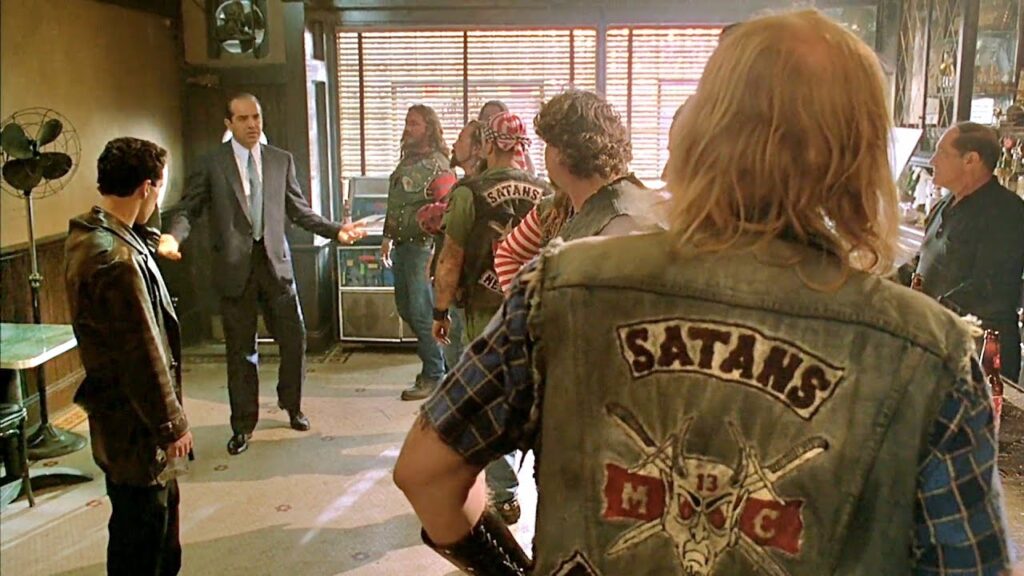
His sole and self-serving opus, A Bronx Tale, casts the thieves and murderers of his old neighborhood as Goombah Angels who thrash the hell out of Anglo bikers. The bikers strangely don’t come to savor the neighborhood cuisine but to hoist a few in the Goombahs’ bar/headquarters of all places. Within a goombah minute with meaty fists a-flying the Anglos are run out of town—neighborhood saved!
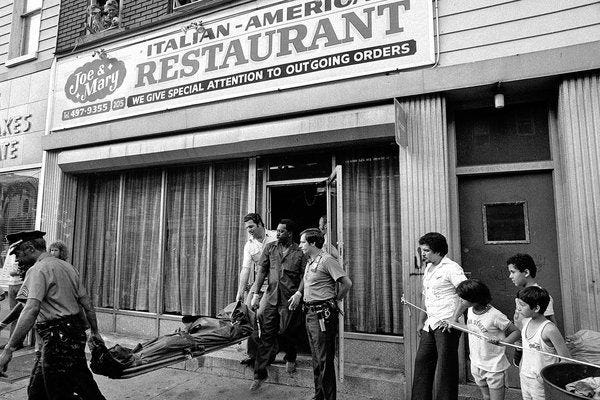
Misguided Italian Americans no longer recall the disease of their beloved gangsters. They weren’t “families” but gangs. They hooked their neighbors on gambling (“the numbers”) and kept them in debt (“the vig”) with loan-sharking. Every now and then they conducted bloody “hits” in the old neighborhood. Joey Gallo got his in 1972 at Umberto’s Clam House in Little Italy. Carmine Galante got his in 1979 at Joe and Mary’s restaurant in Brooklyn. John Gotti’s neighbor strangely disappeared after killing the Don’s son in a traffic accident. Reality sucks!
Sadly, the Italian American mindset is too much bent toward mythology rather than reality. ‒JLM


The most enraging thing about the “mob guys kept the neighborhood safe” is that it negates the 99% of the Italian Americans who lived in those areas—proud, honest, hard-working people who paid their taxes, fought in America’s wars, cleaned their homes (inside and out), and raised good American kids/citizens. The neighborhood was safe because the overwhelming majority of Italians there were law-abiding.
True then, true now. In fact, parents often told their kids to stay away from the Capones and Gottis of the world. They were a bad influence. True then, not so much true now (as Italian mob guys have largely disappeared since and their grandchildren have long assimilated into American culture). They are dinosaurs.
And kudos for reminding people that this nostalgic tone completely negates the violent nature of these men. They protected the neighborhood, all right; their idea of protection meant extorting local Italian American business so that “nothing would happen” to their stores (mysterious fires, windows being broken, etc.). Nice guys?
As for the greaseball thugs vs. Anglo bikers scene in “A Bronx Tale”: Chazz recently revealed that the film’s subplot about Calogero’s romance with a local African American girl was completely made up. Co-star Robert DeNiro asked him to add it.
I would take that biker scene with a grain of salt. Hollywood lies FREQUENTLY. It wouldn’t surprise me that Chazz added that scene, too. Why? Note his character’s line after beating up a biker: “Look at me! I did this to you!” In short, “I’m tough!”
This is the kind of “bull defecation” which passes for actual Italian American history.
This is why I hope more people can see the documentary about A P Giannini. it really is an upbeat “must”.(and that seems to be the consensus of anyone who sees the film). Its American premier was at San Jose’s Cinequest last year….i think called the The Little Fellow, and A P Giannini’s focus on the little man and outreach to the working person…This, along with so many innovations to bring disanfrished people into the world of banking, and at the time more woman into the banking establishment.
We take all this for granted today, ,however, so many of these innovations came from A. P.’s vision….Interesting too, and equally remarkables was this was his second career….He retired from his first career in his middle 40’s as a farm produce broker, in the agricultural regions of Calif, including his roots in the Valley of Heart’s Delight.(aka todays Silicon Valley)…..when he decided to go into banking, he already had a list of contacts throughout the state, as well as a keen understanding of working people and a need have a place to grow their savings.
I Have no idea why those innovations were detested by the Wall Street gang, Morgan and all, but whenever they attacked him , his Italian heritage was always on the line…..and through it all he remained a proud Italian American.
I am also amazed that this was his second career and reminds me of a friend ,Irene Boitano Dalis….who came from San Jose too, she concluded her initial career as a diva with the Met…..only to retire to her hometown and little by little for 45 more years founded a nationally recognized resident opera company, Opera San Jose, for young singers. a first in the nation. During the 1950’s, when Irene started out in the art form, as a young singer to get some experience, you had to go to Europe to sing in the smaller houses and venus..
These achievements by Italian Americans are certainly more fascinating that what passes for the weird world of media history today.
I read your comments on the Italian-American scene meditating on the positive side. Today, young Italians immigrants continue to arrive and thrive in San Francisco. In contrast, the homeless (americani sfigati) shamelessly abound at many street corners. The Italians, on the other hand, pay little attention for they have succeeded even without AP Giannini, whose bust still stands proudly nearby in one of the first Bank of America branches.
We Italians believe in strong traditional family values and a work ethic of rimbocchiamoci le mani. i.e., no handouts needed.
KEN: “Weird world.” Great phrase. And thanks for the info on the A.P. Giannini film. Other than its off-putting title, I’m sure it’s amazing, as is his life story. (Note: I’m not a fan of the film’s “ironic” title for two reasons: a) The Little Fellow, as everyone movie lover around the world knowns, is Charlie Chaplin’s iconic tramp; and 2) Giannini was anything but a “little fellow”–he was an American business giant).
Your friend’s story is equally amazing, much like the late Ms. Falbo’s. Brava!
ANTHONY: There are many reasons for homelessness. What’s really shocking is how many of them are former veterans of our recent wars (Iraq and Afghanistan). Our nation did take care of our veterans after WWII with the G.I. Bill, but not so much afterward. From Vietnam onward, we’ve used them and then discarded them. Sad.
I’ve pushed for years to have a huge statue of Giannini put where thousands of tourists will certainly see it: North Beach. I think there’s only a plaque on a wall.
There is definitely a bust of him in San Diego’s wonderful Little Italy, along with a huge square which bears his name. That the average Italian American would rather promote Don Vito Corleone (a fictional character!) than Giannini is appalling.