
President’s Trump’s proclamation for Columbus Day 2025 makes no mention of Indigenous peoples and only a sentence honoring Italian Americans. That’s about the right mix.
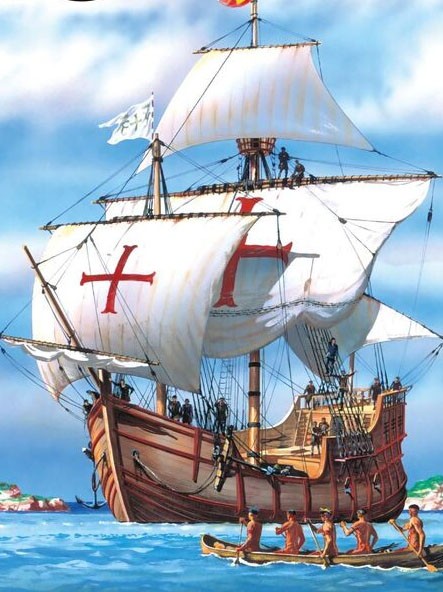
Columbus Day was and always should be about 1492 and the man who bet his life on sailing west to find Asia. It’s not about Chicken Parm or Kiss-Me-I’m-Italian. Those who interpret the holiday as honoring our ethnic group miss the real point. Columbus was an American icon before our folks came over and before the murder of eleven Italian immigrants in New Orleans (1891). He represented European exceptionalism in discovery and civilization. The year 1892 was slated to be a celebration of his 400th anniversary, regardless of any lynching. It was the theme of the World’s “Columbian” Exposition in Chicago (not actually held until 1893). I’m sure there were no pizza or zeppole stands on the fairgrounds.
Acknowledging Italian Americans for their existence and contributions is more of a political cover story than the true meaning of Columbus Day. St. Paddy’s Day is not a federal holiday even though the Irish were also victimized and contributed heavily to this nation. St. Patrick didn’t change the world. Neither did Martin Luther King.
By linking “Indigenous Peoples Day” to Columbus Day, revisionists have succeeded in confusing the message of 1492. Some 30 states do not recognize Columbus Day and about 220 cities have renamed the holiday. Eventually, even the Italian American cover story will no longer save the day. We are lucky that Trump admires Columbus. Let’s savor the moment and celebrate the man and his amazing story.
A very key episode in that story is how Columbus overcame a mutiny in 1498, among the Spanish colonists he brought on his second voyage. Contrary to his wishes, King Ferdinand and Queen Isabel allowed all sorts of noblemen and nonproductive men to populate Hispaniola. Columbus wanted families of farmers, craftsmen, and miners to create a self-sufficient colony and find gold. Spanish women and conjugal bliss would keep lecherous single men from abusing the native women. Clearly, the studly Spanish were already restless.
When Columbus returned on his third voyage he found “more than 160 [men] were suffering from syphilis,” according to his son Hernando. Worse, some of the useless nobles were in open rebellion, robbing and murdering the natives. They no longer cared for the Admiral’s austere rules and wanted a share in the gold and all the native women they desired. Moreover, they wanted to each own natives as slaves on their plantations. Instigators named Roldán and Ojeda managed to recruit scores of other Castilians to the cause.
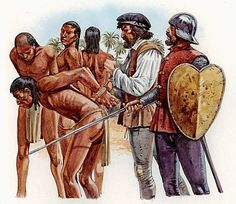
While the Spanish nobles practiced lechery, Columbus practiced nepotism. He employed his two brothers, Bartolomeo and Giacomo, to help rule the colony. Few historians appreciate the fact that their bosses being Genovese never went over well with the Castilians. Time and again his Italic origin and that of his brothers was used against them by discontented colonists. When Columbus went exploring the Caribbean Bartolomeo governed Hispaniola. When Bartolomeo left the capital Santo Domingo, brother Giacomo was in charge.
By 1499, the rebels sent word to the King and Queen that the Columbus family was running rampant against the poor Castilians. The monarchs sent a representative named Bobadilla with special persecutorial powers. When he arrived at Santo Domingo (named for Domenico Colombo, the Admiral’s father) he found two rebel Castilians hanging from gallows, by order of Giacomo Colombo.
It was this act and the lies told by Roldán and Ojeda that forced Bobadilla to send all three brothers back to Spain in chains. It was not for mistreating the natives, as revisionists claim.
The brothers were exonerated by the monarchs, but the rebels were placated by relieving Columbus of his duties and implementing Roldán’s feudal treatment of the natives.
In 1502, Columbus made his fourth voyage. But his ships were refused anchorage at Santo Domingo, so he positioned them outside the harbor as best he could to ride out a hurricane. His ships survived. Meanwhile, a 31-ship treasure fleet carrying Bobadilla, Roldán and the Crown’s gold sailed into that hurricane. Both Castilians were lost and all the Crown’s gold. Among the ships to survive was the one carrying Columbus’s share of gold.
A great movie script, except Italians are the good guys. -JLM



In San Jose, I requested a dialogue be set up to talk about the real Columbus, the world history of the times, and his trials and tribulations as you so keenly pointed out in your comments….., instead I was treated with a kangaroo court of so called academics at San Jose state with not one ounce of open-mindedness. It carried over to a City Hall discussions which were set for about 6 pm, agenda moved to 9pm when most of our group had to leave, and then the illustrious mayor at the time, who identified with what ever ethnic group was to his advantage, noted its late, entertained a short comment by me and he then stated we need to resolve the matter, at that very moment, the council voted to remove the statue and it ended up at the Italian American Heritage Foundation…..all in a matter of days….I have never seen the city move so fast on an item.
For the record I am opposed to arbitrary actions by either the right or left, because what is lost in all this is due process and a form of governance that was once the “ideal” of our political system. It may have started with Columbus Day, but this mentality wont end with that…recently a statue of Father Junipero Serra at a road side rest stop, ..was literally smashed and removed for similar reasons….the highway dept said it did not meet their requirements(its been at that site for over 30 years)…..no public record, no notice no nothing . Arbitrary governance now seems the rule of the day……the true tragedy of this new reality.
A much better way to view the Columbus issue, thank you .
Now if we could get a film made about these little known facts it would be wonderful .
Today we held our 46th annual Columbus Celebration at the American Italian heritage Museum, Albany, NY. The attendance could have been much better. Why don’t more Italian Americans celebrate Columbus Day? So many use Columbus Day as fun holiday, not as a day to honor or how he changed the world for the better. His discovery was amazing. Italian Americans set a good example supporting the events honoring Columbus.
Columbus Day is about honoring Columbus’s historic voyage as well as honoring Italian heroism and intellect.
Columbus was maligned in Howard Zenns book “A Peoples history of America,” a book that was not accepted by the American Historical Society since it was misleading, inaccurate, nor truly historical. A book, unfortunately, that has been used in educational institutions that corrupted the minds of our youth. Mary Garbar’s book, “Debunking Howard Zinn” shows how Zinn takes historical facts out of context to suit his purpose.
Christopher Columbus was a religious individual. When he encountered the natives on his first voyage to the new world, he told his men to treat the natives with kindness and respect, if they give you something, you give them something in return, that through kindness and not violence will you be able to convert these people to Christianity and save their souls from eternal damnation. The church at that time, taught that baptism was the only way to enter the kingdom of heaven. Does that sound like a man who would rape and murder?
A fact taken out of context from his log by Zinn, are the words “They would make good servants and of good skill, for I see that they repeat very quickly whatever was told to them,” This was in reference to the Carib’s, a cannibalistic tribe taking native natives from other islands enslaving, torturing, raping, castrating, and finally consuming them, and why they would want to capture Taino natives as servants.
The Taino tribe had saved Columbus’s crew and supplies from his ship that had hit a reef. In gratitude, he promised them that he would, by “the sword or by chains,” put an end to the Caribs attacks. Zinn used that quote to link Columbus with slavery. When he entered their villages, he observed human bodies ready to be roasted over a fire and human flesh being boiled. He freed the captured men, women, and children, returning them to their islands. Enough said about all natives being friendly! These are just two of Zinn’s malignments.
When Columbus went exploring, he gave his men strict orders to his men to treat the natives with dignity, however when the cat is away the mice will play.
Should we condemn Madam Curie’s discovery of radiation which led to the creation of the atom bomb that killed thousands of Japanese civilians. Should an individual be condemned for his discovery because of the actions of other individuals that abuse the discovery latter on?
Columbus should be restored to his rightful honorable place in history!