
On Friday, October 24th, in an event sponsored by Cinema/Chicago in conjunction with the Chicago International Film Festival, director Spike Lee was interviewed by Dr. Jacqueline Stewart, film professor at the University of Chicago and host of “Silent Cinema Sundays” on TCM (Turner Classic Movies). Alas, a prior event kept me from attending.
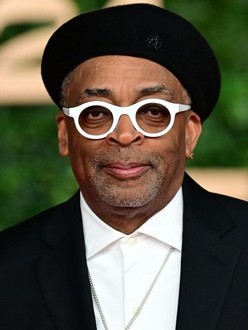
Curiously, as I write this blog, no mention of Lee’s visit managed to make the local papers. This is rather surprising given his love of controversy. To borrow the title of a play by the great African American playwright August Wilson, “Spike Lee’s Come and Gone!”
(Sidenote: To show how complex American history can be, playwright Wilson was actually the son of a German immigrant father and was christened Frederick August Kittel, Jr. Pappa Kittel abandoned the family, a move which later inspired August to change his surname to Wilson to honor his hard-working Black mother. Also interesting: Wilson grew up in a racially mixed area of Pittsburgh with Jewish American and Italian American families, both of whom are alluded to in his many plays.)
As a former film study teacher, I applaud Lee’s undeniable role in American film history. He blazed a trail for African American filmmakers, expanding upon earlier, even heroic, work by directors Oscar Micheaux, Gordon Parks, Melvin Van Peebles, Robert Townsend, Charles Burnett and Julie Dash.
But as an Italian American, I’ve long been both baffled and disappointed by the endless caricatures of my community in Lee’s over-all oeuvre.
For example, in Do The Right Thing, arguably his best film, a pizzeria owner instigates a race riot. In Jungle Fever, an Italian American father discovers that his daughter is dating a Black man and beats her to a pulp. In Summer of Sam, Italians are portrayed, to use New York Times columnist Clyde Haberman’s words, as “drug-and-sex-crazed louts and gangsters.” In his 2008 WWII epic, The Miracle of St. Anna, Lee even managed to insult the Italians by suggesting that partisan freedom fighters aided the Nazis.
In Lee’s defense, Hollywood’s dim view of Italian Americans gave him safe haven via fairness and balance. It certainly didn’t help that a trio of misguided Italian American filmmakers—Francis Ford Coppola, Martin Scorsese, and (on HBO) David Chase—vivified such stereotypes, using “art” as a veneer to sterilize them. D.W. Griffith portrays the Ku Klux Klan as heroes in his 1915 civil war epic Birth of a Nation and is condemned; Coppola treats mafia killers as heroes in The Godfather films and is revered. Say what?
The ultimate victim in all of this is history, specifically, the history between African Americans and Italian Americans—which, as author John Gennari notes in his 2017 book Flavor and Soul: Italian America at its African American Edge—is far more complex than anything in Hollywood’s narrow universe.
If Lee’s films are your guide, you would never know that jazz band leader Joe Marsala (also from Chicago) broke the color barrier in jazz by hiring African American musicians (1936); that Mayor Fiorello LaGuardia appointed the first Black female judge in the US (Jane Bolin, 1939); that Congressman Vito Marcantonio and labor leader Emma Bambace fought endlessly for civil rights (1940s); or that Frank Sinatra used his clout to open doors for fellow artists like Louis Armstrong, Ella Fitzgerald, and Quincy Jones (1950s).
Similarly, you wouldn’t know that after Dr. Martin Luther King Jr. was attacked by a knife-wielding assailant in 1958, Dr. Emil Naclerio was part of the surgical team which saved his life; that Tony Bennett (born Anthony Benedetto) marched with Dr. King years later in Selma; that Berry Gordy’s right-hand man at Motown Records was Baldassare Ales (1960s); or that Ella Grasso, first female US governor elected in her own right (Connecticut, 1974), had, decades earlier as a state senator, sponsored anti-discrimination laws.
The 1970s, of course, is when the Godfather movies made their mark. Coppola’s one-two cultural gut-punch solidified a stereotype that rivals the staying power of any vampire, be it courtly Count Dracula or the ashen-faced Edward Cullen in Twilight. Mobster and moron images continue to suck Italian American culture dry, even in 2025.
To his credit, Lee credits an Italian American director, Martin Scorsese, as being a friend and mentor. He also is fan of filmmaker Vincente Minelli, father of Liza and a recognized master of the Hollywood film musical. (In fact, Minelli directed one of the few early Hollywood movies with an all-Black cast: 1942’s Cabin in the Sky).
And as someone who grew up as one of the few African Americans in a virtually all-Italian neighborhood in Cobble Hill, Brooklyn, Lee admits that, after a few initially unpleasant encounters, neighbors largely accepted him. Even la bell’ italia, despite his previous dis of their history, has embraced him; he does TV commercials for FIAT—no mean fiat!
Movies are like life: You can’t go back and change them. Sadly, Lee’s caricatures of Italian Americans will live on for future generations. What’s sadder is that Italian American organizations (other than the Italic Institute, of course) never publicly challenged Lee’s view of us, then or now. To use the popular Black expression, “That ain’t right.” ‒BDC



A remarkable assembly of facts. Bravo, signor Dal Cerro. But while pointing out the calumnies of Lee and the rest of Hollywood, we should always keep in mind that our umpteen-million Italian Americans have produced and promoted few positive-image films. Very few, really.
Is there Any Italian American group that would address this kind of thing with the producers, any organized anti defamation group to take part in?
Or would not enough Italian Americans get involved?
Signor Masullo: Grazie! I do mention the Unholy Trio in my piece (Coppola, Scorsese and Chase). I also mention at the end the utter fecklessness of our organizations in combating such defamation over the past decades–even up to the present day.
And an entire other article could be written on the prodigious waste of money in our community, whether from It Am organization still obsessed with “educational scholarships” (but never scholarships aimed at studying Italic culture!!) to the numerous uber-wealthy folk in our community who ignore our artists and writers.
During Rome and the Renaissance, rich patricians supported the arts. That is why the Pantheon still stands and Italian paintings and sculptures dominate Europe.
In America, wealthy Italian Americans spend money on everything EXCEPT Italic culture. The closest thing to the beneficence of our ancestors are the millions occasional given to hospitals or churches for naming rights–and even that comes tinged with a sense of ego (i.e., buying a ticket to Heaven, or so they hope).
Spike Lee is not one of my favorite persons…for reasons u noted, still you bring out some interesting points regarding African American and Italian American Relationships ….that in many ways go back to the post reconstruction South.
During those days New Orleans was the preferred port of entry, and not the eastern seaboard.. Sadly those early Italian American immigrants were not prepared for the dynamics of US race relations, especially in the South…..and then u add the Southern Louisiana dynamics and all hell broke lose, including the mass lynchings and all……The nice racist classification system sorely tested the new wave of Southern Europeans, and the racist element could not figure out how to classify Southern Italians…..To bad Spike Lee was ignorant of all these dynamics, including the fusion and contribution of 19th century Sicilian marching bands in NO to Dixieland and early jazz….
I attended college in NO, and coming from Calif…thought one of my professors overly identified with Black America…..only to find out she was very light skin,, of mixed race….she also told me her grandmother could not speak English and spoke French and Italian from the communities living in her parish. Interesting too, integration in the NO area further segregated the neighborhoods, and aside from the Quarter, most of the Italian Americans now live in the outskirts of the city…..
GLORIA: Not enough Italians would get involved, probably out of fear of being labeled “racist,” the sure-fire to stifle intelligent discourse today in our nation. Also, It Am organizations LOVE celebrity photo ops, and even Spike Lee is a celebrity.
KEN: Excellent points. The Italian/Black jazz connection, as you note (no pun intended), is a remarkable one. A few years ago (2017, to be exact), I lobbied a certain Italian American organization about that year being the 100th anniversary of the first-ever “jazz” record (1917)–it was done by Nick LaRocca and his band, a remarkable bit of musical history.
It would have been a great way to get media attention, and to start a national dialogue about this amazing Italian/Black musical link, which continues to this day. Indeed, I suggested that Nick LaRocca JR (still alive, and still keeping his father’s legacy alive via HIS band) either be honored or even hired to play a tune or two. I was told by a head honcho that they “couldn’t afford a band”—even though what this organization pays for floral decorations at its big banquet could have easily covered any costs. Or what about ZOOM?
It is fact: our “leaders” do not truly care about Italian American history or culture.
Bravo!
Great article with interesting historical references.
Thank you, the Italic Institute, and commenters.
Salvatore