
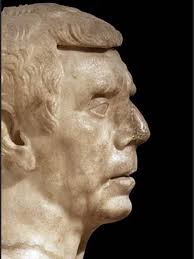
In my father’s hometown of Gaeta (Lazio), Italy there stands the tomb of Lucius Munatius Plancus (c. 87 BC – c. 15 BC), a Roman soldier and politician who allied himself with both Julius Caesar and his successor Octavian. In fact, it was Plancus who lobbied the Roman Senate to bestow the title Augustus (“the increaser,” or “consecrated”) on Octavian after defeating Antony and Cleopatra.
Plancus was a remarkable man. Among his services to Italic colonization around the empire he founded the French city of Lyons and the Swiss city that would become Basil. His name still lives in Latin as an idiom for “the good old days”— consule Planco, “when Plancus was Consul.” And we know what he looked like (right), which is the point of this essay.
How many ethnic groups can see what their ancestors actually looked like? Jews forbade graven images so we have to depend on Italian Renaissance artists to imagine what Moses, David, and Solomon looked like. Egyptian tomb paintings and monumental statues were far from realistic portraits of the pharaohs. Even the artistic Greeks left us few real portraits of their famous men and women. There is no single “true” portrait of Alexander, as “great” as he was.
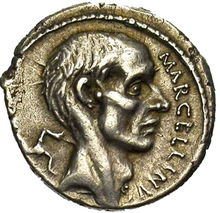
Yet, I can show you Munatius Plancus and many of Rome’s best generals with a quick internet search. Roman emperors? Almost every one from Augustus to the last, 500 years’ worth! Whether as a marble bust or bas-relief on a coin, Roman portraits were the real thing. Take a look at the coin, above, minted for Consul Claudius Marcellus the general who extended Italy to the Alps in 222 B.C. by defeating a Celtic army. He’s probably in his 40s, bald, bony, and large of nose. But not all Romans were this secure in their real looks.
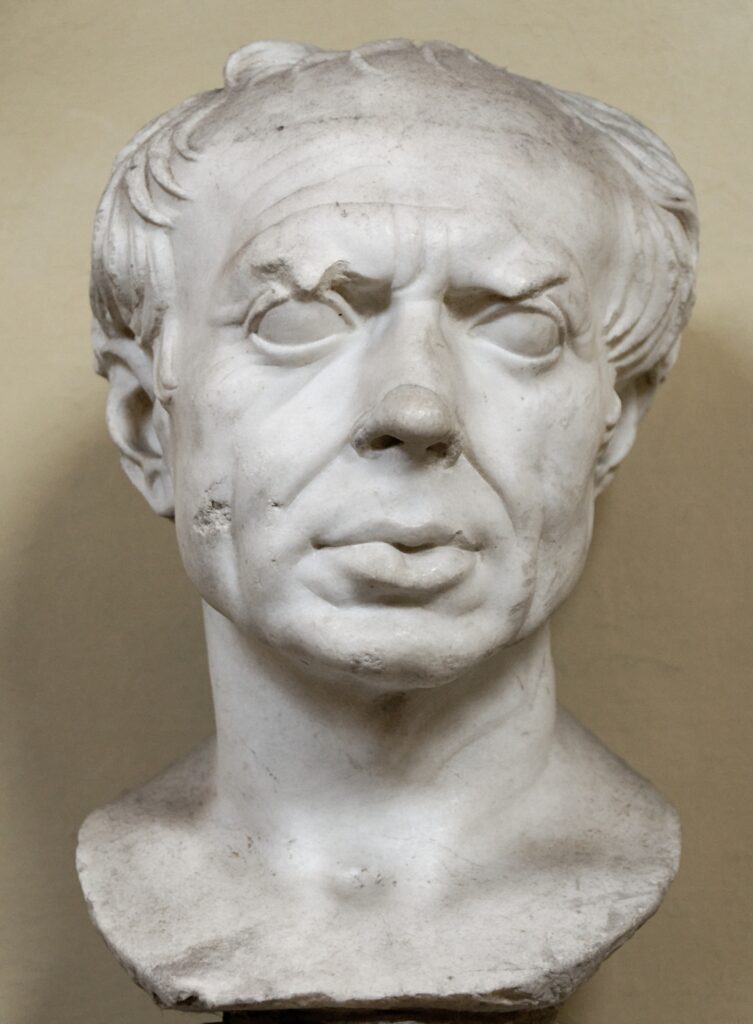
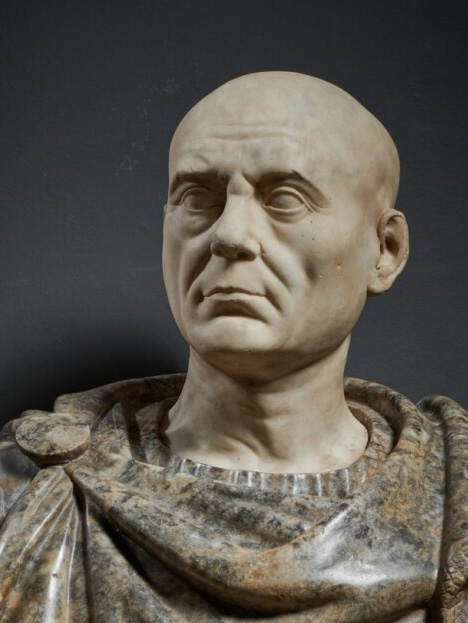
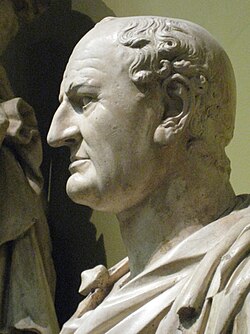
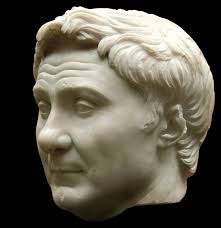
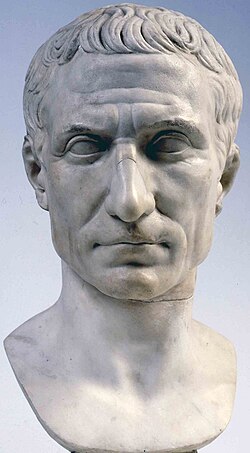
Julius Caesar was nicknamed “the bald adulterer” by his Italic legionaries, but his bust doesn’t show a receding hairline. However, General-then-Emperor Flavius Vespasian, who smote the Jews in A.D. 70, has an all-Italic older look being bald, jowly, and ample in nose and ears. Likewise, Scipio Africanus, the man who defeated Hannibal in 202 B.C. had no problem immortalizing his bald pate. Balding General Gaius Marius who reformed the legions by recruiting Italian peasants and making them carry 60-pound loads (“Marius’s mules”) didn’t even trim his eyebrows for the sculpting.
General Gnaeus Pompeius appears to have licked the baldness problem. Unfortunately, the man who won battles on three continents and cleared the Mediterranean of pirates, came to a sad end in Egypt during the civil war against dictator Julius Caesar. His severed head was sent to Caesar as a peace offering by Cleopatra’s brother, no doubt hoisted by that voluptuous mane of hair.
Now, wasn’t this history lesson less painful by showing you all the graven images? –JLM



still an amazing piece of history when you stop and consider the legacy these sculptures represent! Go to any Italian museum as well as major world museum and there are so many busts around, you lose sight of their relevancy. Likewise the skill it took to make these bust has still not been surpassed by todays technology.
Here is to the anonymous artist who created these amazing pieces!!!!! and as you note…..time capsules.