
Dr. Joseph Giordano, the man credited with saving President Ronald Reagan’s life on the day he was shot in 1981, passed away last June at age 84. Dr. Giordano was among the many ethnic Italians that stand out in history.
You find them in the most unlikely of places. Russia’s Peter the Great (1672-1725) had a personal physician named Gregory Carbonari, an ethnic Italian of Austrian citizenship. Among his ancillary services to the Czar was reviving prisoners being tortured so they could suffer yet again. Napoleon’s last doctor on St Helena during his exile was Dr. François Antommarchi an Italian physician. He was appointed at the request of Napoleon’s mother, Maria Ramolino. He was on the job for only two years but performed the Emperor’s autopsy—he died of stomach cancer.
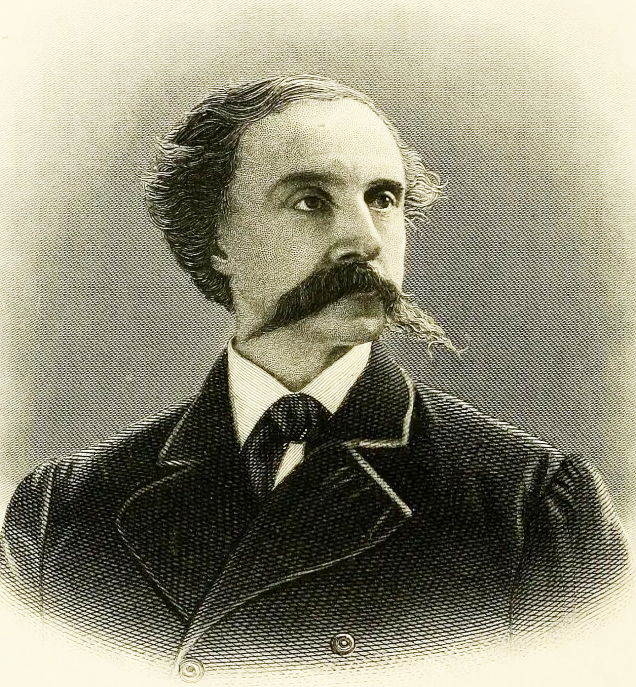
I recently learned that President Lincoln’s right hand man Secretary of State William Seward was attended to by Dr. Tullio Verdi. Seward was the man who advocated the purchase of Alaska (“Seward’s Folly”) from the Russians. (He should have purchased Greenland and saved us the angst today!) More relevant to this essay is that on the very night Lincoln was assassinated a hitman went to Seward’s home in Washington, DC and nearly stabbed him to death. It was Dr. Verdi who was called in to assess the wounds. Luckily, the wounds were not life-threatening but did damage Seward’s facial muscles. Dr. Verdi was able to stop the bleeding and bandage the Secretary of State. To spare Seward any further trauma, the doctor ordered that news of the president’s death be withheld from the Secretary. But Seward soon wondered why the boss hadn’t visited his bedside the next day. Seward went on to serve President Andrew Johnson and closed the Alaska purchase in 1867.
Dr. Verdi had come to America in 1850, a refugee from the failed Italic revolt against Austrian occupation. With a recommendation from Giuseppe Garibaldi (Garibaldi was also in exile on Staten Island at the Antonio Meucci house.), Verdi found a job at Brown University in Rhode Island teaching French and Italian. In 1857 he moved to Washington, DC and married a Brahman Anglo lady. The Seward family made him their family doctor in 1865.
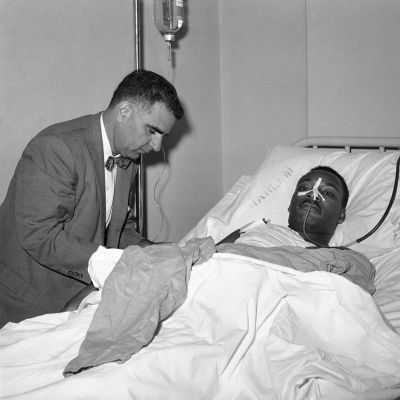
In addition to the examples mentioned above, Martin Luther King’s life was saved by Dr. Emil Naclerio in 1958 after the civil rights leader was stabbed by a Black woman during a book signing in Harlem. During the AIDS epidemic, it was Dr. Robert Gallo and Italian colleagues who discovered the HIV inhibitors capable of slowing the disease in 1995.
Considering this, isn’t it odd that Hollywood rarely casts television or movie doctors with Italian surnames? I suppose for “balance” Tony Soprano’s family doctor (Dr. Bruce Cusumano) and his shrink (Dr. Jennifer Melfi) are paesani. But multi-ethnic doctor/hospital television series relegate Italic professionals to the janitor’s closet.
Both in Italy and here, there is a plethora of Italic pioneering in medicine. Whole areas of medicine were “fathered” by Italians:
- The science of pathology was launched by Antonio Benivieni in 1507 whose work was improved upon by Giovanni Battista Morgagni (1682 – 1771), “The Father of Modern Anatomical Pathology.”
- Gaspare Aselli described parts of the circulatory system in 1625 before Willian Harvey’s more complete work (1628).
- Biologist Francesco Redi (1626 – 1697) is considered the “Founder of Experimental Biology” and “Father of Modern Parasitology.”
- Marcello Malpighi (1628 –1694) was the Father of Microscopic Anatomy. Some body parts are named for him.
- Girolamo Fabrizio (1533 – 1619) is the Father of Embryology.
- Scientist Gabriello Fallopio (1522 – 1562) explored the anatomy of the ear and reproductive system. The Fallopian Tubes are named for him.
To explain how Italy was able to produce such genius one must appreciate the Roman Empire and its power to aggregate both the knowledge and DNA of three continents into a relatively small peninsula – something many of our community in their ignorance still cannot fathom. Even during the “Dark Ages” Europe’s first medical school was founded at Salerno around the year 802.
Before the media can relate our achievements beyond being “cooks & crooks,” we must restore our own Classical mindset. –JLM
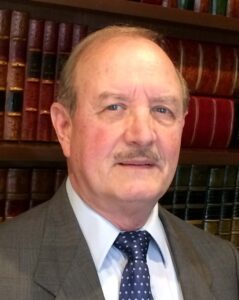
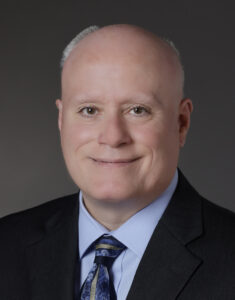
Dr. Naclerio was honored at a local MLK parade a few years ago, an event which, miraculously, did make the major media. But we need movies, not news clips:
https://www.cbsnews.com/newyork/news/nyc-surgeon-who-saved-dr-martin-luther-king-jr-from-1958-stabbing-honored-at-long-island-parade/#:~:text=Hempstead%20also%20honored%20the%20family,his%20first%20book%20in%201958.
Tremendous information.
Thank you for all your work to preserve our story.
If anyone is visiting Pittsburgh or nearby in the future, a must-see are the “Nationality Rooms” at the University of Pittsburgh, located in the heart of the city.
They are all impressive in their own way; however, the “Italian Room” has listings on the back of its chairs of universities founded in Italy going back to the first ones in Salerno and Bologna. The sheer amount of referenced universities is staggering.
This is why one-third of Shakespeare’s plays are either set-in-Italy or have Italian surnamed characters. Then, like now, the rest of the world recognized true genius.
And the portrait on the wall of the Nationality Room is of Elena Cornaro Piscopia, the first woman in the world—let us repeat that phrase: in the world–to receive a university degree (Padua, 1678). Mona Lisa Vita in “My Cousin Vinny?” Mamma mia!
Great piece by John Mancini!
Physicians with Italian surnames have a longstanding tradition of treating both renowned and everyday patients, which continues today. As a veteran healthcare journalist, I can tell you that Italian doctors, pharmacists, and medical researchers are ubiquitous in the U.S. and around the world. Considering that fact, yes, it is indeed odd that Hollywood rarely casts television or movie doctors with Italian surnames. A mere oversight, or something more nefarious? ? For example, the acclaimed medical television drama The Pitt, doesn’t have a single doctor with an Italian surname. If you picked mere oversight, you are incorrect!
Even more puzzlingly is the lack of Italians in war movies considering Italian-American massive participation in WW1, WW2, Korean and Vietnam wars.
The one WWII movie that portrays both Italian soldiers and Italian Americans is A Walk in the Sun. Takes place in the aftermath of the Salerno or Anzio invasion, following an American Army platoon loaded with diversity (except Blacks) I believe there are two IAs, one who speaks Italian and the other who takes the war in stride but wishes he were back in the states making money on the Black-Market shortages. When the platoon comes across two Italian Army deserters they are treated well but told to scram. Like all Allied-made movies during and after the war, Italian soldiers are portrayed either as quick to surrender or oppressed by the Fascists. The only movies I’ve seen that differ from this is The Immortal Sergeant, in which an Italian tank crew fights back and The Best of Enemies, a joint Italo-English movie that shows both sides as humorous victims in the fog of war. The Valiant is another joint venture that highlights the remarkable Italian sinking of the British fleet in Alexandria harbor in 1941. All these movies are very hard to find.
If you want a true accounting of Italy’s war effort you can find our report Italy at War in our Research Library at https://www.italic.org.