
It happened just last week: A few days before Thanksgiving, I was in a department store, looking for some early Christmas gift items, when I suddenly thought: “It doesn’t feel like Christmas yet.” And it didn’t. Temperatures in Chicago were still in the low 40s. There were even a few days of scattered sunshine and clear blue skies. And no snow!
Then, a few days after Thanksgiving, while driving home from another shopping trip, it became official: The local radio station in my car played a song that has become synonymous with the holiday season: Linus and Lucy, the famous ditty from the 1965 TV special, “A Charlie Brown Christmas.”
To quote a line from another song from that famous program: “Christmas Time/is here…”
Yet to me, this song not only represents Christmas—its sense of joy and love—but something just as evocative: the unending gift of Italic musical genius.
A few weeks earlier, I had the great privilege of attending a performance at the Lyric Opera in Chicago of the so-called “Cav/Pag” double bill: Cavalleria Rusticana (by Pietro Mascagni) and I Pagliacci (by Ruggero Leoncavallo). The two operas hadn’t been performed at the Lyric in over a decade. Yet these two short (90-minute) pieces of theatre still represent, even in a compact form, the strength and beauty of Italian musical composition.
I was joined at the show by my colleague Don Fiore, a local expert on both Italian aviation and Italian opera. “I grew up with this music,” Don whispered to me. Lucky him! And he still keeps in touch with it by playing with the local Caliendo Banda Napoletana.
(Sidenote: Someone else who became familiar with this music was filmmaker Martin Scorsese; he used it over the opening credits of his 1980 film, Raging Bull, thus polluting the sublimity of the music by associating it with a violent, wife-beating, thuggish boxer name Jake La Motta. Thanks, Marty!)
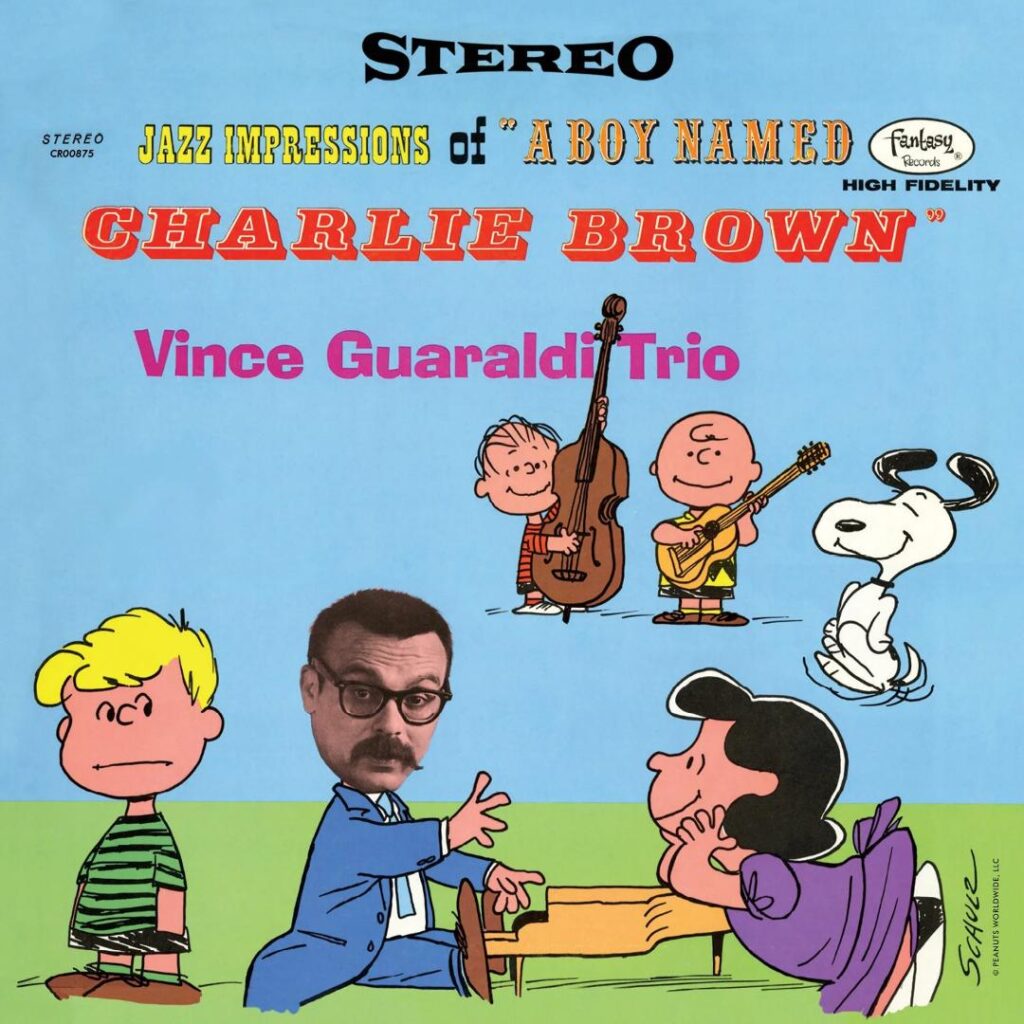
Yet there is a direct link between those two gentlemen and Vince Guaraldi, the man who composed the score for the Charlie Brown Christmas special. Actually, it was the Vince Guaraldi Trio, comprised of Vince (piano), Fred Marshall (bassist), and another Italian American, Jerry Granelli (drums). Guaraldi did what Mascagni and Leoncavallo did: he took a “popular” art form (a short story in Mascagni’s case, an alleged play in Leoncavallo’s) and imbued it with innovative melodies which still sound fresh 60 years later.
Did it matter that Guaraldi’s chosen genre was jazz music? It shouldn’t. Jazz has often been called “America’s classical music,” and is certainly more appreciated all around the world than in the United States, where it originated. The idea of a jazz musician being hired (by producer Lee Mendelson, a fan of Guaraldi’s) to score a children’s animated cartoon seemed truly odd at the time. Yet “A Charlie Brown Christmas” became a media sensation, thanks in large part to its memorable musical score.
Guaraldi’s musical prowess was nurtured in North Beach, the “Little Italy” of San Francisco where he grew up. After winning a 1962 Grammy award for his album, Cast Your Fate to the Wind, Guaraldi then composed a famous “jazz mass,” performed at San Francisco’s Grace Cathedral on May 21st, 1965. Seven months later, on December 9th, 1965, Guaraldi and his trio made American musical (and television) history, investing a simple children’s cartoon with wit, beauty and, yes, grace.
You don’t have to be a musical expert to detect a sense of italianità in Guaraldi’s score. Take the song, Skating, for instance, where the quick, fluttering taps on the keyboard are meant to evoke falling snowflakes. The sense of play and improvisation harkens back to Antonio Vivaldi, who used violins to evoke changes of weather in his Four Seasons.
Then there’s Linus and Lucy itself, a song so infectious, from its very first few notes, that I defy anyone to immediately not start tapping their toes when they hear it. (Indeed, I started doing so on my brakes when I heard the song in the car and almost ran off the road.) This is similar to opera composer Giacomo Puccini’s great gift—his ability to infuse passion into his music from the get-go. How he did this, I do not know. And I also don’t know how Guaraldi did it. But I come back to my original point: Italians know music.
Also: Maybe there’s a mystical connection via the piano (Guaraldi) and the violin (Vivaldi)–instruments which were both invented by the Italians? You tell me.
Yet with the joy comes the sadness. Guaraldi died of a sudden heart attack at age 47, thus depriving the world of possibly more great tunes. And, as per the point we at the Italic Institute continually make, his being an Italian American is a fact ignored by our fellow Americans. Hollywood has conditioned people to use a specific M word when it comes to Italians, and you know what it is.
Another, more factual “M” word should be applied to us—musicians. I’d even add yet another “M” word: magnificent.
In Charles Dicken’s famous shorty story, A Christmas Carol, the miserly Ebeneezer Scrooge learns the true meaning of the Christmas spirit after being visited by three actual spirits: the ghosts of Christmas past, present and future. It took him a long, lonely night to do so. Too bad they didn’t have phonograph machines in 19th century England. Ol’ Ebbie could have listened to “A Charlie Brown Christmas” and thanked Vince Guaraldi.
The next time you see any of the various Christmas Carol movies on TV, turn the sound down at the end and play Linus and Lucy while Scrooge is dancing in the streets. Talk about a perfect match. ‒BDC



This is a beautiful, touching and informative piece of writing.
Kudos to “Chef” Dal Cerro. I’d like to add a kudo for Charles Schulz, the creator/artist of Charlie Brown. He wasn’t Italian (but should have been). His art was the cake; Guaraldi’s was the icing.
Thank you, Bill, for these sentiments. You know from my interview with our Institute and from personal discussions what my musical heritage means to me. I have the complete piano Guaraldi Christmas Book and have taught students all the songs from the show including his jazz arrangement of “O Christmas Tree”. You might be interested to know that the snowflake effect you mentioned is achieved by parallel 3rds on the piano, a very challenging technical devise. I’d like to add while we’re touching on Italic Christmas genius in music, the opera “Amahl and the Night Visitors”, by Italian born Gian-Carlo Menotti, an outstand genius in the development in operas in English. Amahl premiered on NBC Opera televised 12/24/51. His “The Saint of Bleeker Street” was featured on Ed Sullivan.
Bill – thank you for what you do.
Thanks for highlighting the contributions of Guaraldi. As a musician, I’ve tried (and failed) to duplicate his voicings in other pieces. His open chords (9ths, 13ths and variations) are so inviting to the ear. He was the antithesis of the be-bop approach of the 1950’s, which may have turned off listeners to jazz. One can understand why the “suits” may have been reluctant to put a jazz soundtrack to something as mainstream as Peanuts. But, credit goes to the producers and Guaraldi for creating timeless music that I still play today with bands.
Thanks, Bill, for your music essay. We Italians love music. And if you go to You Tube and type in my late son’s name: Frank Rosati, you’ll hear Linus and Lucy. He was in the Frank Barbera Trio.
BTW, my favorite operatic composer is Giacomo Puccini….I saw Madam Butterfly when I was 16 years old, thanks to our Long Island City High School music teacher, who gave us FREE TICKETS to NYC Opera!!