
The two oldest man-made objects standing outdoors in our country are from Italy.
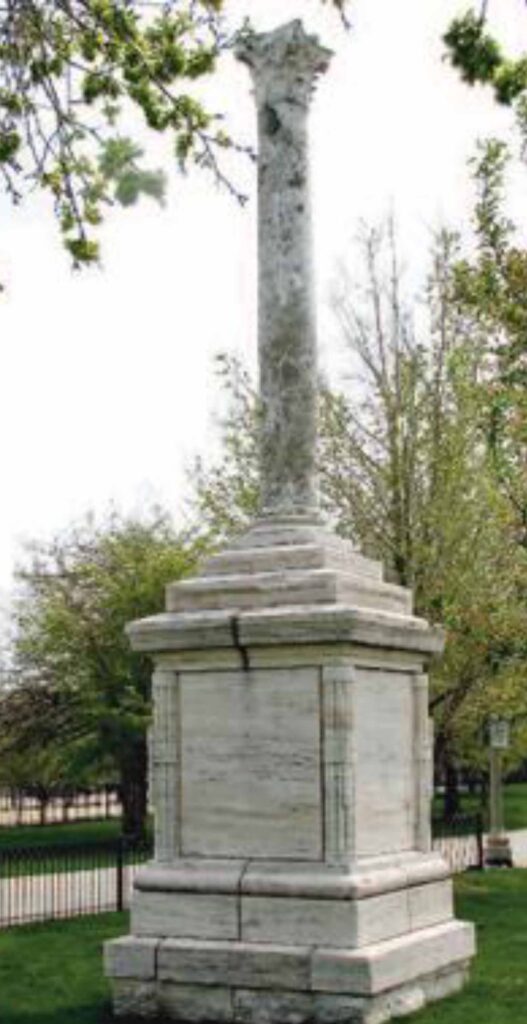
One is the Balbo Column in Chicago, a gift from Mussolini to commemorate the mass flight across the Atlantic by 24 Italian seaplanes in 1933. The other, actually a pair, are columns gracing the entrance to Delmonico’s Restaurant in Manhattan. The Balbo column came from Ostia Antica, Rome’s ancient port city. The Delmonico columns came from the ruins of Pompeii, according to the restaurant’s founder. In short, these Italic artifacts are over two thousand years old.
I’m not talking about museum exhibits but actual items from Classical Italy open to public inspection. Even the Indigenous cliff dwellings of the Southwest are only a thousand years old. And the Vikings, if they really landed in Newfoundland, left more to the imagination than actual works.
The good news is that this blog is not about stone columns but a lead-in to Delmonico’s. This Manhattan landmark has achieved another first in being the oldest continuing fine eatery in the city. Sure, there are Fraunces Tavern (1762) and Ear Inn (1817) that predate Delmonico’s (1827) but they are far from fine dining experiences. George Washington reportedly messed on Chicken Pot Pie at Fraunces; and Ear Inn catered to longshoremen (a discerning bunch!) But Delmonico’s was mainly a steak house, even has a steak named for it—an 18-oz thicker-cut boneless ribeye…$89. Wanna 22-oz with bone…$98. That’s doggy bag big, with a bone for the doggie! Chef Alessandro Fellippini (from 1864-1888) developed the restaurant’s culinary identity as a steak house.
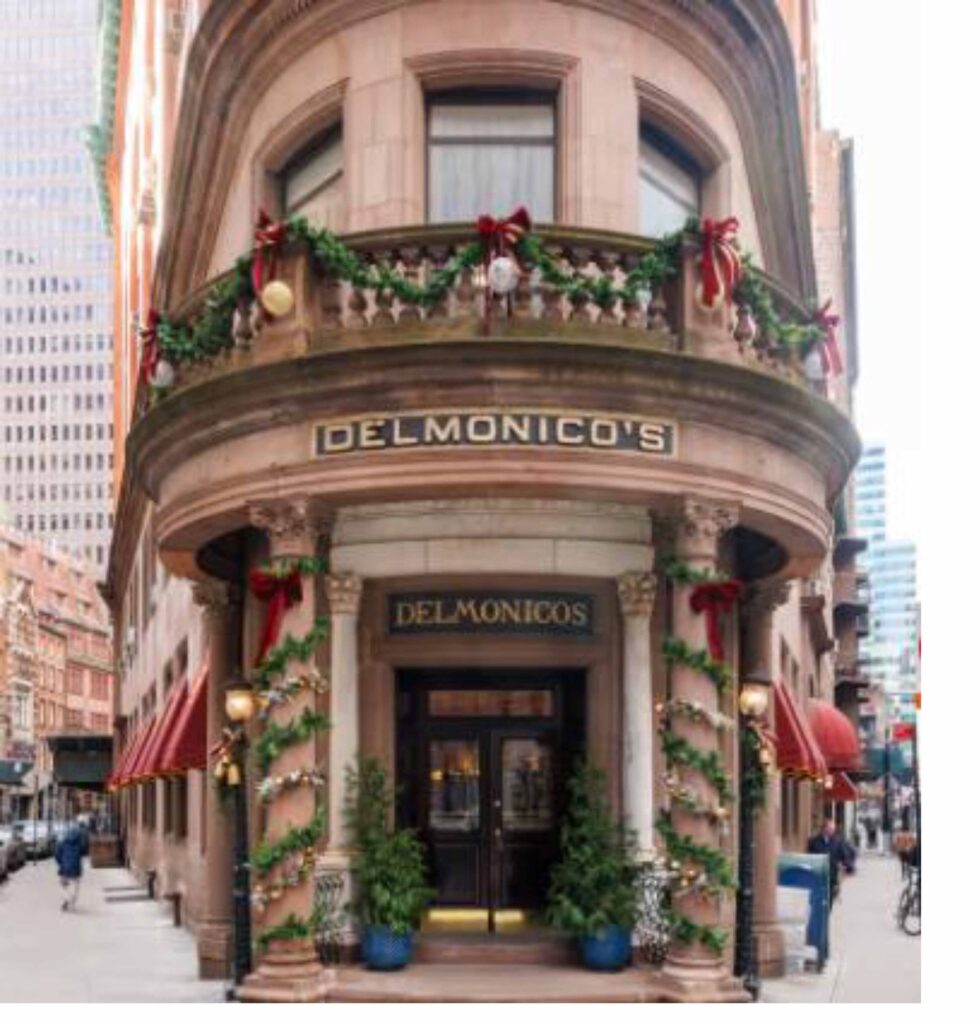
frame the entrance
As for the history of this renowned restaurant, it was opened as a pastry shop by two brothers from Switzerland, ethnic Italians named Giovanni and Pietro Delmonico. They were later joined by nephew Lorenzo who created the upscale menu and the largest private wine cellar in New York, now over 1,000 bottles. It was Lorenzo who imported the Pompeian columns. The Great Fire of 1835 burned down the restaurant as well as hundreds of other buildings extending for 17 blocks of lower Manhattan. The Roman columns survived and became a symbol of recovery for Delmonico’s.
Starting in the 1850s, Delmonico’s reputation became international. It was the French Laundry (recall the Gov. Gavin Newsom infamy) in its day when Republican presidential nominee James G. Blaine was spotted there by the press in 1884. He was no longer a “man of the people” and lost New York State by 1,000 votes and the election to Grover Cleveland. That ribeye cost him plenty!
Old menus online show that Delmonico’s was shy on Italian cuisine. The wealthy public hankered for haute French cooking. But I found mortadella as a “side dish” (50¢) in 1899 and “Spaghetti, Neapolitan” (50¢) “Macaroni, Italienne” (40¢) or risotto (40¢) as “Vegetables.” If you really wanted to dine Italian Little Italy was a mile north and meals a lot cheaper. Delmonico’s menu today is geared more to steaks (but not Florentine) with the Italian choices limited to burrata as an appetizer ($27), and entrees Caviar Lemon Pasta ($55) or Risotto ($46).
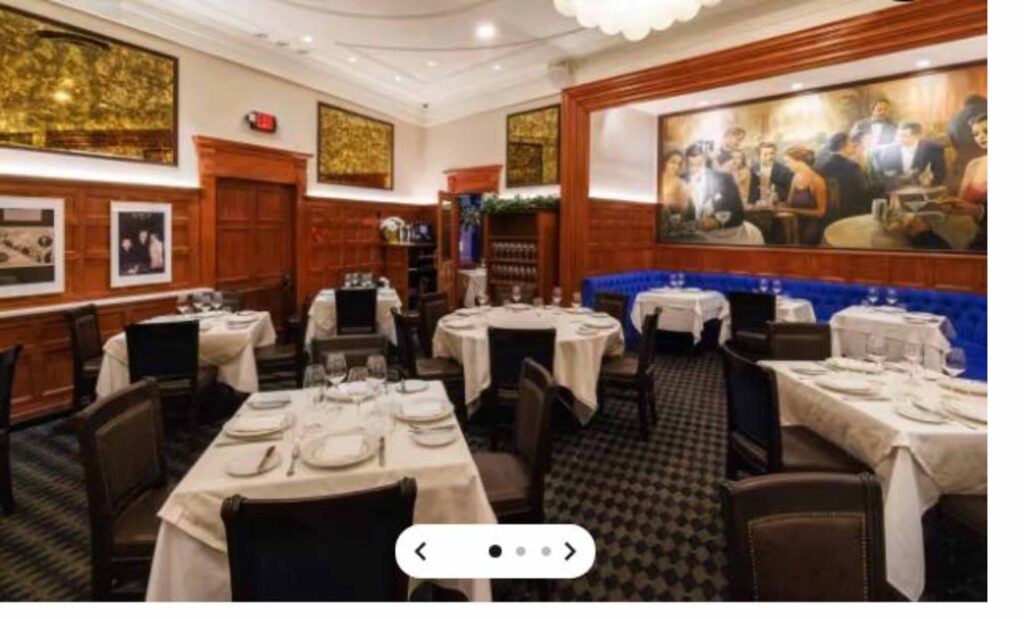
Beside the first ancient columns in America, Delmonico’s blazed the gourmet trail. The first in New York City to offer diners a menu. Inns and taverns back then had fixed price specials not a la carte. In 1876, it created Lobster Newberg, a cream & cheese-ladened entree with sherry. Eggs Benedict was born there, as was Baked Alaska, named to celebrate “Seward’s Folly.”
Delmonico’s was the go-to place in New York. Among the celebrities it has hosted were Charles Dickens, Samuel Morse, Mark Twain, Oscar Wilde, Marilyn Monroe, Frank Sinatra, Elizabeth Taylor, Elvis Presley, Jackie Onassis, and U.S. presidents Abraham Lincoln, Theodore Roosevelt, John F. Kennedy, and Richard Nixon. A total of eleven presidents and counting. I’m sure Donald Trump has eaten there at one time.
The restaurant is no longer Italic-owned. But its last one, Oscar Tucci (from 1926 to 1977), maximized the brand and celebrity status. Tucci also instituted many of the professional standards in use today in American restaurants known as the Delmonico Way, a method that is explained in the book The Delmonico Way; Sublime Entertaining & Legendary Recipes from the Restaurant that Made New York! by descendant Max Tucci.
So, add this historic restaurant to your bucket list. -JLM


As important as these monuments are, it really is a sore point with me, that a committee I worked on, could not rescue a building built by an Italian “49er, in Angels Camp, California…in the heart of the gold country. The building, called the Romaggi Adobe, is in reality a stone building, built by a Ligurian stone mason immigrant in the 1850’s and even predated the founding of the Kingdom of Italy…..After an exhaustive search for funds, and the death of the chair of the committee, we could not continue the struggle……so there it sits in semi rubble…..We tried so many grants and resources but nothing major was forthcoming. I even tried the SF 49ers, since it has an Italian ownership, and a team name perfect for the connection.
..Ironically in the hometown of the builder, in Romaggi. Liguria there are many buildings much older still in use. I even tried national historical trusts to no avail….Be that as it may, the site serves as an important reminder of the Italian pioneers who were a part of the legendary California Gold rush.. If your read any sort of public and or school text on the gold rush it really erases the diversity of people who came to California…..and of course among the erased were the italian immigrants still a part of the community and names such as Romaggi, Martini, Peiriano, Gazzola, Arata , Rossi and more ; they still abound in 49er country today. Not only did they strike gold but help build many thriving communities. It was also the birth place of one of the first major Italian American mayors in the country Angelo Rossi of San Francisco…..
KEN: Kudos to you for your heroic (and lonely; quite typical of our community) search. If ever there was a national project worth preserving, it’s the Romaggi Adobe. Excelsior!
Your mentioning of the West Coast also ties in with Mr. Mancini’s blog–namely, that yet another famous Italian-owned restaurant is still with us, on the other side of the map.
I’m speaking of Musso and Frank’s Grill, a magnet for both early Hollywood stars (Chaplin, Valentino, et. al) and struggling 20th century writers (Fitzgerald, Raymond Chandler, etc.).
And yes, we rightfully glorify Fiorello LaGuardia as New York’s greatest mayor, which, indeed, he was; yet Mayor Rossi in San Francisco actually preceded him by a year or two.
As a wag said: “Hollywood seems to think Italians never went west of the Hudson River.”
Here is a write-up from Musso and Frank’s website:
“In September 27, 1919, The Hollywood Citizen ran an announcement about the opening of Frank Toulet’s new restaurant, Frank’s Café at 6669 Hollywood Blvd. In time, Toulet partnered with restaurateur Joseph Musso. As the owners of the new Musso & Frank’s Grill, they hired French chef Jean Rue, who created the menu — much of which remains unchanged even today.
The pair sold the restaurant in 1927 to two Italian immigrants, Joseph Carissimi and John Mosso, who years later moved The Musso & Frank Grill next door to 6667 Hollywood Blvd., where it still stands.
Musso’s exclusive, storied Back Room opened in 1934. Guarded by a discerning and austere maitre d’, the Back Room was a legendary private space reserved for the Hollywood elite.
Eventually, the lease on the Back Room expired. Today, the restaurant’s New Room holds the Back Room’s original famous bar, light fixtures and furniture from 1934.
As the years have passed, so too have the beloved generations of Musso’s. The great chef, who led the kitchen for more than 53 years, passed on his torch as well. But the generations have kept the dream alive — first by Carissimi’s son, Charles, and his wife, Edith, and Mosso’s daughter, Rose, and then by Mosso’s granddaughters. Today, Musso’s is owned and operated by John Mosso’s three granddaughters and their children.
The generations may have changed, but one thing never has — our family’s uncompromising dedication to delivering the renowned service and fine cuisine that first made Musso’s famous.
A couple of more “Italic first”:
– The first American Conservatory (American Conservatory of Boston)
– The first American Opera (The Venetian Maskers).
Thank composer Filippo Traetta, who studied in Naples and whose father was a famous musician from Puglia. They will never made a movie about him (like the one they did for Leonard Bernestein).
His story does not fit the overblown narrative of Southern Italy being an uncivilized country full of unskilled peasants.