
Filmmaker Ken Burns has contributed a body of work documenting the great American experiment, some 40 films, offered free to the American people via PBS. He has educated viewers on subjects as diverse as the history of the Brooklyn Bridge to the Vietnam War. His latest entry is a 6-part series on the American Revolution.
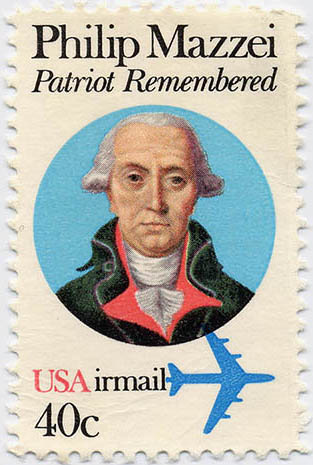
Burns is very much a champion of underdogs and of the least heard in the eras he documents. The American Revolution is chock full of testimonies by Native Americans, colonial women, and enslaved people of the time. Burns misses few side stories or personal testimonies in fleshing out the full story and exposing patriotic myths. But my associates Bob Masullo (Sacramento) and Bill Dal Cerro (Chicago) noted that the documentary neglected to mention such men as Filippo Mazzei or Francis Vigo, two Italians who had more than a passing role in the American Revolution.
Filippo Mazzei came to colonial America in 1773 at the invitation of Virginia planters that included Thomas Jefferson and George Washington. In fact, Benjamin Franklin who was in London at the time, and had met Mazzei there, recommended the Italian. Mazzei was an exporter of Italian products as well as a surgeon. The planters wanted to expand their crops to grapes and new varieties of vegetables.
Mazzei arrived with seed stock and a group of paesani gardeners to teach Virginian slaves viniculture. But he soon involved himself in American politics. He was an outspoken critic of the English and urged Jefferson toward independence. Mazzei also relayed confidential news from his London associates and that of the Duke of Tuscany whose kin included the royal families of France and Spain. It is generally accepted that Jefferson’s “All men are created equal,” was inspired by Mazzei’s op-ed in the 1774 Virginia Gazette (which Jefferson himself translated into English) “Tutti gli uomini sono per natura egualmente liberi e indipendenti”
An intellect himself who spoke English, Mazzei could easily discuss the Roman Republic as a model for an independent United States instead of an Anglo parliamentary system. He may have even personally known and quoted Cesare Beccaria, whose 1764 book on criminal justice inspired the Founders to later add “no cruel or unusual punishment” in the Bill of Rights. [Mazzei’s]…zealous cooperation in the establishment of our independence…acquired for him here a great degree of favor.” – T. Jefferson, 1816, upon hearing the death of Mazzei in Pisa.
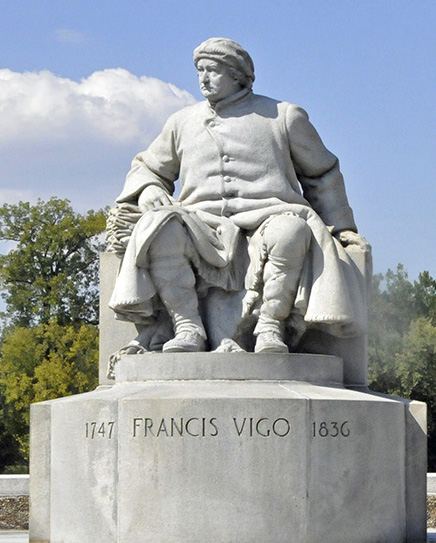
This statue stands in Vigo County, IN
The Burns documentary also omitted Col. Francis Vigo who aided in securing the Northwest Territory beyond the Appalachians for the new nation. The territory later became the states of Ohio, Indiana, Illinois, Michigan, Wisconsin, and part Minnesota. But during the Revolution it was held by the British and their Indian allies. The Congress had sent George Rogers Clark (later of Lewis & Clark) to capture the few British forts situated there in advance of an American influx of settlers. Francis Vigo, an Italian merchant employed by the Spanish governor of Louisiana, spoke French and probably some Spanish. French was the lingua franca of trade with the Native Americans along the Mississippi right up to Canada. By the time Clark embarked on his mission in 1778, Vigo had been cultivating relations for four years with both the Natives and French trappers. The Indians trusted Vigo and the French hated the English.
Clark was in a precarious position. He didn’t know if the Indians would fulfill their treaty obligations with the British, and he didn’t know how strong the British force at Vincennes (Indiana) was. Vigo was the key to success. Not only did Vigo influence the Indians to remain neutral but his language skills brought Clark a contingent of Frenchmen to double his attacking force. He even lent the Continental Army $1,452 for a keel boat, two cannons and a crew of forty men. As for Vincennes, Vigo’s spies reported that the post was ripe for capture. Clark had everything his needed for victory. Soon thereafter 20,000 American settlers poured into the territory.
In 1800, Vigo was made a colonel in the Knox County Militia and that county was renamed for him. Vigo was never repaid for his loan while alive. But in 1876 the U.S. Supreme Court ordered his heirs paid with interest that amounted to $49,898.60. ‒JLM

This is a sore point with me,(especially regarding Burns sweeping historical panoramas) we are constantly out of the loop when it comes to Italian American history, and our contributions to this great land. While some groups are automatically included these days, we are out of the “elect”. (From both the right and left in political thought)
And this is why, its important to have these media alternatives available to at least potentially share and pass on a more relevant reality within our respective contacts. Sometimes it feels like preaching to the choir…..still a melody may carry forth….
There are two significant reasons why such omissions occur. One, we have far too few of our own in media, and two, the few that we do have, have little or no knowledge of our history.
The fact that we don’t make alliances with other groups who could support us compounds the problem. The main enemy is us.
Any amateur historian knows that the American forefathers were heavily influenced by the Roman republic. They know that Mazzei’s words inspired Jefferson. They know that the fasces, the symbol of ancient Roman authority is found in the U.S. Capitol.
Ken Burns in no amateur historian! Why then, did he omit this information? If I were a conspiracy theorist, I would suspect that someone had an agenda. Was it Burns? What is the writer of the documentary, Geoffrey Ward? Or producer, Sarah Botstein?
It is no coincidence that these experienced documentarians and historians left this information out linkin Rome, and Italians to the founding of America. If you think that it is, you are pathologically naïve.