
The American Film Institute (AFI) honored Francis Ford Coppola last April, and I caught a rebroadcast last week. The filmmaker was lauded to the heavens for works as diverse as Peggy Sue Got Married to The Cotton Club and Apocalypse Now. But the festivities at the AFI were clearly centered around The Godfather.
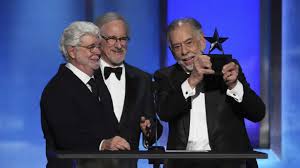
Spielberg (sharks and Raiders), Coppola (murderers & thieves)
Josh Groban performed the theme song from The Godfather series “Speak Softly, Love”— only he sang the traditional lyrics in Sicilian dialect “Brucia la Terra” (“The Land Burns”). The AFI audience was further blessed with a Sicilian menu that included tomato-braised beef arancini, fennel salad, pan-seared bronzino, veal marsala, and a trio of cannoli. This feast was washed down with wines from the Coppola Estate. Had he been honored for The Cotton Club the guests would have perhaps gnawed on ham hocks, collard greens, and Colt 45.
Interestingly, I didn’t catch anyone uttering the words Italian or Italian American during this lovefest. As we know The Godfather wasn’t about our ethnic group. According to Coppola, “I’ve always felt The Godfather was really less about gangsters, than about power and powerful families, and the succession of power, and the Machiavellian way that real power works in the world,” as told to the BBC’s Barry Norman in 1991.
That Coppola is among the best American filmmakers living or dead there is no doubt. His success has been varied because he is a true artist, not always concerned with box-office or moral messaging. He’s taken many risks for his art, even going bankrupt three times after making a mint with The Godfather, due to bad films or his obsession with vineyards and vintage cars. His latest dog is Megalopolis in which he poured $120 million and has so far grossed only $10 million.
The truth is that this genius has relied on his heritage and the exploitation of his own people to reach the top of his profession. Before The Godfather, he was a run-of-the-mill director devoid of Italian inspiration, to wit:
Tonight for Sure (1962) was a low-budget, sexploitation comedy film, his directorial debut.
The Bellboy and the Playgirls (1962): Another sexploitation film.
Dementia 13 (1963): A horror thriller film.
You’re a Big Boy Now (1966): A coming-of-age comedy.
Finian’s Rainbow (1968): A musical fantasy film and box office flop.
The Rain People (1969): A road drama with only a minor cult following today.
In short, Coppola was saved by Mario Puzo, author of the 1968 bestseller The Godfather, and their common background in Italian American culture. Together, they hit upon a formula that Hollywood hadn’t discovered in decades of gangster movies: to make crime movies without any good guys. Flesh out the real-life headlines of mob hits and Senate investigations into organized crime and link them with the innocent Italian American culture that Puzo and Coppola grew up with – weddings, baptisms, family dinners, immigrant parents, the music, the food, the emotions. Hollywood had touched on Irish culture in Cagney gangster movies of the 1930s but neither Little Caesar nor Al Capone films had authentic Italian trappings. Write what you know, as would-be authors are told, and the Puzo-Coppola team went all in.
At the AFI ceremony Steven Spielberg called The Godfather the “…greatest American film ever made. You have taken what came before and redefined the canon of American film, and in so doing, you’ve inspired a generation of storytellers…”
Coppola surely did inspire Martin Scorsese, David Chase, and a host of others to our disservice. -JLM



It is so sad, Coppola like many of his kind are so ignorant. They become rich hurting Italians in so many ways. It is no wonder the Ameicans are brain washed about us. So many like Coppola could use their talents to raise us up. They don’t, they get rich destroying our image. I am sorry to say too many italian Americans support what they produce. I have been told to lighten up when I speak against what they are doing. No I won’t! They need to be told they are traitors!
Earlier this week Francis Ford Coppola underwent a cardiac procedure at Rome’s Policlinico Tor Vergata hospital.
He was under the care of renowned Italian-born cardiologist Dr. Andrea Natale. Natale, the executive director of the Texas Cardiac Arrhythmia Institute in Austin, Texas, is an electrophysiology specialist who pioneered several treatments and devices for the treatment of such disorders including atrial fibrillation (AFib) treatment.
Natale went to medical school at the Universita’ degli Studi di Firenze, School of Medicine and Surgery, Firenze, Italy.
He’s completed fellowships in Cardiology and Cardiac Electrophysiology at the University of Western Ontario, Department of Cardiology, London, Ontario, Canada, University of Wisconsin, Sinai Samaritan Medical Center, Milwaukee, WI.
Oh, the irony!
Coppola the godfather [pun intended] of pernicious stereotypes and caricatures of Italians and Italian Americans – was helped by one of the most respected cardiologists in the world.
An Italian cardiologist!
Yet, the negative images and depictions of Italians that Coppola helped to create are the anthesis of what Dr. Natale represents.
Because of the godfather, goodfellas and the sopranos – that last image that comes to mind when most people think Italians is a world renowned cardiologist and executive director of the Texas Cardiac Arrhythmia Institute.
No, instead they think of sociopathic low-life criminals and food.
Like John Mancini correctly points out: Coppola, thanks to Puzo’s overrated novel, managed to blur the lines between the sociopathic thugs and real world, “innocent Italian American culture.”
There are a lot more Dr. Andrea Natale’s in the world – but you’d never know if you watch television or go to the movies.
The most disturbing part of Coppola’s health news in Italy is that Italian media outlets have celebrated Coppola, emphasizing his Italian roots with pride. No reference to the enormous damages he has made to Italy and Italians. My only explanation is that most Italians are not aware of the magnitude of stereotypes. Even journalists from major national media outlets never mention them.
I can only say, “Ditto.”