
Christmas and New Year’s Day were handed down to us centuries ago. Their message is actually the same—a new start. Christianity was launched with the birth of a child and January 1st opens a new year.
Both events coincide for a practical rather than a celestial reason. In their eagerness to find a way to celebrate the birth of Jesus, early Christians spirited away the Roman holiday of Saturnalia from the pagan Italic people. That December festival already had all the elements of the Christian message.

The city was founded and named for a Roman camp (castra)
Saturnalia ran from December 17th through the 23rd. It was a time of gift-giving and the relaxation of rules, household slaves were given time off to represent the coming of Saturn’s “golden age” when there would be no wars and equality would reign on Earth. What a perfect fit for Christmas! But there was more.
Some forty years before the birth of Jesus, Roman poet Virgil wrote of Saturnalia:
“Now the Virgin returns…a new race descends from heaven. …smile upon the boy just born, in whose time [wars] shall cease and a golden race shall arise throughout the world.”
Virgil was actually predicting Augustus and the Pax Romana, but it was easily spun for Christianity. The early Christian fathers were master salesmen. St. Paul had already eliminated the Jewish requirement for circumcision, a short “cut” to conversions. Now they found a reason to date the birth of Jesus in December (only Luke and Matthew even mentioned the savior’s birth, without a month.)
As for New Year’s Day, the Romans used to celebrate that in March, the reason the months of September through December are now numbered wrong. In 153 B.C. they made it January 1st and named the month for the double-faced god Janus, who symbolically looks backward and forward.
So much of Christianity was molded by pagan Romans that none of the 12 Apostles would even recognize what became of it. Jesus’s own brother James (only the Catholic Church considers him a “cousin.”) refused to recognize the uncircumcised converts Paul was bringing in. The early church was splintered into scores of sects until the Roman emperors forced a unity of doctrine and leadership, eventually bestowing on it the secular powers of Rome.
Jews still deny Jesus was the Messiah, who was not supposed to reform Judaism but rather liberate Judea from the Romans. In fact, Jesus was crucified for political reasons, not religious by Pontius Pilate (INRI – “Jesus of Nazareth King of the Jews”). The High Priests tried to stamp out the fledging sect, even killing James while the Roman governor was away from Judea in A.D. 62. Both Peter and Paul fled to Italy to escape angry Jewish communities. What began as an internal Jewish reformation ended up a pagan reformation.
Muslim clerics don’t consider Christianity a monotheistic religion because of all the saints we worship. But it was a selling point for Christian missionaries. Pagan worship included gods for all occasions. Pagans couldn’t imagine one God doing all the work. He needed intermediaries to sort out requests. Adding Christian saints allowed for some religious tolerance as different ethnic groups or cities could honor them without being labeled heretics. (Unfortunately, Islam has yet to come up with a better system.)
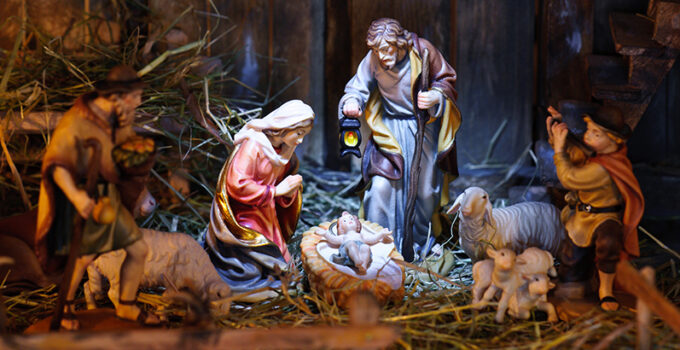
The whole focus on a “holy family” was the doing of St. Francis in 1223 and Italian artisans through 3-D Nativity scenes (il presepio) and paintings. It is this element that is the gem of Christianity. The basic unit of human society—the nuclear family—delivered a universal message that echoes throughout the ages: love, unity, and a new beginning all assembled in a stable.
It was St. Francis who grasped the essence of Christianity. –JLM

One of the joys of traveling is experiencing different interpretations of a similar experience. Currently I am in Buenos Aires, for the holiday, and while there is some commercialism, what struck me was the balanced perspective of the Christmas feeling and the human scale of it….some simple decorations, and warm greeting even to strangers, made it so special. I noticed too people going out in small groups and having dinners during the season, but it was the interaction that was dominant, and not so much the materialism, that starts now , after Halloween and runs through Dec 25. It was fun too, to read the menus which were of course in Spanish describing Italian dishes. It really is a Spanish/Italian fusion culture, and having a last name ending in a vowel, added to the experience.