
This week the Irish celebrate an Italic saint while we celebrate a Jewish one.
The Roman St. Patrick not only led the conversion of heathen Celts but taught them to read and write in Latin, which they parlayed into “saving civilization.” St. Joseph, on the other hand, went from honorable mention in the Bible to the icon of Father’s Day (March 19th) in Italy.
Fortunately, St. Joseph is not recognized in Islam—though Mary and Jesus are—so what I’m about to write will not open me up to a fatwa. But some Sicilians may doubt me. Joseph and all the other saints that Italic people revere have diverted us from our classical heritage. It was planned that way by the Christian fathers who despised those pagan Romans who actually created the “Roman” Catholic Church.
You may know that the word pagan comes from the Latin paganus meaning a country bumpkin. It was these rural Italic people that clung to the old heathen ways while the city folk readily adapted to the latest “cult” in vogue. (An example was the mother-like Egyptian goddess Isis that swept Rome before St. Mary arrived.) Converting the rustics to Christianity meant swapping their Italic gods and goddesses for Jewish miracle-workers—both the Old and New Testaments were full of them. St. Joseph became the patron saint of families and fathers, owing to his acceptance of a pregnant Mary as his bride. Clearly, this alone earned him sainthood because he performed no miracles in any of the four gospels.
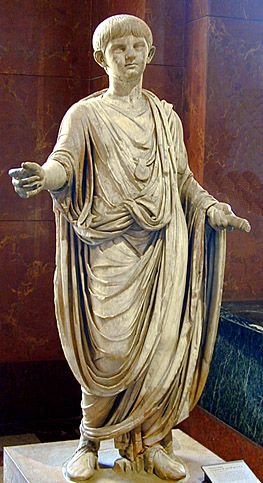
adult togas and registered to vote.
Not for nothing are Jews called the “people of the Book,” just as today their creative writing loomed large in comforting pagans in a tough world when their own gods fell short. St. Joseph took hold in Sicily during a drought and famine in the Middle Ages. Prayers to him opened the skies, ending the famine. Since then, he is honored by offering food to the needy by way of an abundant Tavola di San Giuseppe every March 19th.
Were we still a classical people and kept our ancient traditions as the Jews have done March would be full of special days. March 1st was Rome’s Mother’s Day (Matronalia), Of course, today is the Ides of March, the day Julius Caesar was assassinated, a day of mourning. But St. Patrick’s Day would be our version of Bar Mitzvah or Confirmation—the passage to manhood by Italic boys occurred every March 17th for boys reaching sixteen that year. It was called Liberalia. Fathers took their sons to City Hall to register them as voting citizens and to don the adult toga. As the name implies, the boys were free to become men. Christianity converted this Italic family tradition from a civic function to a religious one.
And so it went, Christianizing pagan Italy, especially in the south, eventually led us from a classical people to one with no memory of our ancient past. Our grandparents came from villages with plenty of churches but few schools or libraries. Imagine Jews without Moses, David, or Solomon, they would still be wandering, Israel a vague memory. Or today’s Greeks without a photo of the Parthenon or a classical statuette in their homes—My Big Fat Greek Wedding wasn’t just a movie; it was a message.
This religious monopoly of our past reverberates beyond our classical legacy. We easily remember the traditions of St. Joseph’s Day down to the correct pastry, but what to do for Columbus Day? Not even Genovese pesto is on our menu. Traditions need symbolic acts and for Italian Americans only Catholicism has them.
Greek and Jewish Americans have struck the balance between their classical past and religious observance. It should not be a secret why the Renaissance began in the northern cities of Italy where the Church did not dominate. Those cities maintained their classical connections.
It’s a lesson we shouldn’t ignore. –JLM



Recent Comments