
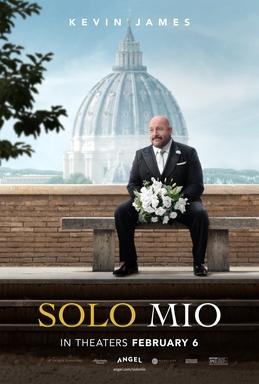
I have long given up on American filmmakers ever doing justice to Italy on the screen. Granted, it’s hard for any filmmaker who didn’t grow up in a specific country to know all about its cultural or historical nuances, even routine things like the way people talk or interact.
Whenever I see a film set in Italy, I have since conditioned myself to ignore the plot or acting (usually awful) and, as a character in Kevin James’s new film, Solo Mio, says, “Just focus on the landscapes.”
This new film, featuring the former star of the popular TV show King of Queens, breaks no new cinematic ground. The plot has its Hollywood holes, and you get the usual cliches of people rolling pasta or raising wine glasses like trophies.
But beggars can’t be choosers. I had to grudgingly admit that the film is better than the usual, condescending, Italy-is-a-postcard-paradise confection. How is another set-in-Italy movie a prosciutto cut above the rest? I count the ways.
First, James, heretofore known as a comic actor, shows some seriously good acting chops. He plays a regular guy who goes to Rome for a destination wedding only to be left at the altar by his nervous bride, who flees elsewhere in Italy.
(Note: One would think his first order of business would be to track her down, or that members of the wedding party would still stick around to console him—two major gaps in the early part of the film. But, that’s Hollywood.)
Despondent, James’s character (whose fiancée is an Italian teacher at an elementary school back in the US—one of the film’s many positive takes on Italian culture) mopes around the hotel until the sympathetic desk manager tells him to go ahead and enjoy his honeymoon anyway. You know, when in Rome, etc. Everything is paid for. La dolce vita awaits!
Though he tries his best, he sticks out like a sore thumb when riding his bicycle built for two on daily city tours. His lonely guy status attracts the attention of two married American couples who bring him into their orbit and try to comfort him. The couples are a bit cartoony but not overly so. In fact, the best dramatic scene in the film involves the two men coming over to James’s room late at night as he has an emotional breakdown. So much for la dolce vita.
And yet, the concept of la dolce vita is soon instantly resurrected via the second fresh element in the film—a completely believable female character named Gia, a local caffe manager. She is played by Nicole Giramaudo, a face new to me but semi-known in Italy via TV work. The Italian women in set-in-Italy films are usually seen through the eyes of American males—and not completely unfairly—as voluptuous sirens. Yet this is the first time I can recall seeing a middle-aged Italian woman who suggests so many regular, everyday women in Italy—witty, charming, casually sophisticated. Brava!
The third fresh element in the film is the use of (finally!) more contemporary Italian music. We hear tunes from well-known groups like Ricchi e Poveri and legendary singers like Mina. We even hear America’s own Nat King Cole, who also occasionally sang in Italian. My only caveat, a minor one, is the overuse of Puccini’s great aria Nessun Dorma from Turandot. It remains an operatic classic but it’s becoming as beloved as tiramisu, hence a borderline cliche. Andrea Bocelli just sang it at the Olympics, as Luciano Pavarotti did at the Torino games in 2006. Even TV commercials use it.
Yet even here, I tip my hat to the filmmakers for respecting the power of the song. In one scene, a lively disco hall becomes quiet as a musician on-stage begins a solo rendition of it. People stop what they’re doing and listen. They know quality when they hear it. This totally rings true. In an American bar, people wouldn’t be able to keep still at all.
And in another scene, James nervously sings the song at a family gathering, hoping to impress Gia. His voice wobbles at first, then gets stronger and more confident as he finishes. Again, totally spot-on. Puccini’s genius was a rare one—he literally infused his arias with emotion from the word go. Even a so-so singer can’t help being swept away. Bravo!
So, who are the filmmakers to whom I owe a bravi? It’s actually a team of eight, the Kinnane Brothers of Rhode Island. They started out fooling around with their parents’ VHS recorder years ago (ah, nostalgia) and have since formed their own production company.
During the pandemic, they hooked up with James, who had admired a previous short film which they did. They produced a series of humorous short videos with him on YouTube which went viral. After the pandemic, they made a 2022 football film with him called Home Team, which became a hit on Netflix. They then produced a 2024 documentary about a local, legendary Rhode Island surfer and skateboarder, Water Brother: The Sid Abruzzi Story.
Solo Mio is their first mainstream film. It’s a very professionally made crowd-pleaser. The brothers share various aspects of the filmmaking process (directing, editing, etc.), along with their brother-in-law, Jeffrey Azize. And, as stated, they managed to go beyond the usual tropes. They even went to Siena to film the famous Palio horse race.
Yet a nagging question: Why does it take a team of eight Irish brothers to feel inspired by Italy? Similarly, why does it take two Italian-born filmmakers (Davide Fiore and the Oscar winning Giuseppe Tornatore) to produce works on the great American business giant A.P. Giannini, founder of the Bank of America (a documentary and upcoming biopic)?
Here in the US, we have our own filmmaking team of brothers, the Russos (Joe and Anthony). They have made billions for Hollywood via their Marvel Comic movies. They also co-produced the Oscar winning Everything Everywhere All at Once (2022), which portrayed Asians Americans in a positive manner. They do sponsor an annual “short film festival” for a national Italian American organization but, in food terms, such films are tasty antipasti. We need a full meal.
Truly, Italian Americans in the arts remain solo when it comes to cinematic pride. That poster shot of Kevin James sitting by himself, a wilting bouquet of flowers in his hands, is a symbol which cuts way too close to home. –BDC



Recent Comments