
Contrary to Ken Burns’ recent documentary on the American Revolution, it was a band of Italians, the ancient Romans—not the Iroquois—who served as the model for our fledgling republic.
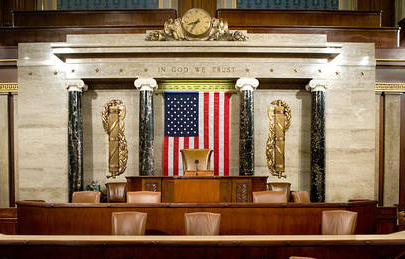
in the U.S. House of Representatives.
Thomas Jefferson, James Madison and John Adams also studied the Greek style of governance. However, America’s Founders believed that Athenian democracy insufficiently embraced the legal underpinnings of a truly egalitarian polity.
As Roger Vigneron and Jean-Francois Gerkens note in The Emancipation of Women in Ancient Rome: “Of course, the Romans lived in a world with many inequalities: there were slaves, peregrines and barbaric peoples. But inside the Roman people itself, the rule of juridical equality was the duty to be pursued.” We can thank that polity of ancient Italy for pioneering this concept of equality before the law.
Historian Rufus Fears has noted that the Romans “crafted our Constitution to reflect the balanced Constitution of the Roman Republic, with the sovereignty of the people guided by the wisdom of the Senate, with a powerful executive in the form of the commander in chief, the consul.” Indeed, John Adams wrote that “the Roman Constitution formed the noblest people and the greatest power that has ever existed.”

not Iroquois saplings & bark long houses.
Writing in Smithsonian magazine, James Daley stated: “It’s not surprising that in the United States’ nascent years, comparisons to ancient Rome were common. And to this day, Rome, whose 482-year-long Republic, bookended by several hundred years of monarchy and 1,500 years of imperial rule, is still the longest the world has seen.”
In The Age of Federalism: The Early American Republic, 1788-1800, Stanley Elkins and Eric McKitrick observed how “The very nomenclature of government—’president,’ ‘senate,’ ‘congress’—as well as the official iconography, the mottoes of state, even the architecture, would be heavily Roman.”
After defeating the British Crown, George Washington returned to his Mount Vernon “villa” for a life of rustic simplicity, emulating Rome’s Lucius Quinctius Cincinnatus. Dubbed the American Cincinnatus, our first president became our Pater Patriae (“Father of his Country”) by embracing the Roman ideals and civic virtues embodied in the motto of the Society of the Cincinnati: “He gave up everything to serve the Republic.”
Thomas Jefferson derived “All men are created equal” from an essay in the 1774 Virginia Gazette penned by his dear friend Filippo Mazzei. The third president of the United States translated “Tutti gli uomini sono per natura egualmente liberi e indipendenti” to craft our national credo.
When President John F. Kennedy invoked antiquity’s proudest boast—Civis Romanus sum (“I am a Roman citizen”)—at the height of the Cold War, he did so to remind the free world of the West’s foundational precept.

from Roman Law, not Hebrew or Iroquois.
Indeed, the freedoms and legal protections conferred by citizenship were part and parcel of ancient Rome’s revolutionary res publica, or “the public thing.” Having forged a polity of laws and not men, the Romans held that equality before the law was paramount. Moreover, the Twelve Tables of Rome limited what both individuals and the government could do.
As Thomas F. Madden stated in Empires of Trust: “For the Romans, all political power resided with the people. The people of Rome chose their representatives to serve in popular assemblies. Over the centuries, various assemblies rose and fell in importance, but all of them were the legal means by which the people exerted their authority.” [These ‘assemblies’ became our House of Representatives.]
The Italic influence on our government has echoed through the centuries. It can be seen in the design of the White House and the Capitol, and in the Great Seal of the United States of America on the dollar, which bears the Latin phrase E pluribus unum (“Out of many, one”). And when POTUS 47 delivers his State of the Union address tonight in the House of Representatives, take note of the two bronze fasces—symbols of Roman magisterial authority—beside him.
How much richer would Burns’ docuseries have been had it mentioned at least some of these influences? –RAI
[Note: This opinion piece first appeared in Fra Noi, Chicagoland’s Italian American magazine. (www.franoi.com)]



Recent Comments