
Yesterday I read about an Italian American neighborhood that was the original Little Italy in New York City. No, not Mulberry Street in lower Manhattan but East Harlem above 96th Street. Today, both those areas are “Italian” by the skin of their teeth. Mulberry Street is enveloped by Chinatown. East Harlem is better called Spanish Harlem (nicknamed El Barrio) for the massive influx of Puerto Rican and Dominican residents after World War II.
What I was reading was an article in Atlantica Magazine from July, 1934. Some 41 issues were left to me by a cousin who edited it from 1930-1934. (You can access these issues in our online Research Library at italic.org.) No food or fashion, Atlantica was probably the first intellectual periodical in our community. The article was written by a young Peter Sammartino, who later founded New Jersey’s Fairleigh Dickerson University in 1942. (Today, the university offers over 100 degree programs, has 13,000 students on two NJ campuses and one in Canada and in England.)
In his commentary Sammartino espoused the need for an innovative high school in East Harlem citing “one of the highest crime rates in the country.” In fact, the Genovese gang was founded there and both the Mafia-Camorra War (1915–1917) and the Castellammarese War (1930–1931) depicted in The Godfather were mainly fought there. Sammartino and his generation knew that aimless Italian American youth in East Harlem were recruited by these thugs.
Into the 1950s, even I can recall the scourge of juvenile delinquency that plagued New York City. It was the basis of West Side Story: the “American” Jets vs the Puerto Rican Sharks. The authors shifted the battleground from east to west Manhattan and Americanized the Jets whose leader was “Tony.” There may be some question about this, but the show reflected the agony of New York’s changing neighborhoods, especially East Harlem.
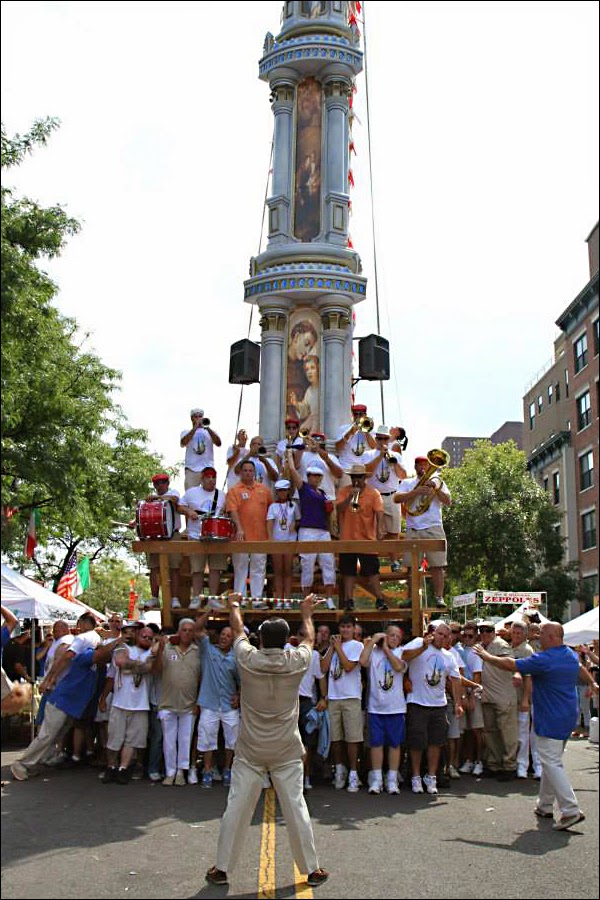
In its Italic heyday (1878- 1950s) East Harlem with a population of 300,000 produced politicians Fiorello LaGuardia and Vito Marcantonio. It’s still home to Rao’s Restaurant (opened in 1896) and Patsy’s Pizzeria (1933) pioneer of the NY-style thin crust. Also still an Italic enclave is Our Lady of Mt Carmel Church (1884) serving the spiritual needs of the remaining 1,000 or so Italian Americans. These dedicated parishioners continue the traditional Giglio (“Lily”) Feast, started in 1908, by lifting a 4-ton, 7-story statue to St. Anthony.
Another product of East Harlem was a generation of ambitious kids who embraced the public school system that their mischievous fellows rejected and went on to attend the local college on the west side of 116th Street—Columbia University. Not only within walking distance but it was named for one of Italy’s greatest sons. These boys formed a club at the university: il Circolo Italiano and petitioned the university president for an Italian cultural center on campus. He agreed to furnish the land if they could finance a building. The wealthy Paterno family heard their plea and La Casa Italiana, a 30,000 s.f. six-story building, was opened on Columbus Day 1927 dedicated in person by inventor Guglielmo Marconi.
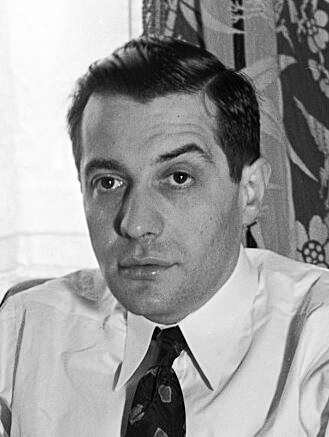
Student Peter Riccio was the driving force in this effort and he acknowledged the inspiration derived from then-lauded Fascist Italy, even writing his doctoral thesis on the regime in 1929. However, by 1940 Riccio rejected what Italy had become and managed to be appointed Director of La Casa in 1957.
I find it fascinating that this one neighborhood produced not only the Columbia wiz-kids and some of New York’s notorious criminals but also LaGuardia, one of America’s best mayors, and 7-term Congressman Vito Marcantonio, the Bernie Sanders of his time—a progressive/socialist and even more controversial. He embraced diversity to the point of angering some of his Italic constituents with his zealous advocacy for Blacks and Puerto Ricans. He called for an independent Puerto Rico and reparations for American colonial exploitation of the island. But ultimately, he was a champion and voice of all his poor and struggling constituents regardless of ethnicity. Hollywood would love his story.
How many such neighborhoods does our national community have? There is so much that we take for granted. ‒JLM
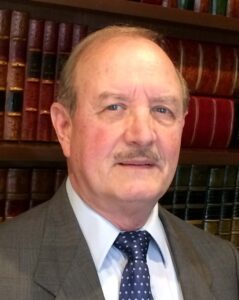

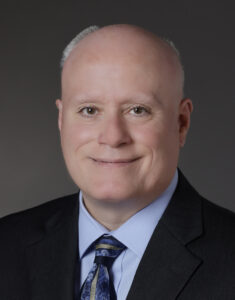
And there is also prominent educator Leonard Covello, who mentored Marcantonio as well as other It Am students at DeWitt Clinton High School in New York. Covello was the male version of Maria Montessori, a teacher who intuitively knew how to reach students.
Covello’s name was so well-known that after black and white students rioted in 1945 at Benjamin Franklin High School, he invited Frank Sinatra to come and calm things down.
Ol’ Blue Eyes did so, happily. In fact, Sinatra spoke out against anti-Semitism and anti-Black prejudice throughout his career, an interesting fact about him rarely acknowledged by the press, although Jews and African Americans still revere his name amongst them.
Ciao Bill, Come stai?
Your note about Frank Sinatra reminds of the short film ” The House I Live In”
(Our country could use this NOW!)
https://www.youtube.com/watch?v=ovwHkb1wEfU
This short film, which earned an honorary Academy Award for director Mervyn LeRoy in 1946, exhorts the message of religious tolerance and post-war hopefulness. Frank Sinatra, then the idol of teenage bobby-soxers, takes a break from a recording session and finds a group of children bullying one boy because he’s Jewish. Sinatra reminds them that Americans may worship in many different ways but they still remain Americans. The film ends with Sinatra performing the title song, penned by Abel Meeropol, best known for the song “Strange Fruit” which denounced the horror of lynchings. Named to the National Film Registry in 2007
There is a sense of pageantry to this article, especially as it connects the richness of our Italian American roots to life today. Recently hosting some artist from Italy, they really were not at all aware of italian Americana…and a very distinct set of experiences that this article highlights.
When I host such visitors, I like to point all this out….as best I can, since this is a very complex and fascinating piece of history. And in my opinion not understood or well appreciated as not only a product of Italy but the immigration and unique assimilation process that becomes “Italian Americana”. Recently returning from Argentina I was also struck by so many enriching, and similar observations, as well as quite unique experiences. All well worth celebrating.
You are correct Ken. Italians do not fully understand us. My glaring lesson was the Casa Italiana issue at Columbia. When Gov Mario Cuomo convinced the Italian government to buy the building and even had a law passed to make sure it would remain tax-exempt, our community celebrated the “rescue” of a cultural center we built and operated for 63 years. Instead, the Italians threw both IA students and orgs out of the building as well as the Italian Language Dept. They created a European cloister for foreign students. My long battle with the Italian diplomatic corps confirmed that they considered us a bunch of yahoos with little geo-political understanding. Yet Italy still expects us to be their advocate and buy their products with zero in return. Contrast this with how Mussolini treated La Casa: he furnished it from old Italian castles and estates and sent Guglielmo Marconi to inaugurate it. He did not interfere with its operation or taint it with Fascism. It survived the war and thrived for 3 decades or more after the war. Today’s Italian Republic could care less about our intellectual growth.
LINDA: Yes, thanks for the reminder on the Sinatra short subject film. Hope all is well.
KEN: Nice insights.
JOHN: The loss–i.e, the “retransformation” of La Casa–continues to be a tragedy.
I recently took a tour of the mansions built on the glamorous upper east side of NYC (with emphasis on those built during the gilded era) .
The tour guide mentioned that it became possible to build such mansions thanks to the presence of Italian (masonry) and German (carpentry) immigrants. I wonder if many of the Italian masons and carvers who built the upper east side lived in East Harlem (being East Harlem so close to the upper east side.).
This was the only positive note about Italians during several NYC tours.