
Last October, the Commission for Social Justice, an arm of the Sons and Daughters of Italy, tried to distribute positive image material to New York City libraries in celebration of Italian History Month. Two Manhattan libraries considered the material pro-Columbus and refused to accept it. A library in Brooklyn literally tossed it in the garbage.
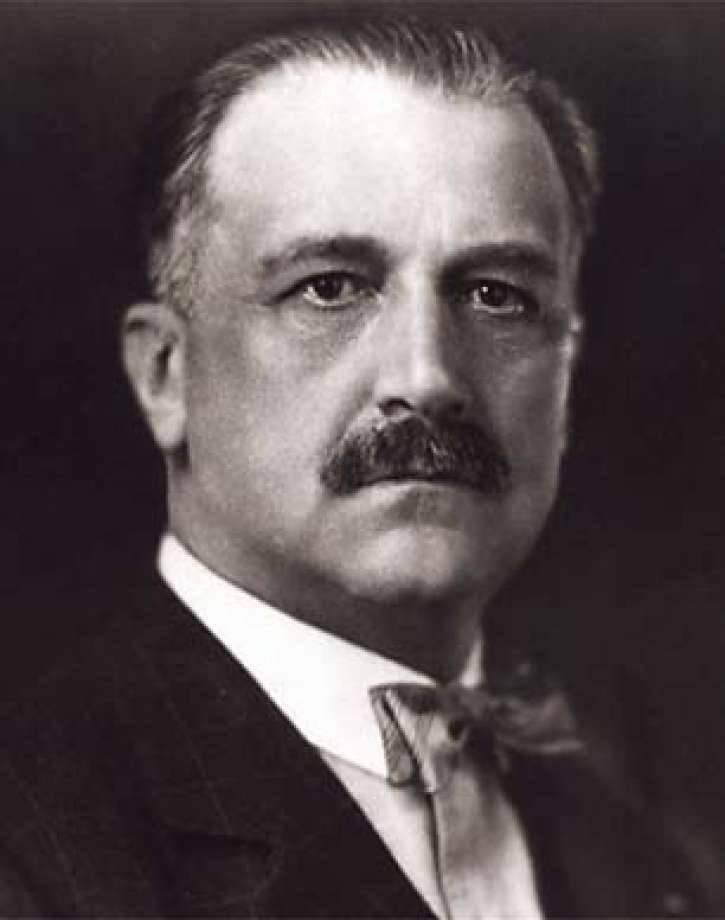
It seems that many Americans, especially the media, cannot distinguish Italian American treasure from trash. Christopher Columbus is still a bone of contention rather than the heroic genius who unified the globe and gave the world two sanctuary continents. Truth be told, there is a whole list of Italic people who made our lives better, among them Amadeo Peter Giannini.
In our recent newsletter (Update) we reported on a new documentary (A Little Fellow) about A.P. Giannini, founder of Bank of America. It was made by Davide Fiore, an independent filmmaker. It is a long-overdue portrait of the man who created one of the largest banks in the world, pioneered branch banking and opened its doors to the “little fellow.” Before Giannini, banks were mainly for the well-to-do and limited geographically.
I was so impressed by this documentary that our Institute wrote to the Public Broadcasting System (PBS) urging their American Experience producers to contact Davide Fiore for permission to air his 90-minute film. PBS has done some programs on Giannini in connection with the 1906 San Francisco earthquake and the Golden Gate bridge, but not his whole story. Americans know more about fictional Don Vito Corleone than Giannini—not kidding!
In a blog on 19 February 2018, I recounted the 1949 feature movie House of Strangers, starring Edward G. Robinson. About a fictional Italian American banking family, the film was a hatchet job on Giannini full of stereotypes and criminal behavior. It was my contention that this film provided author Mario Puzo a framework for The Godfather. In fact, a 2017 showing of the film at Penn State was heralded as having influenced Francis Ford Coppola: A crooked banking family and rivalry among his sons leading to an attempted fratricide. (Picture Don Vito, Sonny, Michael, and doomed Freddo.) Giannini objected to its production but died a month before it was released, at age 79.

to spread branch banking
“across (trans) America.”
By 1949, Giannini’s career and life were over. The new documentary chronicles that career from the founding of the Bank of Italy in 1904 in San Francisco to its rebirth as Bank of America in 1930 to reflect its massive branch network across the nation. It details the Anglo banking establishment’s—mainly J. P. Morgan—attempts to thwart that new system. But Giannini had the last laugh when in 1945 Bank of America became the largest in the U.S. ($6 billion in assets to Morgan’s $4.6 billion).
Giannini tried to retire to Europe in 1931 only to be drawn back in when Wall St coaxed Giannini’s successors and large shareholders to break up the bank. An infuriated Giannini returned and initiated a shareholder war on Wall St. by convincing a multitude of small shareholders to back him. By early 1932, Giannini regained control of Bank and its holding company Transamerica.
All through the 1930s and 1940s, Giannini’s bank lent to Hollywood for movies we acclaim today such as Snow White, Gone with the Wind, It’s a Wonderful Life, and so many more that he was known as the “Banker to the Stars.” He bankrolled Charlie Chaplin’s United Artists studio and had a department just for the film industry as well as special loan departments for ethnic groups, with interpreters, and women.
Both Hollywood and Wall St. have trashed A.P. Giannini and by association our community. Today, Bank America supports every ethnic group in America to enhance those groups’ public image on PBS and elsewhere. The producers of A Little Fellow pointedly note in the closing credits that Bank of America did not contribute to their film, a telling message. –JLM
P.S. In 1962, the TV show Death Valley Days devoted an episode to A.P. Giannini and the 1906 earthquake. You can watch it on Tubi: Watch Death Valley Days S10:E24 – The Unshakable Man – Free TV Shows | Tubi

Wow! Great find (“The Unshakable Man” episode on YouTube).
There is also a young Carmelita Pope playing Mother Cabrini in a filmed TV play about her in the late 40s. It’s not very good but it does show that attempts were made back then to honor our heroes. I’m having difficulty finding it right now but I did see it months ago.
Luckily, in 2023, a full-length, top-budget Hollywood film was since made about her.
And if you think that the bigotry (anti-Italian, and even anti-Catholic) which Giannini experienced was a thing of the past, don’t forget that when a poll was conducted in NY a few years ago to honor female historical figures with new statues, Cabrini was rejected by then-mayor Bill di Blasio’s wife even THOUGH CABRINI FINISHED FIRST IN THE POLLS.
To his credit, then-governor Andrew Cuomo stepped in and set things right. You can now view the Mother Cabrini statue in Battery Park in Lower Manhattan.
I did not know about the latest failure of the Commission for Social Justice, the feckless arm of the Sons and Daughters of Italy. If another ethnic group had been rebuffed this way it would express its outrage in its own media, make enough of a fuss to get it in main-stream media, and if there were still no resolve, take it to court. Alas.
As for A.P. Giannini, back in 2014 I wrote a long article about him for The Italic Way, in which I called him the greatest Italian-American of them all and cited many of his accomplishments that supported that view. So, I applaud Fiore’s documentary as something long overdue, although I wish Fiore was Italian-American. (He’s an Italy-born Italian.) Additionally, I have great hopes for the major studio biopic on Giannini that Giuseppe Tornatore (Cinema Paradiso, Ennio) is set to direct. It is titled The First Dollar.
We will be showing the documentary on April 17 at Casa Italia (Chicago). I am hoping for a big crowd to help spread awareness of Mr Giannini and all that he accomplished.
I have seen the documentary now, 3 times and it really ages well. The fascinating thing was that while many people know the story about the SF Earthquake incident, what comes through loud and clear in this film, is the outright hostility AP had to confront from the banking establishment. The earthquakes tale was sad, but earthquakes don’t discriminate. What he received from Wall Street, and all was just prejudice, hostility and ethnic slurs. Really, a lesser person would have folded…..his tale is a profile in true courage and his innate believe in the common man aka the little fellow. We so badly need this belief and optimism in our country today.
The talk of Giannini reminds me of a comment by Joe Maselli, the New Jersey-born businessman who stayed in New Orleans after WWII and became a great success.
Joe later went on to build the American Italian Cultural Center and nearby Piazza Italia in downtown New Orleans, a must-see item for anyone’s bucket list.
Joe once said, “The only thing the media gives Italians credit for is crime. We didn’t invent that!” Bingo. No, we did not. America had crime long before Italians arrived.
But we (i.e, through Giannini) built branch banking, something all Americans take for granted. Actually, the we is correct, as Giannini and his staff were Italian.
Today, as noted in Fiore’s documentary, Giannini’s creation, Bank of America, didn’t even fund his project. Nor do many Italian Americans largely occupy and run it.
Its headquarters aren’t even in San Francisco anymore but in Charlotte, NC.