
We don’t usually associate Italians with the “winning” of the West. But some 828,000 sq. miles of middle America, known as the Louisiana Purchase of 1803, had Italian connections.
The area was claimed by France starting with the voyage of Giovanni da Verrazzano in 1524 when he reached the mouth of the St. Lawrence River. Later French explorers and colonists outflanked the English coastal colonies by claiming all the waterways from the St. Lawrence to the Great Lakes and all the Mississippi River down to New Orleans. To further consolidate these possessions, for 25 years the French employed the services of Italian-born Enrico Tonti to deal with the natives and assert French authority throughout the Mississippi basin.
In 1762, the French gave this Louisiana Territory to Spain as compensation for helping France during the ill-fated French & Indian War. But in 1802, Napoleon Bonaparte (yet another son of Italy) arranged the return of the Territory to France—but not for long. The Napoleonic wars in Europe and in Haiti were costly, so the Emperor sold the Territory to the growing United States in 1803.
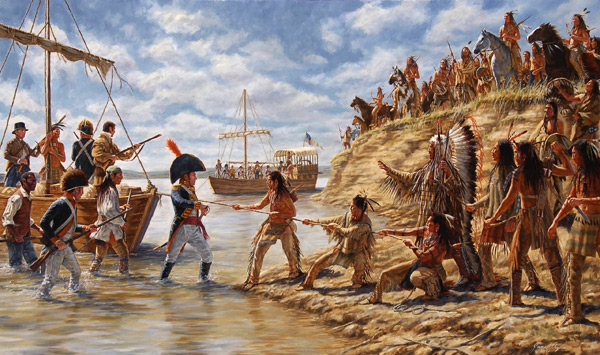
American history needed Verrazzano, Tonti, and Bonaparte but to complete the picture it needed a man named Bartolomeo Girandoni, an Italian gunsmith.
After buying the Louisiana Territory, President Thomas Jefferson wanted it explored and mapped out. Enter Meriwether Lewis and William Clark, two intrepid frontiersmen who would travel 8,000 miles during the 2-year undertaking. They would encounter tribes few Anglo-Americans were familiar with. They needed to bring gifts, trade goods and weapons, in addition to their river boats, tents, tools, food, medicine, and whiskey. Their standard weapons were only capable of firing two rounds a minute, depending on the skill of the rifleman. A number of tribes would have similar muskets acquired from French and Spanish fur trappers and replenished by remote trading posts. The so-called Corps of Discovery needed a weapon that would impress even those Indians.
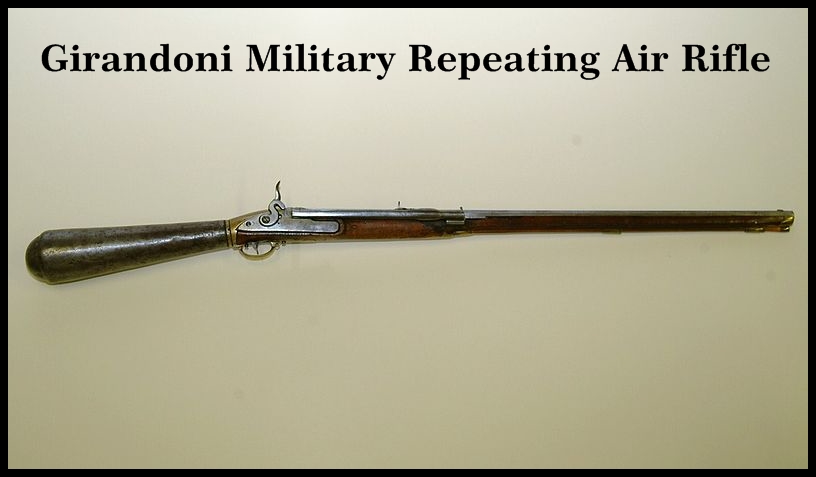
The Girandoni Air Rifle was the talk of Europe at the time. It could fire off 22 rounds in thirty seconds without reloading or using gunpowder—powerful enough to kill a deer. It was smokeless and nearly noiseless. In an age of muzzle-loading, single shot Kentucky rifles and the need to ‘keep your powder dry’, such a weapon was a wonder. All 22 rounds could be loaded at one time through a side breech. The stock acted as a compressed air chamber releasing enough air to ‘fire off’ each round in quick succession.
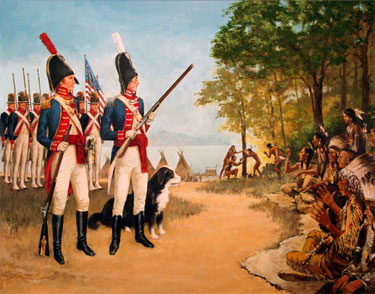
Paul Schreier, curator of the National Firearms Museum, describes the way the air rifle engendered both trepidation and respect in native tribes:
“Meriwether Lewis would unveil the Girandoni air rifle and demonstrate the gun, much to the amazement of the Indians. It could fire 22 times in 30 seconds and struck fear that caused intimidation amongst the tribes, and they quickly spread the word. Lewis would demonstrate the gun with every new encounter and the Indians, not knowing how many more of these guns where in their longboat, repressed their aggression, traded with the expedition and allowed them to pass. Without the Girandoni, any of the tribes could have overcome the 36 to 38 members of the expedition, taken their muskets, pistols, powder and other supplies and used them against their neighboring tribes and greatly alter the course of land procurement for the fledgling new country.”
If, indeed, Lewis and Clark owed their safety in large part to the Girandoni Air Rifle it should be accorded its rightful place in American history, along with the Winchester, the Colt, and the Smith & Wesson as winners of the West.
Another notch for the Italian contributions to America. -JLM



Recent Comments