
Forget Presidents’ Day! The day we should be celebrating is February 15th; the day navigator Amerigo Vespucci took command of a Portuguese ship in 1502 and added two new continents to the world map.
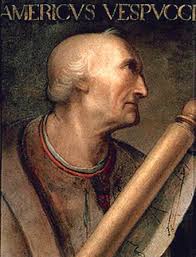
We all know the story of Columbus seeking Asia and mistakenly calling the Caribbean “India.” He died believing that, even after four voyages. Columbus was still alive when Vespucci recounted his belief in a letter to a friend in Italy that Columbus had stumbled on new continents not just islands. It’s hard to believe that Columbus didn’t get wind of Vespucci’s assertion because news traveled fast among Italians in Italy as well as in Spain and Portugal.
The Admiral had to have doubts about “India” when he bumped into Panama, blocking his westward exploration and later when he skirted South America at the mouth of the Orinoco River (Venezuela). That huge river had too much fresh water to come from an island. Still, he figured it was proof that it drained part of the Asian continent. So how did Vespucci see things?
Vespucci knew Columbus, the Italian communities in Spain and Portugal were very tight knit despite their origins in different Italian city-states—navigators, businessmen, mapmakers, and bankers numbered in the hundreds. In fact, Vespucci had been to the Caribbean twice while the Columbus family was running things there. Like Columbus he was an accomplished navigator in Spanish employ, but never a ship captain. That changed in 1501.
The King of Portugal knew of Vespucci’s skills and asked that he come work for Portugal. The Portuguese had employed Italian navigators for decades. They accompanied and advised many a Portuguese captain including Vasco Da Gama, whom they had urged to be the first to circumnavigate Africa. The King now wanted Vespucci to follow up on his admiral Pedro Cabral who had accidentally discovered “Brazil” on his way around Africa. Sounds strange, but Cabral was trying to bypass the notorious dead calm off the African coast and swung too far west—his navigational skills were wanting. Now, the King figured Vespucci could better map a voyage west and find out what “Brazil” was all about.
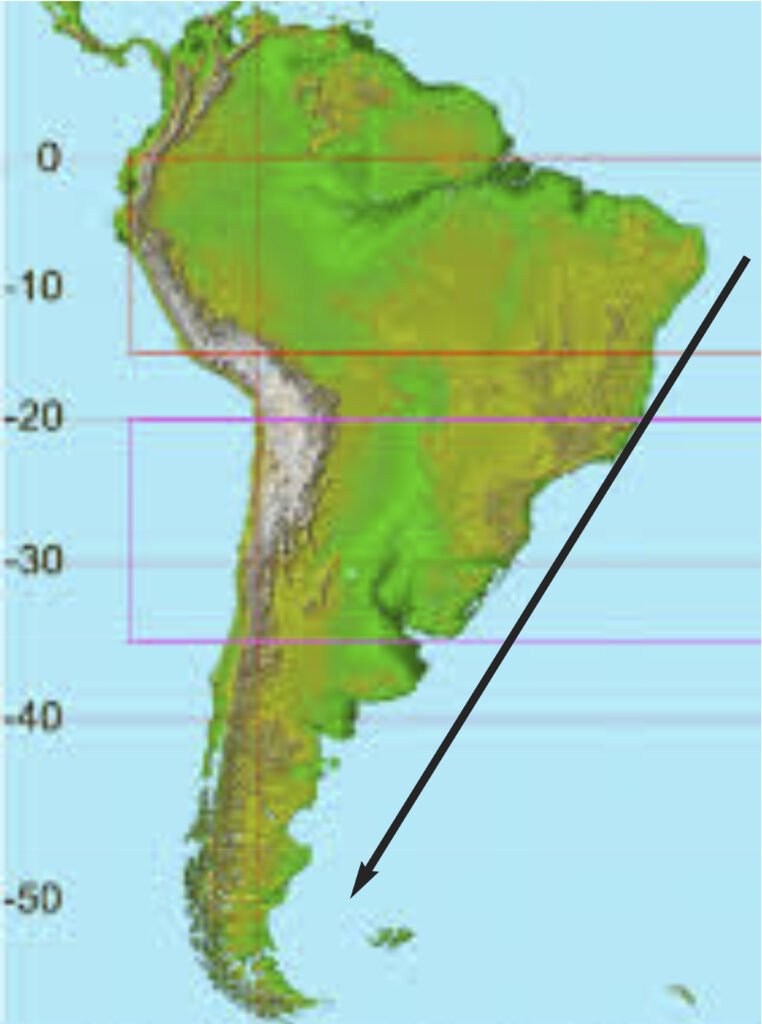
Three Portuguese ships set sail in 1501 for “Brazil” with Vespucci navigating. They reached their destination then hopped southward down the coast to see how big Brazil was. All went well until the Portuguese captain resigned, not wanting to proceed beyond latitude 25-degrees south. To replace him, a vote of the three crews was held and Vespucci elected. That was 15 February 1502, the very first democratic vote in the New World!
Vespucci unlike Columbus was not seeking gold or commercial ends. Rather, he was a man of science. (He is considered the first, in 1499, to determine longitude—the north-south lines—using the moon.) The expedition continued down the coast of South America as far as latitude 52-degrees south, the southern tip of Argentina, only 960 miles from Antarctica. (Consider that Da Gama’s trip around Africa was only down to latitude 32-degrees south.) The weather and sea turned ugly, so the small fleet headed home. Eighteen years later, Ferdinand Magellan would find the way around the continent at latitude 53.5-degrees south.
Many historians have spurned Vespucci as a fraud who stole credit from Columbus. None of the historical records have supported that. Vespucci’s reputation is confirmed by the monarchs of Spain and Portugal as well as their respective captains and crews and the entire overseas Italian community. He mapped some 2,500 miles of South American coast and proved conclusively that a new hemisphere existed. Columbus did write of a “new world” as an overseas “Asian” empire for Spain, but Vespucci wrote of a “New World” in the true sense for global humanity.
The Italic people should be proud that his name lives on, literally all around us. -JLM



What comes through in Vespucci’s tale is really the “think tank” of technology it took at that time to navigate these oceans. No small task especially dealing with the unknown. They were exceptional people and created a foundation of knowledge that is really not at all appreciated by the public at large. Nor is the linkage to the Renaissance and the knowledge we are all beneficiaries of today. It is almost amusing to hear of the criticism of these “explores’ by people who would have a very difficult time rowing a boat in a fish pond, not to mention the high seas!.
I still think one way to circumvent (no pun intended, honestly) the Columbus haters is to make October 12th “National Italian Explorers Day.” The Institute suggested this long ago.
While we wait for Columbus’s unfairly hijacked reputation to be restored, we can hang both the American and Italian flags on October 12th and also educate people about Vespucci, Malaspina, Verrazzano, Tonti, Beltrami and even the Italian “second-in-commands” who often accompanied other explorers (e.g, Antonio Pigafetta, whose
public statue in his home city of Vicenza notes his assistance to Ferdinand Magellan).
The very word “exploration” can also be expanded to include the sky (Galileo), the land (Eusebio Chino), the intellect (Machiavelli) and certainly the imagination (Dante Alighieri).