
I mentioned in my last blog that even the coldest places on Earth (in the previous case, Alaska) have been touched by that great Italian hand (explorer Alessandro Malaspina). It’s now fitting to see what Italians are up to on their own turf during wintertime. Christmas has passed; so has La Befana the good witch, passing out her gifts to children.
But that doesn’t mean the Italians are done celebrating.
In the follow-up to Lent, the entire nation lets out a collective roar via the annual Carnevale season, where residents all over the nation, from North and South to Sicilia and Sardegna, throw off winter doldrums with typical Italian flair.
With apparent roots in both classical (Greek and Roman) culture and native folklore, Carnevale comes with its own popular phrase: “A Carnevale, ogni scherzo vale!” (At Carnival, anything goes; or, literally, at Carnival, every joke counts). It’s a time when people release their last gasp of partying energy before the arrival of the Lenten season, when people switch to a more sober mood leading up to Easter. (Nota bene: The Italians celebrate Easter, too!).
I deliberately use the word sober because the Italians, almost unique to any people on the planet, know how to have a good time without ever overdoing it. You’ll rarely see Italians, young or old, staggering drunkenly in the streets, even during the most extreme bacchanalia (from Bacchus, the Roman god of revelry). The concept of “fare una bella figura,” or making a nice impression on others, seems to prevent it. Ditto their seemingly in-born sense of dignità (dignity).
The closest to out-of-control you may seem then is during the carnival celebrations in Ivrea, where everyone pelts each other with oranges, or on the island of Sardinia, where elements of paganism still play a role (ash covered faces).
The majority of carnival celebrations are completely dedicated to la dolce vita—in this case, a time for friends and families to do what Italians do best: elevate good times to art.
The two most famous events take place in the two “V” cities, Venice and Viareggio. But did you know that Venice kicks off its Carnevale with an amazing gondola procession filled with its famously costumed performers? See the clip below.
Venice Carnival 2026 Grand Opening 🇮🇹 | The Water Parade on Grand Canal (4K)
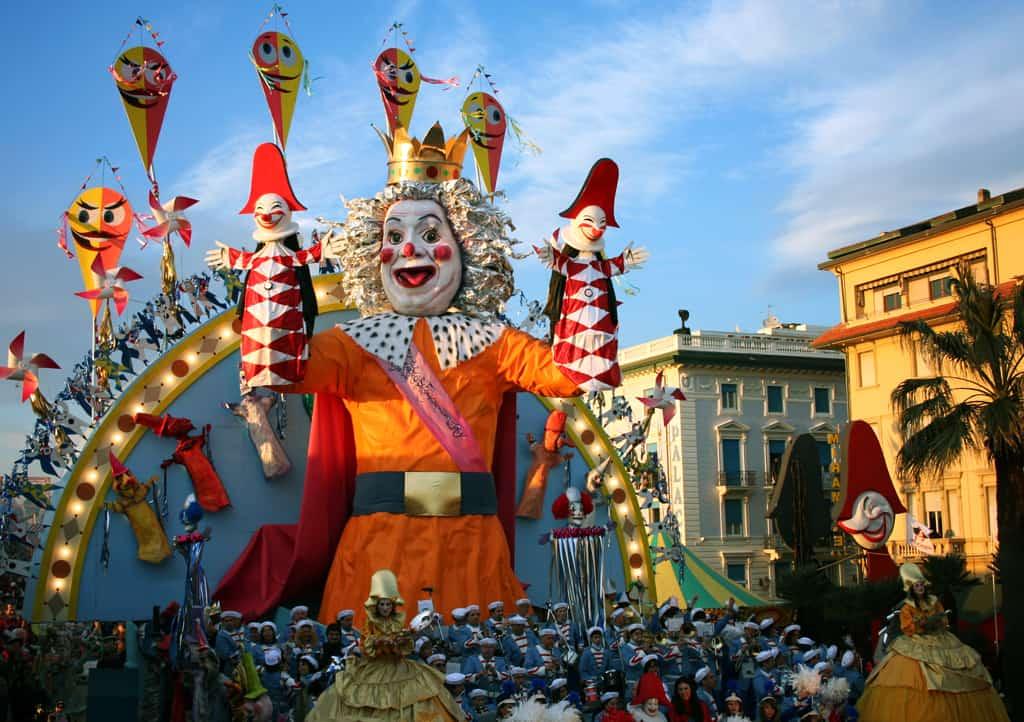
As for Viareggio, the expression “words cannot describe” is more than apt. The first time I visited the Carnevale in Viareggio (2004), I was stunned speechless. And it was the exact same reaction again in 2006 and in 2018.
Why? Because you see, in visual form, the innate creativity—indeed, brilliance—of the Italians. All year long, the residents of this seaside town, located near Pisa and Lucca, build gigantic, 60 foot, fully animatronic parade floats (or, carri), many so huge that costumed revelers can even dance or congregate on them. Every float is a valentine to Italic imagination and beauty. A lot of them are also floating pieces of satiric art, often parodying political figures. See the link below.
https://www.youtube.com/shorts/3OC014VSW1E
Walt Disney himself would have shrugged his shoulders and said, “I give up. The Italians win.” Yes, they do.
Actually, anyone who visits any of the carnevali in Italy wins. Make your plans for next year! –BDC



The Carnevali are fantastic. There are no words to describe it. It must be seen to believe. God bless Italy. And God bless America…that is filled with Italians.
Really beyond words how the Italians can stage such parades – on land and water. I only wish our Columbus Day parades even approached the magnificence of Italian spectacles. Instead, we have a couple of simple floats and truckloads of people waving small flags. In most cases Columbus and his small fleet are either missing or have minor roles in celebrating the most amazing event in human history.
Not a TikTok fan but the clip below does a nice summary of Viareggio’s celebration.
(Actually, celebrations: The float parades take place at least five or six times before Lent, mostly during the daytime but also at night, where they’re lit up.)
And Viareggio, despite its magnificent boardwalk and Art Deco buildings, is still considered the Italian equivalent of a working-class/lower-middle class town.
Yet even here, the level of artistry on display is worthy of nearby Florence.
https://www.tiktok.com/@rob_murgatroyd/video/7469753047015738670
Follow up to my previous comment: My only “Italian beef” with the video is the host’s use of the hyperbolic American word “insanity.” What struck me the most about Viareggio was how the entire town buzzed with energy and yet everything remained calm and mellifluous in that uniquely Italian way. Indeed, after the parades, there are street festivals throughout the neighborhoods, where parents, kids, and friends all eat, sing, or show off some of their costumes. It is the very essence of “sanity.”
In America, there would be fistfights, vomit on the streets, or (worse) gunfire.
Yet, according to the American media, it is always Italians or Italian Americans who are the “violent people.” Anti-Italian prejudice is not a joke! There is more beauty in any one of these floats than any of the giant balloons in the annual Macy’s Parade.
When Italian Olympian Federica Brignone was competing in a ski event, NBC referred to her Italian fans as “rowdy”. Her fans encouraged her with gusto and she won a gold medal. However, they were in no sense of the word “rowdy”.
Italian culture, fashion and history were well showcased in the 2026 Olympic opening ceremony. Also, their athletic prowess has resulted so far in 9 gold medals and 24 total medals, second only to Norway. The world has also seen that Italy has art and architectural treasures that are truly unique and stunning.
MARIO: I caught that “rowdy’ reference, too. Words do matter. Clearly, the Anglo world is still very deeply Puritan, certainly when it comes to even expressing unrestrained joy.
They say “rowdy” when “passionate” is much more appropriate.
I go back to the 1979 film “Breaking Away,” which showed some insights into this dynamic.
The 19 year old protagonist, the son of an Indiana stonecutter, embraced Italian culture through his love of cycling. He even convinced himself he was Italian; he used the language, serenaded an Anglo college girl with an opera aria, named his cat “Fellini,” and kissed his embarrassed father on the cheek after dedicating a bicycling award to him.
The climax of the film came when the son raced against actual Italians who visited Indiana for a Team Cinzano race. Upset that he was holding his own against them, yet in a friendly way, an Italian cyclist threw a stick in the son’s spike, causing him to crash. This led to the son’s disillusionment with Italian culture. He later came home and did what? Cried in his father’s arms. It’s a very touching scene, yet it sticks out because this is exactly what Americans do NOT do–express emotions. Italic culture broke down the father’s distance.
Now, if only the screenwriter hadn’t sullied the reputation of Italian cyclists as cheats! Indeed, the worst cycling cheater in history was Lance Armstrong of the good ol’ USA.
By contrast, during WWII, cycling champion Gino Bartali used his skills to secretly relay forged documents to Jews hiding in Italy. He saved countless lives. He was a hero.
Bill, in general, the media coverage of the Olympics has been extremely positive concerning Italy, as I am sure you would agree. I have been very pleased with all of the special-interest segments devoted to Italian history, music, cuisine and culture (even Snoop Dogg, it seems, has become an Italophile).
MARIO: Most of what I have watched has been positive, though when Giada DiLaurentis took a respondent to eat in an Italian restaurant and the guy did the typical, touristy,
over-pronunciation of a dish–complete with an over-exaggerated hand gesture–I lost it.
Black Americans complain all the time of how well-meaning white liberals do the same via their culture, confusing condescension with respect. Non-Italians do the same with us.
Italians have an inborn sense of dignity. Non-Italians ignore that and “un-dignify” them.
Or, at least, try to do so. Quite annoying.
I have never, ever seen an Italian tourist meet an American and start speaking in a southern twang or spit out cliche American phrases: “Hey, man! Wussup? You cool?”